
The gambler's fallacy in slots is the belief that a win is "due" after a losing streak (or that a slot has turned "cold" after paying). In reality, each spin is an independent event driven by an RNG, so past outcomes don't change the next result. The practical fix is simple: set rules that ignore streaks.
Core principles explaining why slot outcomes feel nonrandom
- Independence: previous spins don't "load" the next spin.
- Clustering happens: random sequences naturally produce streaks that look meaningful.
- Selective memory: players remember dramatic reversals and forget routine losses.
- Confusing frequency with fairness: "due" thinking mixes long-run averages with short-run results.
- Game design amplifies patterns: near-misses and celebratory effects make outcomes feel guided.
Myths about hot and cold slots: origin and debunking
The "hot/cold" slot idea comes from everyday experiences where systems do have state: a machine overheats, a queue clears, a shop restocks. Players import that logic into slots, then read meaning into short streaks.
In gambler's fallacy slot machines scenarios, the mind treats losses as a debt the game must repay. That framing feels intuitive because it fits a story: "It hasn't hit in ages, so it must hit soon." Slots don't work on debt or fairness; they run on independent draws.
Boundary that helps: "Hot/cold" can describe your session experience (variance and mood), but it does not describe a persistent state that makes the next spin more likely to win. If you keep playing because you believe outcomes are correcting themselves, you are acting on the fallacy.
Probability fundamentals: independence, distribution, and expected value
- Independence (the key): if a spin has win probability p, it stays p after any streak. A long run of losses does not make the next spin "more likely" to win.
- Streaks are normal: randomness produces clusters. Seeing L-L-L-L does not imply a switch to "cold"; it implies you witnessed one of many possible sequences.
- Short-run vs long-run: long-run averages stabilize slowly. Your session is a small sample, so "it should have balanced out by now" is usually just impatience.
- Expected value (simple check): EV per bet can be thought of as EV = (average return) − (bet). If average return is less than the bet, repeating more spins doesn't fix it; it scales the same expectation over more trials.
- Online slots odds and probability: odds are encoded in the game's math model; your timing, your streak, and your last outcome don't rewrite those odds.
Psychology in play: misconceptions, pattern-seeking, and memory biases
- Chasing after a drought: "No bonus in 80 spins, so the bonus is due." You increase stake or extend play exactly when fatigue and loss sensitivity rise.
- Resetting after a win: "It paid, so it's cold now." You switch games not because of better fit, but because your brain expects alternation.
- Near-miss magnet: two scatters land and you feel the third is "coming." You treat near-miss as progress, even though it's typically just another non-winning outcome.
- Losses become invisible: you recall the one comeback session and forget the many sessions that ended without reversal, reinforcing the "due" narrative.
- Social proof loops: chat and streams highlight big hits ("this game is hot"), creating availability bias: vivid events feel common.
How modern slot RNGs, hit frequency, and volatility actually operate
- RNG basics: if you're asking how do slot machines work random number generator, the practical model is: the game continually generates numbers; when you press spin, one number (or set) is mapped to an outcome. The mapping (game math) is fixed; your last results don't alter it.
- Hit frequency vs payout size: a game can pay "often" with small wins or "rarely" with bigger swings. "Many dead spins" can be normal for certain designs.
- Volatility explains mood: high volatility produces longer losing stretches and occasional large wins. That emotional contrast fuels hot/cold stories.
- What you can infer: only what the game publishes (rules/features) and what you can observe responsibly (your bankroll, session length, comfort with swings).
- What you cannot infer from a streak: that the next spin is "primed," that the bonus is "loaded," or that switching games will "unlock" a win.
| What the brain concludes | What randomness allows | Player action that avoids the trap |
|---|---|---|
| "After many losses, a win is due." | Losses can continue; each spin is independent. | Stop based on limits, not on "due" feelings. |
| "It just paid, so it's cold now." | A win can be followed by another win or a long drought. | Don't switch purely because you saw a win. |
| "Near-miss means I'm close." | Near-miss is still a miss; no progress is stored. | Treat near-miss as a normal losing outcome. |
Decision rules that prevent fallacy-driven betting errors
- Pre-commit a stop point: set a loss limit and a time limit before you spin; end the session when either hits, regardless of streaks.
- Use a flat stake (or a fixed schedule): avoid raising bets "because it's due." If you change stake, do it for planned entertainment value, not pattern-reading.
- Define a "game switch" reason: switch only for non-streak reasons (theme preference, feature set, volatility preference), not because it "feels hot/cold."
- Track outcomes briefly: write down number of spins and net result; the goal is not prediction, but catching self-justifications in real time.
- Translate feelings into a check: when you think "one more spin," ask: "Would I make the same choice if the last 10 spins were mixed?" If no, it's likely the fallacy.
- Be skeptical of slogans: most slot machine strategies that work are bankroll/discipline strategies, not methods that change probabilities.
Policy and consumer protection: what operators and regulators should do
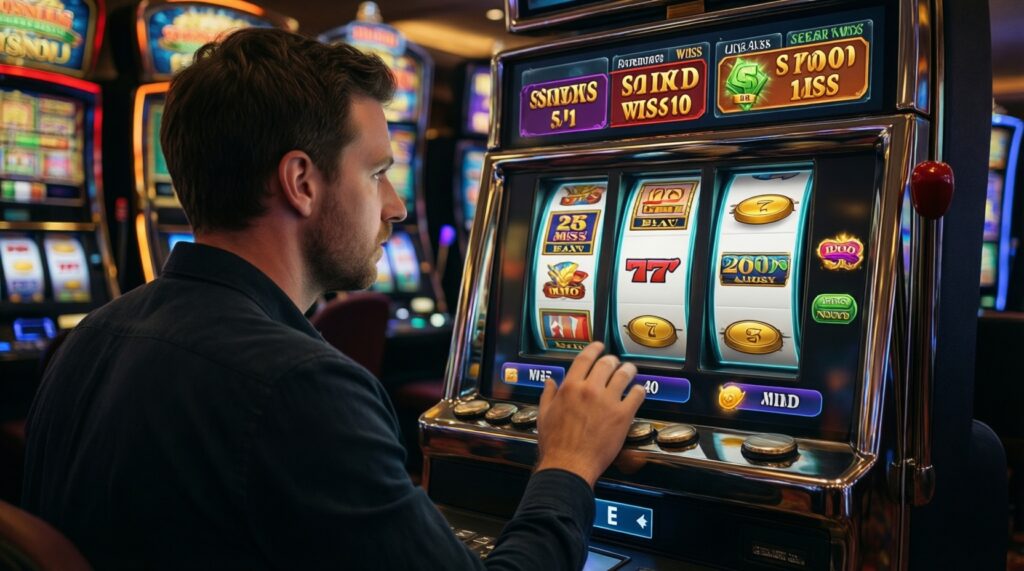
Mini-case: a player searches for the best online casino slots to play and ends up in an interface that highlights "recent wins" and "almost hit the bonus" banners. Those cues can intensify gambler's fallacy behavior, even when the underlying RNG is fair.
Practical guardrail (UI logic) that reduces fallacy-driven chasing without changing the game:
if (session_loss >= loss_limit OR session_time >= time_limit):
    show("Session limit reached. Consider stopping now.")
    show("Reminder: streaks do not change the next spin's probability.")
    offer("Take a break")
Regulators and operators can also require clearer phrasing around independence (each spin is separate), prohibit misleading "due" language, and ensure limit tools are easy to find and keep enabled across sessions.
Practical clarifications players often want about slot randomness
Does a losing streak increase my chance to win on the next spin?
No. That belief is the gambler's fallacy; the next spin's chance is not improved by previous losses.
Are "hot" and "cold" slots real in online casinos?
Not as a predictive state. Streaks happen naturally, but they don't mean the game is warming up or cooling down.
If I switch slots after a bad run, am I improving my odds?
Switching can change the type of experience (volatility/features), but it doesn't turn streak logic into an advantage.
What does RNG actually mean for my session?
It means outcomes are determined by a fixed mapping from random draws; your timing and past spins don't "charge up" a bonus.
Is there any reliable way to predict when a bonus will trigger?
No. Bonus triggers are probabilistic; any "it's due" prediction is pattern-reading, not information.
What's one practical habit to avoid chasing losses?
Use pre-set stop rules (time and loss limit) and follow them even when you feel a win is due.
Do paytables or volatility labels change the fact that spins are independent?
No. They describe distribution and variance, not memory; independence remains the same on every spin.