

Short slot sessions often look "hot" because random variance and sampling error dominate small samples, making ordinary streaks appear meaningful. As the number of spins grows, results tend to stabilize toward the game's expected return (RTP), and early extremes fade. The safest approach is to treat short-run wins or losses as noise, not evidence of a special machine.
Essentials: variance, sampling error, and the illusion of 'hot' machines
- Short sessions amplify luck: a few bonus hits can overshadow dozens of neutral spins.
- Variance is the built-in swinginess of a slot; high variance makes "hot/cold" impressions more frequent.
- Sampling error shrinks with more spins; fewer spins means wider uncertainty around your observed return.
- RTP is a long-run expectation, not a promise for a session; "slot machine RTP explained" should always include this limitation.
- The "hot slot machine myth" persists because humans overweight recent streaks and remember wins more than losses.
Why short sessions exaggerate performance signals
A "short session" is any run where the number of spins is too small for the slot's natural payout distribution to average out. In practice, this is most sessions players actually do-especially when switching games frequently or stopping right after a bonus. The key boundary is not minutes, but sample size: how many independent spins you observed.
In a small sample, a single rare event (a big win, free spins, a feature trigger) can dominate your net result and create the illusion that a machine is "hot." That illusion is stronger in high-volatility games, which is why understanding "slot machine variance explained" matters more than tracking a few outcomes.
A simple uncertainty metric is a confidence interval around your observed average return per spin: estimate ± z × SE, where SE is the standard error of the mean return. In short sessions, SE is large, so the interval is wide-meaning your "signal" is mostly uncertainty.
How statistical variance scales with session length
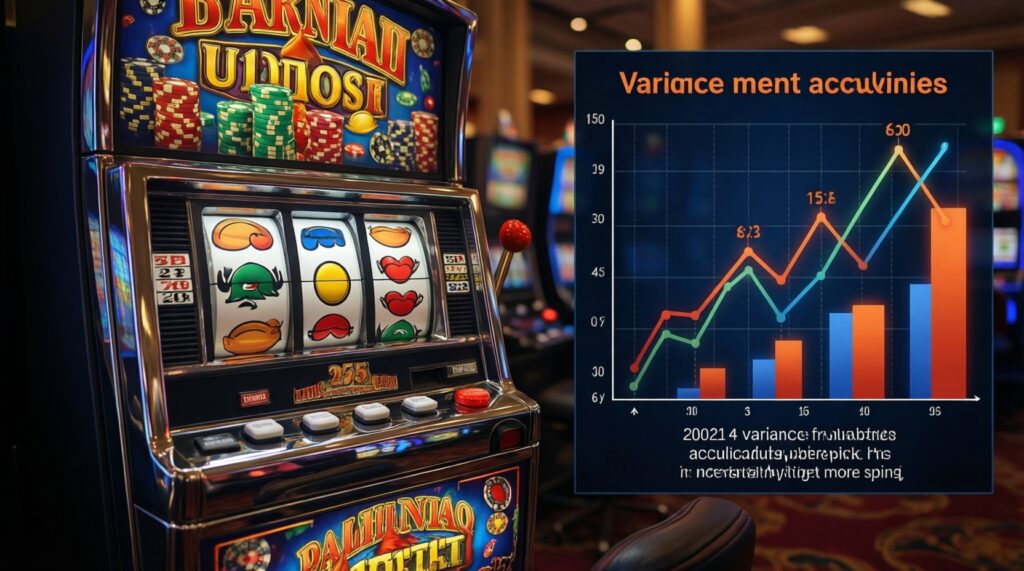
- Variance per spin is fixed by the game. Your session variance is that per-spin variance accumulated over spins.
- Uncertainty shrinks with more spins. For average return per spin, SE ≈ σ/√n, where σ is the standard deviation of spin returns and n is spins.
- High-variance slots have larger σ. Even with the same RTP, they produce bigger streaks, so "hot" impressions happen more often.
- Stopping rules distort perception. Quitting after a win or switching after losses creates biased samples that look more extreme than they are.
- Session outcomes are not symmetric. Many spins are small losses, while wins are infrequent but lumpy; that shape makes humans see patterns.
- What "best slot machines to win" really means. In the short run, it mostly means "a machine that happened to hit during my sample," not a reliably superior outcome.
Regression to the mean and mistaken attribution of skill
Regression to the mean means extreme early results are likely to be followed by more typical results, purely due to randomness. A simple way to frame it is the z-score: z = (observed − expected) / SE. In short sessions, SE is large, so apparent "extremes" are often not statistically extreme at all.
- "I found a hot machine; I should keep playing it." You're often just continuing from an unusually lucky patch that's unlikely to persist.
- "This machine is cold; I should leave immediately." Short-run underperformance is common even for high-RTP games; leaving can be sensible for bankroll control, but it doesn't diagnose the slot.
- "My timing/rituals triggered the bonus." Feature triggers are part of the RNG process; attributing them to skill is classic mistaken causality.
- "Online casino slots real money hit differently at night." Time-of-day patterns are usually memory bias plus variance; without large samples, you can't separate chance from a real effect.
- "I beat the RTP by switching machines." If you only remember the switches that preceded wins, you're selecting on outcomes and creating a story after the fact.
Using simulation and power analysis to set sensible session sizes
If you want to test a hypothesis like "this slot is paying better today," simulation is safer than intuition. You simulate many sessions under the assumption the game behaves normally, then compare your observed session to that distribution. Power analysis is the complementary question: how many spins would you need to reliably detect a meaningful difference if it existed?
Safer steps you can actually do
- Monte Carlo check: simulate thousands of sessions of n spins using a plausible payout distribution (or approximations), then see how often your result occurs by chance.
- Use thresholds, not vibes: decide a rule like "only treat it as unusual if z ≥ 2" (or a chosen p-value) before you play.
- Predefine session length: fix n spins in advance to reduce stopping-rule bias.
- Track net return per spin: store results as an average per spin (and its SE), not just "up/down today."
Hard limits you should not ignore
- Without the true payout distribution, your σ estimate can be wrong; "slot machine RTP explained" rarely provides enough to estimate volatility precisely.
- Multiple testing inflates false positives: if you try many machines and only talk about the "winner," you're guaranteed to "find" a hot one.
- Real-money constraints matter: bankroll, bet sizing, and time limits should dominate decisions more than statistical curiosity for online casino slots real money.
- Power can be impractical: detecting small RTP differences would require very large samples that typical players won't reach.
Signal detection: distinguishing genuine hot machines from noise
- Myth: recent hits predict near-future hits. In RNG slots, recent outcomes don't increase the probability of the next outcome.
- Confusing payout events with expectation. A bonus round can be large yet still consistent with the game's usual distribution.
- Ignoring uncertainty bands. If you can't put an interval around your session return, you're treating point estimates as facts.
- Cherry-picking machines and time windows. Looking only at the best-performing slice creates the "best slot machines to win" narrative from noise.
- Overreading "RTP" as a short-run guide. RTP is a long-run average; using it to justify a "hot" claim is a category error.
Operational protocols to minimize false positives in short runs
Mini-case: you test three slots for "hotness" during a single evening. If you freely switch and stop after wins, you'll almost certainly crown a winner-because you created a selection process that amplifies variance. Use a basic protocol to reduce self-deception.
A simple protocol you can follow (and audit)
- Choose one machine and lock a fixed number of spins n before starting (no early stopping).
- Record: bet size, spins, total return, and calculated average return per spin.
- Compute a z-score: z = (observed − expected)/SE, with SE ≈ σ/√n (use a conservative σ if unknown).
- Decision rule: only label "unusual" if z exceeds your preset threshold; otherwise treat it as normal variance.
- If testing multiple machines, tighten the threshold or reduce the number of comparisons to avoid false discoveries.
Mini-pseudocode (conceptual)
set machines = [A, B, C]
set n = fixed spins per machine
set threshold_z = preset (e.g., 2)

for each machine in machines:
  play exactly n spins
  compute avg_return_per_spin
  compute SE ≈ sigma / sqrt(n)
  z = (avg_return_per_spin - expected_return_per_spin) / SE
  if z >= threshold_z:
    flag as "unusual"
  else:
    flag as "within normal variance"
Self-check before calling anything "hot"
- Did I fix the number of spins in advance, or did I stop because I was up/down?
- Did I test multiple machines and only remember the best outcome?
- Can I state an uncertainty measure (SE, interval, or z-score) for my observed return?
- Am I mixing up a feature hit with evidence of a higher expectation?
- Is my bankroll plan driving decisions more than the "hot slot machine myth" narrative?
Common clarifications on short sessions, variance, and perceived 'hotness'
Are "hot" machines real in RNG slots?
Not in the predictive sense: past outcomes don't change the next outcome. What looks hot is usually variance plus selective memory.
Does a higher RTP mean I'll win more tonight?
No. RTP is a long-run expectation; in short sessions, variance can dominate and overwhelm small RTP differences.
What does "slot machine RTP explained" actually guarantee?

It describes the expected average return over a very large number of spins. It does not guarantee a profitable session or a stable short-run return.
Why do high-volatility games feel streakier?
Because "slot machine variance explained" boils down to a wider payout distribution: fewer wins, bigger jumps, longer dry spells.
Is switching machines a good way to find the best slot machines to win?
Switching increases the chance you'll encounter a lucky streak somewhere, but that doesn't prove the machine is better. It often increases false positives.
Do online casino slots real money behave differently than demo play?
They should follow the same RNG logic if they are the same game configuration. Your perception differs because real stakes amplify attention and recall.
What's the most practical "safe step" for casual players?
Predefine a budget and a fixed session length, then treat outcomes as entertainment results, not machine diagnostics.