

A max win cap is a hard ceiling on the highest payout a slot can return, typically expressed as a multiple of the bet (e.g., xN). In game design, caps reshape the payout distribution tail, reducing extreme wins and enabling tighter risk control, but they can also affect perceived excitement, volatility tuning, and how players evaluate "fairness" and value.
How caps constrain outcome mechanics
- They truncate the far-right tail of the payout distribution, limiting rare extreme outcomes.
- They force designers to "re-home" value: either redistribute probability mass below the cap or reduce expected return for capped paths.
- They change volatility more than they change everyday hit feel, unless the cap intersects common feature outcomes.
- They create a hard boundary for progressive-like aspirations, which can help risk control but can harm long-session motivation if messaged poorly.
- They simplify exposure management for operators while increasing the need for clear player-facing disclosure and math transparency.
- They influence feature design choices (multiplier ladders, retriggers, collector mechanics) by constraining "runaway" states.
Defining max win caps: objectives, variants and placement
Definition: A max win cap is an explicit limit on total payout for a single game round (spin), often stated as "max win xN". In practice, it is implemented as a rule that clamps the final award to a maximum value even if internal feature math would produce more.
Objective: Designers use caps to control tail risk (rare catastrophic payouts), keep feature states bounded, and align product risk tolerance with market requirements. You will see this in max win cap slots positioned as "high potential" but still bounded.
Variants: Caps can be applied at different layers: per-spin total, per-feature, per-line/way, or per-bonus sequence. "Slots with max win cap" usually mean the player-visible per-spin total cap, but engineering often also adds internal sub-caps to prevent runaway multipliers.
| Cap placement | What gets capped | Design impact | Typical implementation note |
|---|---|---|---|
| Total round (spin) cap | Final payout after all features | Preserves normal feel until near the extreme tail | Clamp at settlement; log "would-have-paid" for analytics |
| Bonus/feature cap | Bonus total (e.g., free spins outcome) | Prevents long bonuses becoming mathematically explosive | Stop retriggers / freeze multiplier growth at threshold |
| Multiplier ladder cap | Max multiplier value | Changes feature pacing and aspiration curve | Hard max or diminishing increments near top |
| Symbol/line cap | Single evaluation component | Can distort paytable feel if it hits common outcomes | Avoid unless mandated; players notice "clipped" big hits |
Formalizing the effect: caps, RTP, hit frequency and volatility
Definition: Mathematically, a cap truncates outcomes: if a round would pay X, the paid amount becomes min(X, C) where C is the cap in bet-multiples.
Practical implications:
- RTP interaction: If you introduce a cap without compensating changes, expected value decreases because high-end outcomes are clipped. To keep RTP constant, you must add value back elsewhere (more mid-tier wins, more bonus frequency, or higher average bonus returns below the ceiling).
- Hit frequency is not the same as volatility: You can keep hit frequency stable while lowering volatility by compressing the tail (more "normal" wins, fewer extreme spikes). Conversely, if the cap intersects frequent feature outcomes, hit feel changes immediately.
- Volatility tuning becomes constrained: High volatility typically relies on rare, very large outcomes. A hard ceiling reduces the maximum possible "spike," so designers often increase the probability of upper-mid prizes to preserve excitement.
- Feature design constraints: Collector/meter mechanics and retriggers can push payouts into runaway territory. Caps force deterministic stopping rules (e.g., no further retriggers after threshold, multiplier growth flattens).
- Bankroll dynamics: With capped tails, long-run variance reduces; short-session outcomes can still feel swingy if you concentrate value into fewer, larger-but-still-capped events.
- Testing requirement: You need to measure "cap-hit rate" (how often the cap is reached) and "near-cap rate" (how often results land close), because these predict player suspicion and social chatter.
Shaping payout curves: from distribution tails to prize ceilings
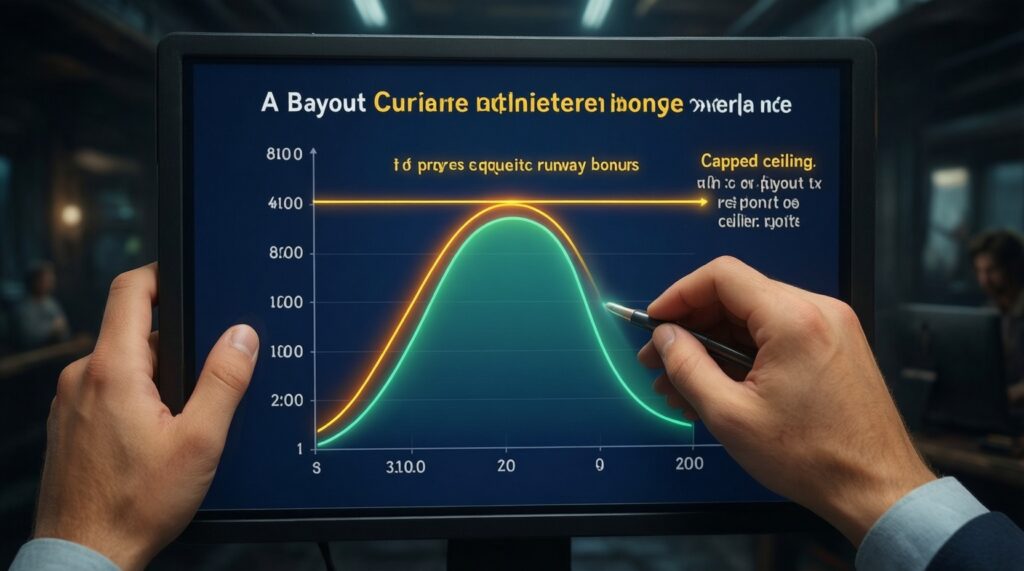
Definition: In payout-curve terms, a cap sets a maximum y-value; the design question is how to reshape the curve below that ceiling so the game still delivers the intended experience.
Typical application scenarios (including lower-resource options):
- Runaway bonus prevention: If free spins can retrigger indefinitely, cap the bonus total or cap retriggers after a threshold. Limited-resources alternative: implement a simple retrigger counter (max retriggers = k) rather than a full dynamic "risk-managed" retrigger model.
- Multiplier ladders with bounded tops: If multipliers climb via collects, set a hard maximum multiplier. Limited-resources alternative: replace a complex multiplier curve with a short step-ladder (e.g., 2x/3x/5x/8x/10x) and tune probabilities.
- Operator exposure control for wide bet ranges: When max bet scales high, a cap limits absolute payout exposure. This is common in max win limit casino slots that allow aggressive staking but must remain risk-manageable.
- Portfolio positioning: Some studios ship capped max win slot games as "medium-high volatility, bounded top" to fit a safer product tier without redesigning the whole math model from scratch.
- Regional compliance and platform requirements: Markets and aggregators may prefer bounded maximums. When targeting Thailand-facing products (th context), studios often keep the max-win claim conservative and consistent across skins to reduce disputes.
For players searching "best capped slots online", the experience difference is usually not the cap itself but how much of the game's aspirational value was moved into attainable upper-mid prizes versus ultra-rare jackpots.
Regulatory and commercial constraints: tailoring caps by market
Definition: Constraints are the non-math reasons you cap: platform policies, risk tolerance, dispute handling, and the commercial need for predictable exposure.
Benefits for product and operations
- Exposure predictability: Upper bound on per-round liability simplifies risk modeling and commercial approvals.
- Design containment: Prevents "edge-case explosions" from stacked modifiers (wild expansions + multipliers + retriggers).
- Simpler QA scope: A well-defined ceiling makes extreme-outcome testing more tractable, especially for complex features.
- Portfolio consistency: Easier to position games in volatility bands without one title becoming an outlier due to tail events.
Costs and constraints you must manage
- Player trust risk: If the cap is reached in a visible way, players may perceive "stolen wins" unless disclosure is clear and the cap-hit rate is extremely low.
- Marketing constraints: A lower cap limits "headline" max-win claims; if competitors advertise higher ceilings, you need stronger mid-tier entertainment value.
- RTP accounting complexity: If you compensate for the cap, you must ensure the added value doesn't create new dominant patterns (e.g., too many near-cap outcomes).
- Content creator dynamics: Streamers highlight extreme moments; caps reduce viral ceiling shots, so you may need alternative "shareable" moments (big symbols, dramatic bonus reveals) below the cap.
Player psychology and UX: perceived fairness, aspiration and churn

Definition: UX impact is driven less by the cap number and more by when players feel it constrains them, and whether they understand it before it matters.
- Mistake: letting players hit the cap too often. A cap-hit rate that becomes noticeable turns the ceiling into a negative feature; aim for it to be an extreme rarity rather than a repeatable target.
- Mistake: capping a common "dream outcome." If your main feature routinely approaches the ceiling, the game feels artificially clipped and reduces aspiration.
- Myth: "A cap always lowers volatility." It lowers the maximum tail, but you can re-inject volatility below the ceiling by concentrating value into fewer big (but capped) outcomes.
- Myth: "Players don't care about max win." They may not until they do; transparent help text and consistent labeling reduce churn after a perceived near-miss at the ceiling.
- UX best practice: Show the max win clearly in rules, and ensure win celebrations don't imply a higher "infinite" upside if the system is capped.
Operationalizing caps: simulation, live telemetry and iteration
Definition: Operationalizing a cap means implementing the clamp, validating RTP/volatility targets, and monitoring cap-related player signals in live telemetry.
Lean workflow (suitable when resources are limited):
- Implement the cap at settlement: Compute internal payout, then pay min(internal, cap). Log both values.
- Run focused simulations: You do not need perfect distribution plots at first; start by tracking (a) RTP delta after capping, (b) cap-hit rate, (c) 99.9th percentile payout before vs after.
- Compensate deliberately: If RTP dropped, add value back in one controlled place (e.g., slightly richer mid-tier bonus outcomes) rather than many small tweaks.
- Ship with telemetry flags: Track near-cap events, player session length after near-cap, and complaint keywords in support tickets.
- Iterate with guardrails: Change one lever per iteration and re-check that your compensation did not create a new "near-cap farming" pattern.
# Pseudocode (conceptual)
internal_win = evaluate_reels_and_features(state)
paid_win = min(internal_win, MAX_WIN_CAP)

log({
  "paid_win": paid_win,
  "internal_win": internal_win,
  "cap_hit": internal_win >= MAX_WIN_CAP,
  "near_cap": internal_win >= 0.9 * MAX_WIN_CAP
})
If you maintain a catalog of slots with max win cap, standardize your telemetry so you can compare cap-hit/near-cap behavior across titles and quickly detect when a new feature pushes too much probability mass into the ceiling.
Practitioner questions and typical clarifications
Does a max win cap automatically reduce RTP?
It reduces RTP unless you compensate elsewhere, because any clipped outcomes remove expected value. With compensation, RTP can remain the same while the tail shape changes.
Where should I implement the cap: total round or inside the bonus?
Total-round capping is simplest and least intrusive to normal play. Bonus-level or multiplier-level caps are useful when specific feature states can run away.
How do I know if players will notice the cap?
Players notice when the cap-hit rate or near-cap rate is high enough to appear in normal play or streams. Track near-cap frequency and post-event churn to quantify sensitivity.
Can I keep the same volatility index after adding a cap?
You can keep a similar feel, but the extreme tail is still truncated. Designers usually compensate by increasing upper-mid outcomes or adjusting bonus frequency, then re-validating with simulation.
What is the lowest-effort way to make a runaway feature safe?
Add a hard stop: cap retriggers, cap max multiplier, or cap bonus total. This is often faster than building a complex dynamic risk controller.
Are capped max win slot games less exciting for streamers?
They can be, because the absolute ceiling moment is bounded. You can offset this by designing dramatic near-cap moments that are still below the cap and by making bonus reveals more engaging.
How should I communicate max win cap slots to avoid disputes?
State the max win clearly in the rules and keep terminology consistent across the UI and help text. Avoid celebratory messaging that implies unlimited upside when a cap exists.