

To compare slots fairly, evaluate RTP, volatility, bonus feature design, and payout caps as a single system. If you only chase "best paying" labels, you'll misread how returns and risk unfold in real play. Use a consistent checklist: verify the same RTP version, match volatility to your bankroll goals, and audit features and caps that can quietly limit outcomes.
Quick Comparison Checklist for Fair Slot Evaluation
- If two games have different RTP versions, then do not compare them until you confirm you're testing the same RTP setting in the same jurisdiction/casino.
- If you want "best online slots RTP volatility" in one pick, then prioritize a solid RTP first, then choose volatility that matches your session length and budget.
- If a slot advertises many features, then check whether those features add frequent small value or rare high value (they are not equivalent).
- If you're evaluating "high RTP slots with low volatility", then look for mechanics that pay often (low dead spins) and avoid designs that push most value into rare bonuses.
- If you see "max win" marketing, then treat it as a hard ceiling; if the ceiling is low relative to the game's hype, then downgrade the slot for long-run potential.
- If you want to "compare slot games RTP volatility features" quickly, then standardize: same bet size, same number of spins (or same time), and record bonus triggers and largest hit.
- If you're hunting "best paying online slots real money", then assume variance matters more than short tests; pick the game whose volatility you can actually withstand.
Common Myths About RTP, Volatility and Features
Myth: "Higher RTP always means you'll win more tonight." If you're using RTP as a short-session predictor, then you're using it outside its purpose: RTP is a long-run average, and short-run outcomes are dominated by volatility and hit distribution.
Myth: "Low volatility means lower maximum wins." If you equate volatility with max win, then separate the concepts: volatility describes how swingy payouts are; max win is a design limit (sometimes plus a technical/contractual cap). A game can be relatively smooth yet still have a high stated max win, or be very volatile with a modest cap.
Myth: "More features = more value." If you count features instead of value allocation, then you'll overrate flashy mechanics. Features can redistribute the same expected return into different timing: frequent micro-bonuses vs rare large events.
Myth: "A bonus round guarantees profit." If you assume a trigger is a payday, then you'll misbankroll: many bonuses return less than the triggering spins cost, especially in high-volatility designs.
How RTP Is Calculated and Its Practical Limits
If you're comparing RTP, then treat it as the expected return of the game math over a very large number of spins, not as a promise for any session. Practical comparison requires checking what RTP actually applies and what parts of the game contribute to it.
- If the provider offers multiple RTP configurations, then confirm the exact RTP version used by your casino (the same title name can run different RTPs).
- If the game has multiple modes (base, bonus buy, free spins, side bet), then verify whether the displayed RTP refers to base game only or includes optional purchases.
- If the slot has progressive or pooled elements, then verify what portion of value comes from those elements and whether you are eligible for them in your region.
- If two games have similar RTP, then do not assume they "pay the same"; instead, compare where the RTP sits (base game vs bonus concentration).
- If you're trying to label "best paying", then define it first: higher RTP, smoother returns, or bigger top-end potential-these are different targets.
- If you can't find the RTP in the game info, then treat any "best paying" claim as unverified and focus on volatility/feature evidence you can observe.
Reading Volatility: What It Tells You and What It Doesn't
If RTP is "how much" in the long run, then volatility is "how it arrives" (smoothly or in spikes). Use volatility to match a slot to a bankroll and time horizon, not to predict the next spin.
- If you have a small bankroll or short session, then prefer lower volatility because it reduces the chance of extended downswings before any meaningful hit.
- If you can tolerate long dry spells to chase occasional large payouts, then higher volatility can fit-provided you accept that many sessions will end negative.
- If you're comparing "best online slots RTP volatility" across two games, then treat equal RTP + higher volatility as higher risk of short-term loss, not "better value."
- If a game's value is concentrated in a rare bonus, then expect volatility to feel higher than labels suggest, especially if the base game is mostly dead spins.
- If you notice frequent small wins but your balance still drains, then the slot may be "busy" but not generous; volatility can be low while net results remain negative due to low average win size.
Dissecting Bonus Features: Frequency, Impact and Predictability
If two slots show similar RTP and volatility tags, then bonus design often explains why they feel different in real play. Focus on trigger frequency, the typical bonus outcome, and whether features scale with bet or are constrained by caps.
- If a feature triggers often but pays small, then it mainly stabilizes sessions (good for entertainment, not necessarily for upside).
- If a feature triggers rarely but can chain (re-triggers, multipliers, expanding mechanics), then it can drive high volatility and create "all-or-nothing" sessions.
- If the game offers a bonus buy, then treat it as a separate product: compare its cost-to-expected-return and its variance profile to normal spinning.
- If a slot has multiple bonus types, then check whether the "best" bonus is actually accessible or is a rare upgrade layer on top of a trigger.
- If a mechanic is deterministic (e.g., guaranteed minimum win, fixed number of free spins), then you can estimate its floor more reliably.
- If a mechanic is heavily random (mystery multipliers, random symbols, random collectors), then expect outcomes to cluster: many weak bonuses and a few standout ones.
- If the bonus needs specific symbol setups (collectors, meters, levels), then treat "near-misses" as normal variance, not as a sign the game is warming up.
- If you're evaluating "slots with bonus features and max win caps", then ask: can the most exciting feature realistically reach the cap, or is the cap mostly marketing?
Understanding Caps, Betting Limits and Regulatory Safeguards
If you want a fair comparison, then you must include constraints: max win caps, max bet, feature buy limits, and any rule that can prevent the theoretical top payout from being reachable in your play style.
- If a slot has a stated max win, then treat it as a hard limit; if your goal is chasing rare huge outcomes, then a low cap is a deal-breaker.
- If the max bet is low, then the practical value of a high max-win multiplier may be limited for players who scale stakes.
- If the game has multiple RTP settings, then the same title can be "better" or "worse" depending on the casino; if you can't confirm the setting, then avoid confident comparisons.
- If a bonus buy is unavailable or restricted in your jurisdiction, then do not include bonus-buy RTP/experience in your evaluation.
- If you rely on "best paying online slots real money" lists, then verify whether they consider caps and restrictions; many comparisons ignore them.
Practical Step-by-Step Workflow to Compare Two Slots Fairly
If you want to compare two slots quickly without fooling yourself, then run the same workflow for both and decide based on your goal (stability, bonus hunting, or top-end chasing).
- If you're starting, then define your target in one line: "I want smoother sessions" or "I accept swings for big bonuses."
- If you have candidate games A and B, then confirm for each: RTP version, max win, max bet, and whether bonus buy/side bets exist.
- If either game hides RTP or uses unclear wording, then treat it as higher uncertainty and downgrade it unless you can verify details in-game.
- If you can test, then keep conditions constant: same stake, same session time (or same spin count), and record (a) bonus triggers, (b) biggest win, (c) ending balance delta.
- If game A triggers features more often but your balance still trends down faster, then A is likely paying many small returns; if that's your entertainment goal, keep it, otherwise favor B.
- If game B has long dry spells but occasional large hits, then only pick it if your bankroll and patience can survive the downswings.
If goal == "low stress":
  pick higher RTP (verified) AND lower volatility feel (more frequent meaningful wins)
If goal == "bonus hunting":
  pick clearer trigger path (transparent mechanics) AND acceptable cap
If goal == "top end":
  pick higher max win cap AND tolerate high volatility AND accept many losing sessions
Clarifying Persistent Doubts and Misunderstandings
If two slots have the same RTP, are they equally good?
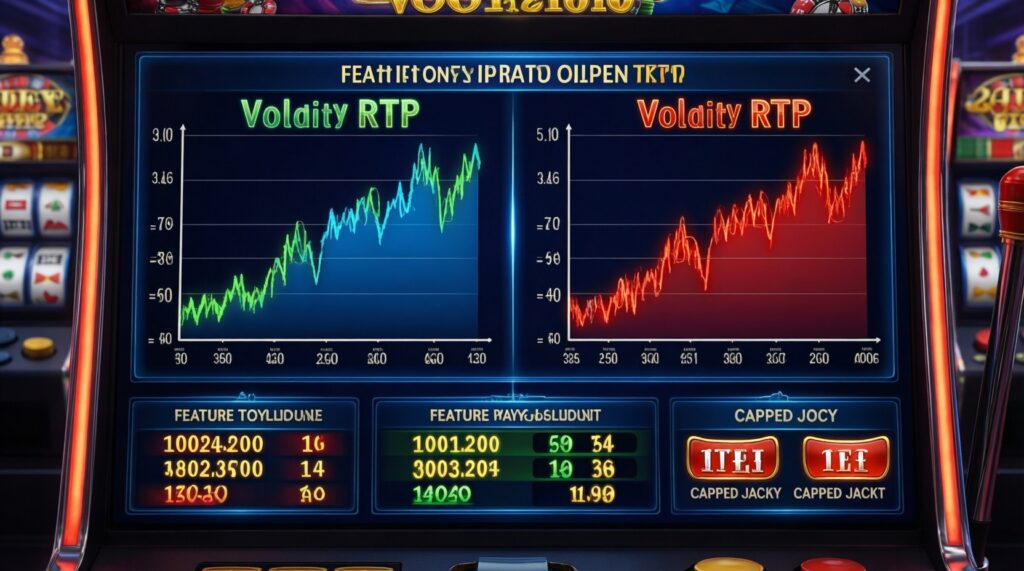
No. If RTP matches, then volatility, feature value distribution, and caps determine how the game feels and what outcomes are realistically reachable.
Does "high RTP slots with low volatility" mean I'll profit more often?
If volatility is low, then you may see fewer extreme swings, but it still doesn't guarantee profit. RTP is an average over the long run, not a session promise.
How can I "compare slot games RTP volatility features" if casinos don't show volatility?
If volatility labels are missing, then infer it from design: rare bonus dependency, dead-spin density, and whether big multipliers sit behind infrequent triggers.
Are bonus buys always better than spinning normally?
No. If you buy bonuses, then you're usually trading time for concentrated variance; the value can differ by game and by rules in your region.
Do "best paying online slots real money" lists account for max win caps?
Not consistently. If a list doesn't mention caps, then assume it may be ranking by headline RTP or popularity rather than realistic top-end constraints.
Is a higher max win always better?
If you never play long enough or can't tolerate volatility, then a huge max win is mostly irrelevant. If your goal is top-end chasing, then cap size becomes important.
Can a slot "warm up" after losses so RTP catches up?
No. If you expect RTP to "balance out" soon, then you're assuming a memory in randomness that standard slot RNG designs don't use.