

Progressive jackpots are prize pools that grow with each wager until someone triggers a specific jackpot event. To judge whether a progressive slot is worth playing, focus on three things: how the jackpot is funded (contribution rate), how it is won (probability model), and expected value (EV) at the current displayed amount-not on recent wins or "hot" machines.
Essential concepts to grasp before diving in
- A progressive is a changing component of value: EV rises as the displayed jackpot grows.
- "Odds of hitting the jackpot" are defined by a trigger event (symbol combo, feature, or must-hit-by), not by the meter size.
- Contribution rate affects where value goes (base game vs meter) and usually increases volatility.
- For online casino progressive jackpots, pools can be local (one game instance) or networked (many casinos/games feeding one meter).
- If you can't estimate EV with a simple formula, treat the progressive premium as unknown and size your bankroll accordingly.
Debunking common myths about progressive jackpots
Myth: "A big meter means better odds." Reality: the meter changes the payout size, not the trigger probability. The probability is set by the game's jackpot mechanism (e.g., a specific reel outcome or a random jackpot award), while the meter determines the prize amount when it hits.
Myth: "Progressives are due after a long drought." Reality: most progressive triggers are modeled as independent trials; past spins don't increase the next-spin chance unless the game has a clearly disclosed "must-hit-by" or accumulating trigger. If you can't identify a stateful mechanic, assume memoryless behavior.
Myth: "The highest paying progressive slots are always the best choice." Reality: "highest paying" is about the sum of (base game value + jackpot value) at a specific moment. A high meter with a tiny trigger probability can still be worse EV than a smaller meter with better economics.
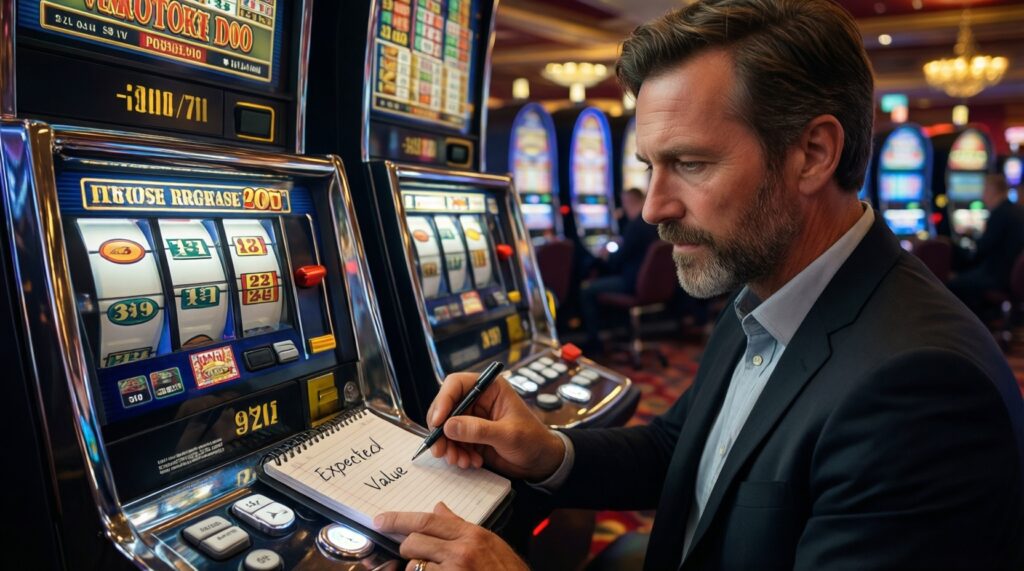
Example formula: treat the progressive as an add-on EV: EV_total ≈ EV_base + p_jackpot × J, where p_jackpot is the jackpot trigger probability per spin (or per eligible event) and J is the current jackpot amount (net of anything not paid to the winner).
How progressive pools are funded and linked across machines
Myth: "All bets contribute equally." Reality: many games require a minimum bet or specific denominations to qualify, and only qualifying wagers typically feed the meter.
To understand how progressive slot jackpots work, follow the money flow and eligibility rules:
- Wager placed: a stake is split into base-game expected payouts, operator margin, and (sometimes) a progressive contribution.
- Contribution applied: if the bet qualifies, the meter increases by
ΔJ = c × bet, wherecis the contribution rate. - Pooling model: the meter can be:
- Standalone/local: one machine or one online game instance.
- Wide-area/network: many terminals or many sites feeding one pot (common for networked progressive slots jackpots).
- Seed/base amount: after a win, the jackpot resets to a predefined seed (the seed may be funded by prior contributions, the operator, or the network-rules vary by product).
- Trigger event: the jackpot is paid when a defined event occurs (reel outcome, feature completion, random draw, or must-hit-by threshold).
- Settlement: win is credited; the meter resets; contributions continue.
Probability models behind jackpot wins
Myth: "One model fits every progressive." Reality: the probability structure depends on the product design, and that structure determines what you should track (bet size, eligibility, state, time-on-device).
Common scenarios you'll see in progressive designs (including best progressive jackpot slots online) are:
- Fixed-probability reel trigger: a specific symbol pattern awards the progressive. Simplified:
p_jackpot = p(pattern)per spin. - Random mystery award: each eligible spin has a small chance of awarding the jackpot independent of reel display. Simplified:
p_jackpotis constant per eligible spin. - Must-hit-by (MHB) / capped range: jackpot is guaranteed to hit before a ceiling value. This introduces state because hitting becomes certain by the cap; EV depends on current meter relative to the MHB range.
- Feature-gated jackpot: you must enter a bonus, then win the progressive inside it. Simplified:
p_jackpot = p(enter feature) × p(win inside). - Tiered progressives: multiple jackpot levels (mini/minor/major/grand), each with its own trigger probability and contribution allocation.
How contribution rates affect RTP and volatility
Myth: "Higher contribution always means better value." Reality: contribution reallocates value; whether it's better depends on how much of that meter you can realistically capture via p_jackpot and the current jackpot size.
If-then recommendations for interpreting RTP impact
- If the game's marketing highlights a large progressive but provides no transparency on eligibility (min bet/qualifying lines), then assume some of your play may not contribute or qualify and discount the progressive premium in your EV estimate.
- If you must increase bet size to qualify for the top progressive, then recompute EV at the qualifying bet; don't extrapolate from lower stakes.
- If the base game feels "tight" while the progressive is emphasized, then expect more value is concentrated in rare events; treat that as higher variance, not as a guaranteed advantage.
If-then recommendations for volatility control

- If your bankroll cannot tolerate long losing stretches, then prefer progressives where value is not overwhelmingly concentrated in a single top-tier jackpot (e.g., tiered jackpots with more frequent minor hits).
- If you are targeting a single large jackpot, then accept that effective variance rises; size sessions by a loss limit and stop rules, not by "trying to get it back."
- If you're comparing "regular" slots vs progressives, then treat progressives as a different risk product: same entertainment spend can produce wider outcomes.
Step-by-step expected value calculations for progressive plays
Myth: "EV is impossible without the provider's secrets." Reality: you can build a usable decision rule with partial information by separating base game value from progressive value and checking break-even conditions.
- Define the unit: per spin (or per eligible wager). Keep currency consistent (THB if you play in Thailand).
- Estimate or bracket the jackpot probability: use disclosed rules when available; otherwise treat
p_jackpotas unknown and only proceed if you can find a credible estimate from the game's info panel or provider documentation. - Compute progressive EV add-on:
EV_prog = p_jackpot × (J - J_seed_share). If you can't model seed funding, use a conservative approximation:EV_prog ≈ p_jackpot × J. - Compute total EV:
EV_total ≈ EV_base + EV_prog. Use this to compare games at the same bet size and eligibility. - Break-even jackpot level: if you know (or assume)
EV_baseis negative, solve for the jackpot amount where the progressive compensates:
J* ≈ (target_EV - EV_base) / p_jackpot(oftentarget_EVis 0 for break-even). - Decision rule: if the displayed jackpot
Jis meaningfully aboveJ*and you can sustain the volatility, then the progressive is a rational target; if not, treat it as entertainment only.
Common EV mistakes to avoid: (1) using total wager contribution c as if it were p_jackpot; (2) ignoring qualification rules; (3) comparing games at different bet sizes; (4) assuming the meter growth benefits you more than it benefits the whole player population feeding the pool.
Practical implications for bankroll management and strategy
Myth: "Strategy can force a jackpot." Reality: you can't control the trigger, but you can control eligibility, cost per trial, and whether you're chasing positive EV or simply a high-variance thrill.
A compact if-then playbook (mini-case)
- If you are choosing between two progressive slots jackpots with similar theme/variance, then pick the one where you can clearly confirm eligibility and jackpot trigger rules; unknown rules usually mean unknown EV.
- If you find a networked meter on best progressive jackpot slots online that looks unusually high, then check whether it's a wide-area pool (many players feeding it) and assume the hit rate is correspondingly designed to be rare; only proceed if your
JvsJ*test is favorable. - If you cannot estimate
p_jackpot, then cap exposure: set a fixed session budget (e.g., X spins or Y THB) and stop when reached, because you're buying variance rather than value. - If you can estimate
p_jackpot, then use a simple gate before each session:
if (p_jackpot * J) >= progressive_premium_needed then play else skip - If your goal is "highest paying" in the practical sense, then define it as "highest expected value at my bet size," not "largest advertised jackpot"; that's how highest paying progressive slots should be interpreted for decision-making.
Concise clarifications and fast answers
Are progressive jackpots truly random?
The trigger is random within the game's defined model (reel-based, mystery, or must-hit-by). Random does not mean the odds improve after losses unless the mechanic is explicitly stateful.
Does a higher jackpot mean higher chances to win?

No. A higher displayed amount increases the payout if you hit, not the probability of the trigger event.
Do all bets contribute to the progressive meter?
Not always. Many games require a minimum bet or specific settings to qualify and/or contribute, so check the info panel before assuming your wager feeds the pool.
How do online casino progressive jackpots differ from local progressives?
Networked online pools aggregate wagers across many players and can grow faster, but the jackpot probability is designed for that larger pool and is often rarer.
Can I calculate expected value without the exact RTP?
You can approximate EV by separating base-game value and progressive value, but you still need a credible estimate (or bounds) for the jackpot trigger probability to avoid guessing.
Is chasing the jackpot a viable long-term strategy?
Only when the current jackpot is high enough to make EV competitive at your eligible bet size and you can handle extreme volatility. Otherwise it's a high-variance entertainment choice.