
A near-miss is an outcome that is objectively a loss or non-success but is perceived as close to a win because it resembles the winning pattern. The "near miss effect" happens when that closeness boosts motivation, attention, or continued play, even though the underlying probability of winning has not improved.
Essence of Near-Misses: A Concise Summary
- Near-misses are defined by perceived proximity to success, not by improved odds.
- They work best when the "almost" is easy to see and easy to imagine turning into a win.
- In near miss gambling, near-misses can increase persistence despite being equivalent to losses.
- A near-miss can feel informative ("I'm getting closer") even when it is statistically uninformative.
- Good analysis separates visual similarity (design) from probability structure (math).
Defining Near-Misses: Psychological and Mathematical Boundaries
Psychologically, a near-miss is a loss that triggers a counterfactual thought: "If only one small thing changed, I would have won." This is the core of near miss psychology: the mind treats "almost" as meaningful, even when nothing causal has changed.
Mathematically, a near-miss is not a special outcome category unless the system explicitly defines it. In a fair random process, the probability of winning on the next trial remains the same regardless of how close the previous outcome looked. If W is the event "win," then typically P(W next | near-miss now) = P(W next | any loss now) unless the mechanism adapts.
The boundary is practical: call something a near-miss only when (1) there is a clear winning pattern, (2) the outcome is visibly close to that pattern, and (3) the user can mentally "repair" it with a small imagined change.
| Concept | What it is | What people often infer | What math typically says |
|---|---|---|---|
| Near-miss | Loss resembling a win | I'm getting closer | Odds are unchanged unless the system adapts |
| Hot-hand belief | Perceived streak-based skill/fortune | Next win is more likely because I'm "hot" | In independent trials, streaks don't increase next-trial probability |
| Skill improvement | Real learning or better strategy | Next win is more likely because I improved | Odds change because the decision process changed |
Probability Structures Behind 'Almost' Outcomes
"Almost outcomes" become common (or rare) based on how results are encoded and displayed. Two systems can have the same true win probability but feel very different if one produces many visually close losses.
- Outcome mapping: Many raw states can be mapped to "looks close to a win," even if none are wins.
- Display granularity: More visible steps (reels, meters, progress bars) create more opportunities to look one step away.
- Near-miss density: Designers can increase the proportion of losses that resemble a win by changing symbols/layout without changing actual payouts.
- Salience asymmetry: Close losses are highlighted; ordinary losses are visually quiet, which biases memory.
- Conditional reveal: Systems that reveal information sequentially (e.g., two matching icons first) amplify "almost."
- Multiple win lines: More patterns means more ways to be one element short of at least one pattern.
A simple way to think about it: if p is the true win probability, near-miss frequency is about how many non-winning states are labeled (by the interface) as "close," not about changing p.
Cognitive Mechanisms: Why Near-Misses Feel Like Wins
People ask why near misses feel like winning because the emotional response often resembles a partial reward: heightened arousal, "I nearly had it," and an urge to try again. The key is that the brain reacts to what the outcome means, not only what it is.
- Slot-style reveals: A slot machine near miss (e.g., two matching symbols and the third just above the payline) encourages the belief that timing or "one more spin" matters.
- Sports and performance: Losing by a narrow margin can increase training intensity because the counterfactual ("one tweak and I win") feels actionable.
- Games with progress bars: Reaching 95% of a target feels like an incomplete win, even when the last 5% is the hardest.
- Shopping and auctions: "Outbid by a tiny amount" feels different from "outbid by a lot," changing willingness to bid again.
- Product onboarding: "Almost finished setup" prompts continuation, even if the remaining step is where most users churn.
Near-misses are especially powerful when people can attribute the miss to a controllable factor (timing, choice, effort), even if the system is actually random.
Models and Metrics: Quantifying Near-Miss Effects
To study near-misses, you need to separate what is manipulated (visual closeness, sequence of reveals, feedback language) from what is held constant (true win probability, expected value). A practical design/analysis rule: if you cannot specify the winning set of outcomes, you cannot define "distance to win" in a meaningful way.
Useful ways to model "closeness"
- Distance-to-win: Define a distance function d(x, W) from outcome x to the nearest winning outcome set W (e.g., "number of symbols off").
- Near-miss rate: Choose a threshold k and define near-miss as d(x, W) ≤ k. Then track NM = count(d ≤ k) / count(all trials).
- Persistence metrics: Spins/attempts after near-miss vs after ordinary loss; session length; re-engagement within the same session.
- Subjective ratings: "How close was that?" and "How much do you want to continue?" collected immediately after outcomes.
Limits and common measurement traps
- Definitional drift: If "near-miss" is defined after seeing the data, results are hard to interpret.
- Confounding salience with probability: A flashier loss can look like "stronger near-miss effect" even when it's just more attention-grabbing feedback.
- Ignoring base rates: If near-misses are frequent by design, persistence may rise simply because users encounter them often.
- Mixing skill and chance: Near-miss patterns in skill games can be informative; in pure RNG they usually are not.
Real-World Cases: Gambling, Games, and Product Interfaces
Near-misses appear in many systems, but the biggest misconceptions come from interpreting them as signals. The examples below are where users (and sometimes teams) misread what the pattern implies.
- Myth: "A near miss means the next one is due." In most near miss gambling setups with independent trials, "due" is a feeling, not a probability update.
- Mistake: Treating near-misses as harmless motivation. In gambling-like loops, extra motivation can mean extra spending and time loss.
- Myth: "The machine is responding to me." A slot machine near miss can feel interactive, but the reel stop is typically not influenced by player timing in RNG-driven systems.
- Mistake: Overusing "almost there" UI. Aggressive progress cues can backfire, increasing frustration and distrust when users realize it was just framing.
- Myth: "Near-misses prove skill." Near-miss psychology makes controllability feel higher than it is, especially when feedback is sequential and vivid.
Practical Implications for Design, Policy, and Risk Communication
For teams building products in Thailand (and similar mobile-first contexts), the practical question is whether "almost" feedback helps users complete beneficial tasks or nudges them into harmful persistence. The same mechanism can support learning (skill tasks) or intensify chasing (random reward loops).
Mini-case: auditing an "almost win" feature without changing true odds
- Specify the win condition: write down the exact winning patterns (set W).
- Define near-miss objectively: choose a distance rule d(x, W) and threshold k.
- Hold probability constant: keep p and rewards the same across variants.
- Change only presentation: animation order, highlighting, messaging, and what is revealed first.
- Measure persistence: attempts after near-miss vs after standard loss; also measure user regret/complaints.
Quick practical tips (useful for analysts, designers, and players)
- If you're analyzing: always report both true win probability (p) and near-miss rate (NM); otherwise "effects" are not comparable.
- If you're designing: avoid framing random losses as skill-relevant ("so close, you're improving") unless users can actually change outcomes.
- If you're communicating risk: explicitly state that near-misses do not change odds in independent trials; say it next to the near-miss feedback, not buried in terms.
- If you're playing: treat a near-miss as a loss with extra decoration; pause after any high-arousal "almost" moment before continuing.
Self-check checklist before you call something a near-miss "effect"

- Can I define the winning set W and a distance-to-win rule d(x, W)?
- Did true odds (p) stay constant across the comparison I'm making?
- Am I separating visual salience (animation, sound, reveal order) from probability structure?
- Did I measure behavior (persistence) and not only self-reported "closeness"?
- Have I considered whether the task is skill-based (near-miss informative) or RNG-based (near-miss usually uninformative)?
Common Practical Questions About Near-Misses
Is a near-miss actually closer to winning in probability terms?
Usually no. In independent random trials, a near-miss does not increase the chance of winning next time; it mainly changes perception and motivation.
What exactly is the near miss effect?
The near miss effect is the tendency for "almost" outcomes to increase persistence or engagement more than ordinary losses, despite being losses.
Why do near misses feel like winning even when I lost?
This is driven by counterfactual thinking and perceived controllability: your brain simulates a tiny change that would convert the outcome into a win, so it feels partially rewarding.
How does near miss gambling differ from normal gaming motivation?
In gambling-like random loops, near-misses can encourage chasing without skill improvement. In skill tasks, near-misses can sometimes guide learning because the "small change" can be real.
What is a slot machine near miss in plain terms?
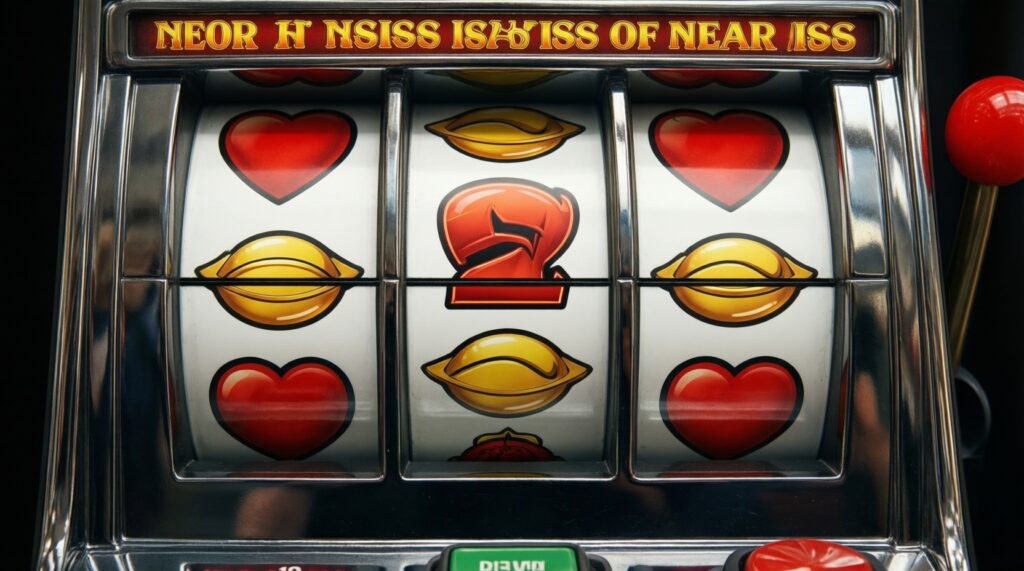
It's a spin that shows a win-like pattern (for example, matching symbols just off the payline) but pays nothing. It is designed to look close to a payout.
Can I quantify near-misses for an experiment or product test?
Yes: define a win set W, choose a distance rule d(x, W), and label near-miss when d ≤ k. Then compare behavior after near-miss versus after other losses.
How can I reduce harmful impacts without removing feedback entirely?
Use neutral loss feedback, avoid skill-implying language in random systems, and add friction after high-arousal outcomes (timeouts, spend/time reminders) to disrupt impulsive continuation.