

To compare two slots mathematically, reduce each game to the same few inputs: published RTP, a volatility proxy, hit frequency, and feature-driven payout shape. Then compute expected value per spin symbolically, stress-test variance with a simple simulation, and choose the slot that matches your bankroll and risk tolerance rather than chasing "best" labels.
Core Metrics to Compare at a Glance
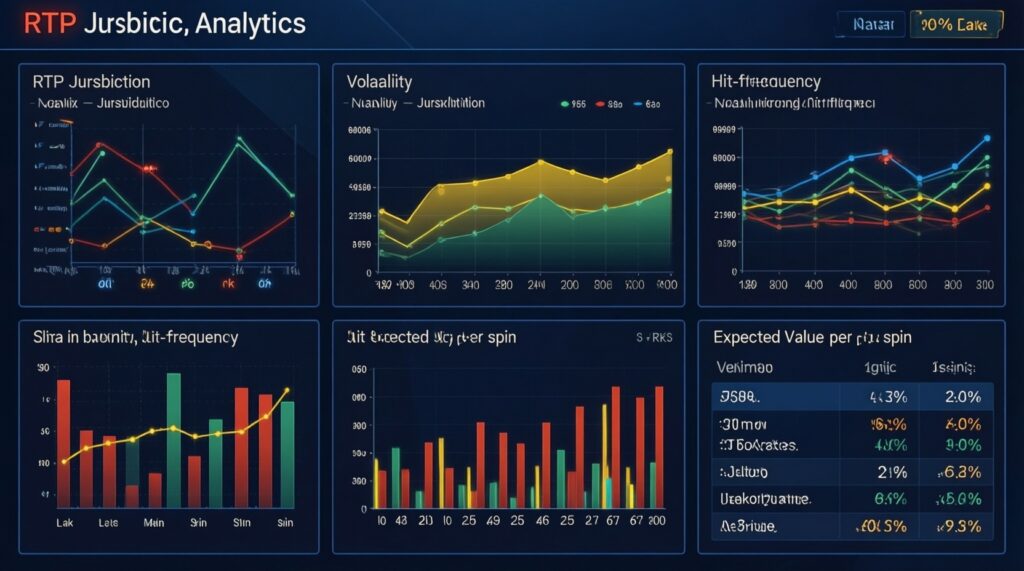
- Published RTP (game return setting) and whether it varies by jurisdiction/operator.
- Volatility proxy: max win multiple, bonus dependence, and payout concentration.
- Hit frequency: how often any win occurs, separate from big-win likelihood.
- Expected value per spin: EV = bet × (RTP − one), compared consistently across both games.
- Feature weighting: how much EV is locked behind free spins, respins, or buy features.
- Bankroll fit: expected drawdowns vs your planned session length and loss limit.
Understanding RTP, Variance and Hit Frequency
Use these criteria to decide which slot is "better" for your goal (value, entertainment time, or jackpot hunting). This is the practical way players in Thailand can evaluate claims like best RTP slots without relying on hype.
- RTP comparability: confirm both RTP values refer to the same mode (base game, including features) and the same provider configuration.
- Volatility type: whether wins are frequent and small (smoother) or rare and large (spikier). If you want slot volatility explained in one line: it's how uneven outcomes are around the average return.
- Hit frequency vs "meaningful hit" frequency: small line wins can be common while bankroll still trends down quickly.
- Bonus dependence: how much of RTP is delivered in bonus rounds rather than base spins.
- Payout concentration: whether a tiny fraction of outcomes dominates the RTP (typical in high-volatility designs).
- Bet sensitivity: whether feature access, coin denomination, or paylines change outcome structure.
- Rule transparency: clear paytable/feature rules reduce the risk of misreading the game's real risk profile.
- Operational constraints: caps, autoplay rules, or local site limits that affect your ability to execute a bankroll plan.
Expected Value Calculations for Two Slots
When you compare slot games RTP and volatility, start with EV because it sets the "long-run price" of entertainment. Use symbolic math to avoid false precision.
Compact formulas you can reuse
- Per-spin EV (net): EV = Bet × (RTP − one).
- Per-session EV (net): EV_session = Spins × Bet × (RTP − one).
- Feature-weighted view: RTP ≈ RTP_base + RTP_features; higher RTP_features usually implies higher volatility and higher bankroll demands.
Decision variants (how to choose between Slot A and Slot B)
| Variant | Who it suits | Pros | Cons | When to choose |
|---|---|---|---|---|
| Higher RTP, similar volatility | Balanced value seeker | Better long-run value without changing the "feel" much | Small RTP differences can be invisible short-term | When both games have comparable bonus dependence and similar max-win structure |
| Slightly lower RTP, much lower volatility | Cautious grinder (time-on-device focus) | Smoother bankroll path; fewer extreme downswings | Less chance of a session-changing win | When your main goal is session length and controlled drawdown |
| Similar RTP, higher volatility | High-variance seeker | Higher upside per unit time; more "peak" outcomes | Higher bust-out probability in short sessions | When you accept frequent losing streaks in exchange for rare large wins |
| Higher RTP, but RTP concentrated in bonuses | Balanced value seeker with patience | Can be good value if you can survive dry spells | EV arrives in lumps; short sessions mislead | When you can fund enough spins to experience multiple bonus cycles |
| Lower RTP, but frequent small hits | Cautious grinder (psychological comfort) | More frequent reinforcement; less "dead spinning" | Often disguises negative drift via small returns | When you explicitly value hit frequency over long-run value |
| Feature-heavy game with optional buy mechanic | Bonus hunter / experimenter | Faster access to high-volatility content (where allowed) | Changes variance drastically; can invalidate naive comparisons | When you evaluate base-play and buy-play as separate modes, each with its own RTP/volatility |
Modeling Volatility: Simple Simulations and Analytical Shortcuts
You cannot "feel" volatility reliably in a few minutes. Use structured checks and a tiny simulation to see which slot matches your risk profile, especially when scanning online slots with highest RTP that may also be extremely spiky.
Actionable "if..., then..." scenarios
- If two slots have similar RTP but one advertises a much larger max win multiple, then treat it as the higher-volatility candidate and demand a larger bankroll buffer.
- If a slot's paytable and rules show many ways to win but most are tiny (common low-level hits), then expect higher hit frequency without necessarily lower volatility.
- If most of the excitement and advertised wins come from free spins/hold-and-win style features, then assume payout concentration and plan for longer sampling before judging results.
- If your goal is "best online casino slots" for extended play, then prioritize lower-volatility structure over marginal RTP differences you cannot practically realize in short sessions.
- If a slot offers multiple modes (base, bonus buy, ante bet, different volatility settings), then compare them as separate products; don't average them mentally.
Minimal simulation pseudocode (reproducible)
# Inputs per slot:
# RTP (as decimal), payout_model() that returns a net win multiple for a spin
# spins, bet

bankroll = starting_bankroll
for s in range(spins):
    bankroll -= bet
    win_multiple = payout_model()   # includes zero
    bankroll += bet * win_multiple
    track_drawdown_and_bust(bankroll)

# Compare:
# - bust rate (how often bankroll hits zero or stop-loss)
# - max drawdown distribution
# - typical ending bankroll range
Bankroll Effects: Session Length, Drawdown and Risk of Ruin
Use this fast selection algorithm to choose Slot A vs Slot B based on your bankroll and the experience you want.
- Define your persona goal: cautious grinder (time), balanced value seeker (best expected deal), or high-variance seeker (upside).
- Set a hard stop-loss and a target session length before you look at any game details.
- Check each slot's RTP and mode (base vs feature-enabled). If modes differ, split the comparison by mode.
- Assign a volatility proxy for each slot using: max win multiple, bonus dependence, and how concentrated payouts appear from the rules.
- Pick the slot whose volatility proxy fits your stop-loss: lower volatility for tighter stop-loss; higher volatility only if you can tolerate early bust-outs.
- Run a small simulation (or at least a mental stress test) and reject any slot where typical drawdowns exceed your comfort.
- Only after the bankroll fit passes, use RTP as the tie-breaker for long-run value.
Comparative Table and Decision Matrix for Player Personas
This matrix helps you choose without chasing labels like best RTP slots or assuming online slots with highest RTP are automatically best for your session.
| Metric | Slot A (fill from game info) | Slot B (fill from game info) | What it implies | Recommended persona |
|---|---|---|---|---|
| Published RTP | RTP_A | RTP_B | Higher RTP improves long-run EV, but won't prevent short-term losses | Balanced value seeker |
| Volatility proxy | Low / Medium / High | Low / Medium / High | Higher volatility increases drawdowns and bust risk, but increases upside spikes | High-variance seeker (high), cautious grinder (low) |
| Hit rate (any win) | Low / Medium / High | Low / Medium / High | More hits can feel better, but may still be low net returns | Cautious grinder |
| EV per spin (net) | Bet × (RTP_A − one) | Bet × (RTP_B − one) | Directly comparable "cost" per spin; most useful over many spins | Balanced value seeker |
| Feature dependence | Low / Medium / High | Low / Medium / High | More dependence means outcomes are lumpier and sample size must be larger | High-variance seeker; bonus hunter if you understand mode risk |
Common selection mistakes that break the math
- Choosing purely by RTP without checking whether the RTP applies to your exact mode and jurisdiction.
- Confusing frequent small hits with lower volatility (they are not the same).
- Comparing a base-play slot to a bonus-buy mode in another slot as if they were equivalent.
- Assuming short-term results validate a slot's quality; variance dominates in short sessions.
- Ignoring payout concentration: two games can share RTP but feel radically different because one pays via rare events.
- Letting aesthetics or "hot/cold" beliefs override the bankroll-fit step.
- Using "best online casino slots" lists without adjusting for your persona and stop-loss.
Adjusting for Bonuses, Features and Non‑linear Payout Structures
For a cautious grinder, the better choice is usually the slot with a lower volatility proxy and higher hit frequency, even if its RTP is not the top. For a balanced value seeker, prefer higher published RTP after verifying mode and configuration. For a high-variance seeker or bonus hunter, pick the game where value is concentrated in features only if your bankroll and stop-loss can absorb long dry spells.
Common Player Concerns and Quick Clarifications
Is higher RTP always the better slot?
No. Higher RTP improves long-run EV, but a higher-volatility slot can still be worse for your session if your bankroll cannot survive typical drawdowns.
How should I interpret "slot volatility explained" in practical terms?
Think of volatility as how wide outcomes swing around the average. Higher volatility means longer losing streaks and rarer big wins.
What does it mean to compare slot games RTP and volatility correctly?

It means comparing the same play mode and then judging RTP (value) alongside volatility (risk). If modes differ, you are comparing different products.
Are online slots with highest RTP automatically best for my bankroll?
No. High RTP can come with heavy bonus dependence and payout concentration, which can increase bust risk in short sessions.
Why do "best RTP slots" lists feel inconsistent across sites?
Because RTP can vary by operator configuration and jurisdiction, and lists often ignore volatility and feature structure. Always verify the RTP shown in your specific casino lobby.
How do I choose best online casino slots for longer play sessions?
Prioritize a lower volatility proxy and a hit rate that matches your comfort, then use RTP as a tie-breaker. This usually produces longer, more stable sessions.