

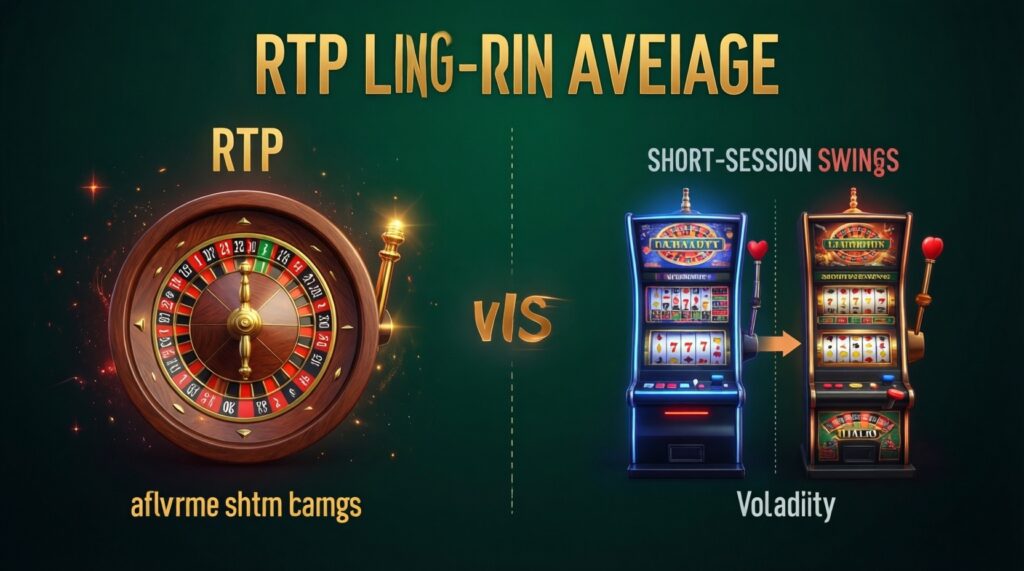
RTP over time is the idea that a game's long-run return-to-player (RTP) only becomes visible across a very large number of bets, while any short session can land far above or below the average due to variance. In an RTP casino setting, your personal "session RTP" is a noisy snapshot, not the game's true expectation.
Essential principles of RTP dynamics
- RTP is a long-run expected value, not a promise for any single session or day.
- Short-session outcomes are dominated by variance and payout clustering, especially in slots.
- Session RTP depends on sample size (number of bets) and the payout distribution shape, not just the listed percentage.
- Convergence toward the published average is slow when outcomes include rare, large wins.
- "Best RTP slots" still produce losing sessions; higher expected value reduces the edge, not the swing.
- Practical decisions (bankroll, bet sizing, stop rules) matter more than trying to "time" RTP.
How RTP Is Defined and Calculated in Practice
RTP (return to player) is the expected fraction of total stakes that a game returns over the long run. Formally, if you stake S in total and receive W back in payouts, then your observed session RTP is RTPsession = W / S. The game's published RTP is an expectation over many bets under fixed rules.
In an online casino RTP listing, the number typically refers to the theoretical average under normal play (same paytable, same features enabled, no external bonuses assumed). It does not mean "you get it back," and it does not describe volatility (how violent the ups and downs are).
Concrete example: Suppose a slot is advertised at a slots RTP percentage of 96% (theoretical). If you spin 200 times at ฿10, your total stake is ฿2,000. If you cash out ฿1,200, your session RTP is 1,200/2,000 = 60%. If you hit a large feature and cash out ฿3,500, your session RTP is 175%. Both are plausible without contradicting the published RTP.
Statistical Variance: Why Short Sessions Can Look Nothing Like the Average
Variance is the mathematical description of how widely outcomes spread around the average. Slot outcomes are not "small random noise"; they are usually a mix of many small losses, occasional medium wins, and rare big wins, which makes short sessions highly unstable.
- Skewed payouts: many spins pay zero, while a minority pay something, so the distribution is not symmetric.
- Rare events matter: a single bonus/feature can dominate the entire session result.
- Clustering happens naturally: "hot" or "cold" streaks are expected in random sequences.
- Same RTP, different volatility: two games can share the same expected RTP but have very different swing profiles.
- Bet sizing amplifies variance: higher bets don't change expectation per unit, but they magnify absolute swings.
Concrete example: Imagine a simplified game where most spins return ฿0, sometimes return ฿15 on a ฿10 bet, and rarely return ฿500. Over 50 spins, missing the rare ฿500 event can leave you far below average; hitting it once can push you far above average-without any change in the underlying RTP.
Law of Large Numbers and How Quickly RTP Converges
The law of large numbers says the average outcome tends to approach the expected value as the number of independent bets grows. "Tends to" is crucial: convergence is not linear, and it can be painfully slow for high-volatility games with rare large payouts.
Where this shows up in real play and reporting
- Single player sessions: tens to a few hundred spins are often too few to "see" the theoretical RTP.
- Streamer or influencer samples: a short recorded session can mislead viewers about whether a game is "paying."
- Comparing two slots: choosing high RTP online slots reduces the house edge, but short-run results can still invert the ranking.
- Bonus hunting: switching games frequently increases the chance you only experience the downswings of many different distributions.
- Operational monitoring: an operator can observe temporary deviations in aggregate, especially when traffic is low (common for smaller brands or off-peak hours in Thailand).
Mini-scenarios you can apply immediately
- You played 80 spins and lost 60%: treat it as normal variance; it does not prove the listed RTP is wrong.
- You hit a big win and think you "extracted the RTP": that win is part of the same distribution; leaving now locks your result but does not change what the RTP "is."
- You want the "best" game today: interpret "best RTP slots" as "lower edge over time," not "more likely to win in the next 30 minutes."
Concrete example: If two games are listed at 94% and 96% RTP, the expected difference is ฿20 per ฿1,000 staked in the long run. In a short session, a single medium win can exceed that gap instantly, making the lower-RTP game "look better" for that session.
Simulating Short Sessions: Models, Parameters, and What to Measure
Simulation is the cleanest way to see why your session RTP jumps around. You don't need the exact proprietary math model to learn the core lesson: heavy-tailed payouts create wide short-run dispersion. If you have limited resources (time, device, or technical skill), use lightweight approaches.
A practical model you can run (even with limited resources)
- Pick a stake and session length: e.g., ฿10 per spin for 100 spins.
- Use a simple payout distribution: for example, set probabilities for returns like 0x, 0.5x, 1.5x, and a rare 50x event (illustrative values).
- Run many sessions: repeat the 100-spin session hundreds or thousands of times (as many as your laptop/phone can handle).
- Record metrics: session RTP, maximum drawdown, and probability of ending profit.
Concrete example: If your model includes a rare 50x payout, you'll typically see a wide spread of session RTPs: many sessions far below 100%, some near the average, and a small fraction extremely high. That visual spread explains why a short session is not evidence about the game's true expectation.
What to measure (and what to ignore)
- Measure: distribution of session RTP (percentiles), frequency of ruin (bankroll hits zero), and longest losing streak.
- Measure: sensitivity to session length (50 vs 200 vs 1,000 bets).
- Ignore: "pattern detection" like alternating wins/losses; randomness frequently creates apparent patterns.
- Ignore: judging fairness by one screenshot of a balance graph.
Low-effort alternatives when you can't simulate properly
- Spreadsheet approach: generate random numbers and map them to a simplified payout table (good enough to see dispersion).
- Back-of-envelope bounds: assume "mostly losses + occasional wins"; estimate how one rare event can dominate total return.
- Use in-game history wisely: treat it as personal logging, not as proof of what will happen next.
Player-Level Controls: Bankroll, Bet Sizing and Session Planning
You can't control RTP, but you can control how variance hits you. The practical goal is to make your plan robust against short-run divergence, especially in an RTP casino environment where sessions are typically short.
- Mistake: equating higher RTP with "safer." A higher listed RTP reduces expected loss rate; it does not guarantee lower volatility or fewer deep drawdowns.
- Mistake: raising bets after losses to "reach" the average. This is chasing variance; the expected value per unit stake stays the same, but risk increases.
- Mistake: using a win to justify longer play. Extending the session increases exposure to the house edge even if you are currently ahead.
- Myth: short sessions beat the house because you can leave when up. Leaving locks results, but it doesn't change the expected value of future spins.
- Actionable rule: set a fixed session budget and a fixed stop condition (time or number of spins), not a "feel-based" target.
Concrete example: If your session plan is "200 spins at ฿10," your risk is mostly about whether you encounter a rare high payout (upside) or a long dead stretch (downside). Changing to "200 spins at ฿20" doesn't improve expectation; it doubles the size of both outcomes.
Operator and Regulator Implications: Volatility, Disclosure, and Game Design
Operators and regulators in Thailand-facing markets should expect customer complaints driven by short-session divergence, even when the math is correct. Clear disclosure of online casino RTP and volatility framing reduces misunderstanding and supports responsible gaming outcomes.
Mini-case: handling "RTP is fake" complaints without misleading claims
- Disclose what RTP means: long-run expectation over many bets under fixed rules.
- Disclose what RTP does not mean: not a guarantee for a session, not a predictor of "due wins."
- Pair RTP with volatility language: explain that two games can share the same RTP but behave differently in short sessions.
- Operational check: monitor for configuration mismatches (wrong paytable/feature settings) rather than reacting to normal variance.
Concrete example (pseudo-logic for internal dashboards):
if (reported_session_RTP is extreme) {
  check configuration_version, paytable_id, feature_flags;
  compare aggregate RTP over larger sample window;
  if mismatch detected -> escalate to game ops;
  else -> respond with variance explanation + player education link;
}
Clarifications on interpreting short-session RTP
Does a low session RTP prove the published RTP is wrong?
No. A low result over tens or hundreds of bets is a normal outcome under variance, especially for slots with rare large payouts.
If I only play "high RTP online slots," will I avoid losing sessions?
No. Higher RTP lowers the long-run expected loss rate, but short sessions can still end negative because variance dominates.
Are "best RTP slots" always the best choice for my bankroll?

Not necessarily. RTP addresses expected value; bankroll safety is often more sensitive to volatility and session length than to small RTP differences.
Is a "slots RTP percentage" the same as hit frequency?
No. RTP is about expected return; hit frequency is how often any payout occurs. You can have frequent small wins and still have low or high RTP depending on payout sizes.
Can I "lock in" RTP by stopping after a big win?
You can lock in your current profit, but you haven't changed the game's expectation. You've simply ended your exposure to future variance and edge.
Does switching games often improve my chances in an RTP casino?
Switching changes the distribution you face, not the math of randomness. It can increase the chance you experience many short downswings without staying long enough to see rare upsides.
How many spins are "enough" to judge a game's RTP?
There is no single safe number; convergence depends on volatility and the payout distribution. Treat short-session conclusions as unreliable by default.