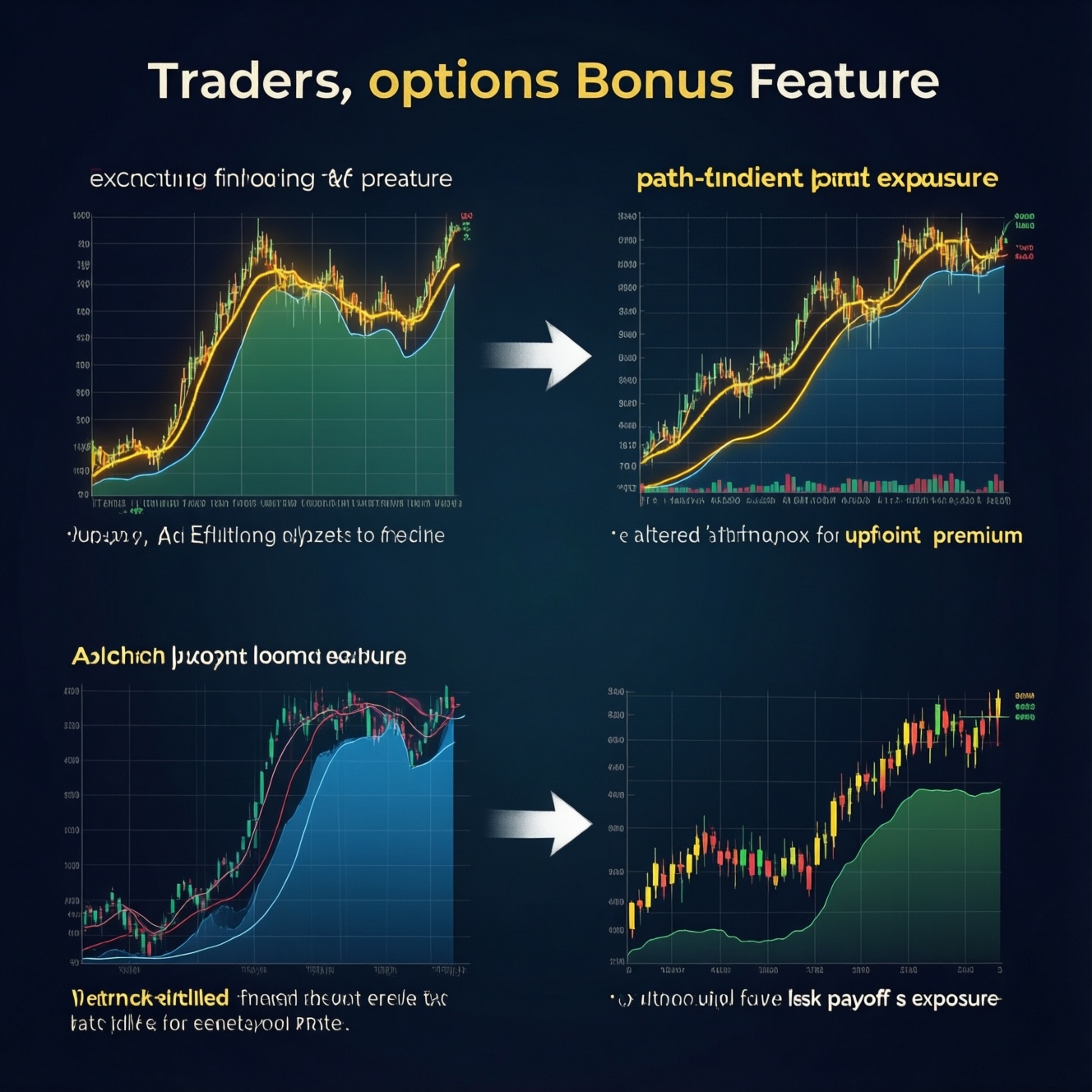
Buying a bonus (feature buy) usually reshapes your risk rather than simply increasing it: you replace a long path-dependent exposure with an upfront premium and a different payoff profile. Net risk can stay similar when you offset the new convexity, cap your downside, and control execution costs. The key is mapping pre- vs post-buy greeks and cashflows.
When Buying Bonus Features Alters Risk: A Concise Overview
- "Feature buy slots" are economically similar to paying an option premium to jump directly into a high-variance payoff segment.
- Risk often shifts from time/variance exposure to upfront premium + tail risk concentration.
- A "buy bonus slot strategy" can be risk-neutral-ish only if you hedge or cap the additional convexity and define a max loss.
- "Feature buy vs bonus buy slots" differences are mostly operational wording; what matters is pricing, settlement, and embedded rules.
- Execution friction (bid-ask, slippage, limits) can dominate theoretical edges, especially on "best buy bonus slot sites" where rules and payouts vary.
Mechanics of Feature Buy Options and Bonus Structures
A feature buy is an upfront payment that grants immediate entry into a bonus/feature round (or an equivalent enhanced payout process). From a risk lens, you're swapping a stream of small random outcomes for one concentrated, higher-variance resolution with clear premium outlay.
Who it fits: intermediate users who can track bankroll, define max loss per attempt, and compare expected value (EV) and variance before committing to "buy bonus slots".
When not to do it (quick):
- If you can't verify the rules (payout caps, multipliers, retriggers, or "feature buy slots" conditions).
- If you cannot tolerate short-term drawdowns from higher variance.
- If execution is opaque (unreliable settlement, unclear bonus valuation, inconsistent terms across "best buy bonus slot sites").
- If you plan to chase losses; feature buys amplify loss-chasing because the premium is large and frequent attempts compound quickly.
How Bonus Purchases Change Option Payoff and Greeks
To analyze how buying a bonus changes risk, treat it like an option-like cashflow transformation: you pay a known premium P now, and receive a random payoff X from the feature. Your per-attempt P&L is:
P&L = X − P
What changes compared with "playing into" a bonus organically is the distribution of X: it tends to have higher variance and more convex tails, so your effective "gamma/vega-like" exposure increases even if your maximum loss per attempt is clearly P.
What you need before using a buy feature approach
- Rule visibility: exact feature mechanics, caps, retriggers, and whether the premium is fixed or dynamic.
- Pricing anchor: a baseline for "fair" premium (at minimum, historical outcomes you logged yourself under identical rules).
- Risk budget: a bankroll plan with a strict per-attempt max loss (usually the premium) and a session stop.
- Execution discipline: you must be able to stop after predefined limits; variance can create misleading "near-miss" signals.
- Comparison framework: you should compare "feature buy vs bonus buy slots" offers by settlement rules and payout distribution, not marketing labels.
Greeks intuition (translated to feature buys)
- Delta-like exposure: sensitivity to the underlying state (e.g., volatility regime or in-game feature probability rules). Buying the feature collapses "time to trigger" uncertainty.
- Gamma-like exposure: payoff curvature: concentrated feature outcomes often increase tail sensitivity. If outcomes are more "all-or-nothing," effective gamma rises.
- Vega-like exposure: sensitivity to dispersion: if the feature's payout distribution widens, your result swings increase. Feature buys typically increase this.
Situations Where Purchasing Bonuses Does Not Increase Net Risk
Risks and limits to accept upfront (risk-aware):
- Pricing can be unfavorable even if the feature is exciting; without a trustworthy valuation, you may be overpaying systematically.
- Variance clustering means you can see long losing streaks even under "reasonable" rules.
- Operational risk (terms changes, caps, payout delays) can dominate your expected outcome.
- If you increase frequency because it feels faster, your total exposure per hour may silently explode.
-
Define "net risk" in one sentence
Pick one metric you will not violate: maximum drawdown per session, maximum loss per attempt, or probability of ruin over N attempts. Without a metric, "buy bonus slot strategy" decisions become emotional.
- Practical default: cap per-attempt loss at the premium P, cap session loss at K×P where K is small and fixed.
-
Normalize exposures: compare like-for-like budgets
Compare "buy bonus slots" vs non-buy play using the same total spend (e.g., total premium vs total spins). If the feature buy simply concentrates spend faster, it can feel riskier even when the budget is identical.
-
Model the payoff as a capped-loss position
With a feature buy, your worst-case per attempt is typically −P. If you already planned to spend P to reach a similar outcome organically, your max loss may not increase-only the distribution changes.
- This is the key "doesn't increase net risk" case: you replace uncertain time-to-bonus with a known premium while keeping the same max spend.
-
Offset the variance by reducing frequency
If you adopt feature buys, reduce the number of attempts so your total exposure stays constant. Net risk is often higher only because people keep the same session length and add high-premium purchases on top.
-
Pre-commit decision rules for stop and scale
Write down when you stop (loss limit) and when you stop after wins (profit lock). This prevents "variance chasing," the most common reason feature buys become meaningfully riskier in practice.
- Example rule: after any win above W, stop for the day; after K losses, stop regardless of "feeling close."
-
Validate with small samples, then re-price
Run a limited number of attempts to estimate your own realized distribution under the exact rules used by the site. If outcomes differ from expectations, treat it as a repricing event and pause.
Assessing Transaction Costs, Liquidity and Model Risk Impacts

- Terms are stable and readable (no ambiguous caps, multipliers, retrigger constraints, or payout exclusions).
- You know the all-in cost per attempt (premium plus any fees, conversion spreads, or withdrawal friction).
- You can execute consistently (no lag, no failed purchases, no partial settlement issues).
- You have a hard session limit that prevents "just one more buy."
- Your comparison uses equal budgets (feature buy spend vs non-buy spend) rather than equal time.
- You have a logging method (date, game/version, premium, outcome, notes) to detect rule or payout drift.
- You understand that "best buy bonus slot sites" is not a guarantee of favorable pricing; you verify the rules per title, per version.
- You can tolerate the variance: you explicitly accept that long losing streaks are possible and plan for them financially.
Risk Management Frameworks for Feature-Buy Strategies
- Budget stacking: adding feature buys on top of your normal spend rather than replacing it.
- Time compression illusion: thinking it's "more efficient" because results arrive faster, while total exposure per hour spikes.
- No stop rules: entering without a loss cap and profit lock; variance then dictates behavior.
- False diversification: switching between many titles on "best buy bonus slot sites" without understanding each feature's mechanics and caps.
- Confusing max loss with low risk: capped loss per attempt (−P) can still imply high session risk if you repeat attempts frequently.
- Overweighting recent outcomes: increasing size after wins or "near misses," effectively raising variance when you feel confident.
- Ignoring rule drift: assuming yesterday's "feature buy slots" pricing and behavior is unchanged after updates.
- Poor comparatives: debating "feature buy vs bonus buy slots" labels instead of auditing payout distribution and settlement terms.
Concrete Trade Examples: P&L Scenarios and Decision Rules
Use these as practical alternatives and forks for when feature buys are (and aren't) justified. Keep the math simple: P&L = X − P.
Alternative 1: Replace, don't add (risk-neutral-ish implementation)

- Setup: You planned to spend a fixed budget B either way.
- Decision rule: If you buy a bonus for premium P, you reduce other spend by P so B is unchanged.
- Why it helps: Net risk often doesn't increase because total at-risk capital per session is constant; only variance timing changes.
Alternative 2: Two-fork comparison to detect hidden risk increase
- Fork A (no buy): Spend B gradually; outcomes are smoother, more paths, fewer extreme swings.
- Fork B (buy): Spend P quickly; outcomes are concentrated, higher dispersion, and you may be tempted to repeat after losses.
- Decision rule: If you cannot commit to fewer attempts in Fork B, don't use the feature buy.
Alternative 3: Use a "one-and-done" cap to control tails
- Setup: Choose at most one feature purchase per session.
- Decision rule: After one "buy bonus slots" attempt, stop regardless of outcome.
- Why it helps: It prevents frequency-driven blowups, the most common real-world reason a buy bonus slot strategy becomes riskier.
Short Practical Answers to Common Trader Doubts
Is buying a bonus always higher risk than playing normally?

Not always. Per attempt, the maximum loss is often the premium P, but the variance usually increases; net risk depends on whether you keep total budget and attempt count under control.
What's the cleanest way to compare feature buy vs bonus buy slots?
Ignore the label and compare the rules: premium, payout caps, retrigger mechanics, and settlement. Then compare outcomes under equal total spend, not equal time.
How do I avoid overpaying when I buy bonus slots?
Log outcomes and treat it like pricing: if realized payouts systematically lag what you expected under the rules, stop and reassess. Without a valuation anchor, you're guessing.
Are "best buy bonus slot sites" a reliable shortcut?
No. Site reputation doesn't replace checking the specific game/version rules and costs; risk often comes from terms, caps, and execution friction, not marketing.
What's a safe buy bonus slot strategy for intermediates?
Use fixed session budgets, strict stop rules, and replace other spend rather than adding feature buys on top. Limit the number of feature purchases per session to control variance.
Which mistake increases risk the fastest with feature buy slots?
Repeating purchases after losses to "get even." Frequency amplifies variance, and the premium outlay makes drawdowns accelerate.