"Hot" and "cold" slots feel real in play, but with modern RNG-driven games they are not reliable properties of a machine or a game. Each spin is determined independently by a PRNG-based RNG process, so streaks happen naturally. The practical move is preventing common decision errors: chasing losses, over-trusting recent outcomes, and "switching" based on emotion.
Core conclusions about 'hot' vs 'cold' slots
- Player labels like "hot" and "cold" describe recent outcomes, not a predictable state.
- RNG/PRNG systems make each spin independent; past spins don't "warm up" future spins.
- Streaks (good or bad) are expected even when outcomes are random and fair.
- Most "slot is hot now" decisions are pattern-seeking plus selective memory.
- The best prevention is process: bankroll limits, stop rules, and avoiding outcome-based switching.
Player definitions: what 'hot' and 'cold' are claimed to mean
In Thai player talk, สล็อตร้อน สล็อตเย็น คืออะไร usually means this: a "hot slot" is believed to be in a phase of frequent wins/bonuses, while a "cold slot" is believed to be "due" to pay later-or to keep paying poorly for a while. These labels are typically assigned after observing a short recent window of spins.
Practically, players use "hot/cold" in two ways: (1) to justify staying after a win streak ("it's hot, keep pressing"), and (2) to justify switching after losses ("it's cold, find a new game"). The boundary you should keep in mind is simple: unless you have verifiable information about the game's math changing in real time, "hot/cold" is only a narrative about recent variance.
If your goal is to avoid costly mistakes, treat "hot/cold" as a mood indicator (how you feel about recent results), not a forecast. That mental reframe prevents most impulse moves.
| Player claim | What it usually means in practice | RNG-consistent interpretation | Fast prevention move |
|---|---|---|---|
| "This slot is hot." | Recent wins/bonuses happened in a short session window. | A normal positive streak in independent trials. | Lock a profit cap and stop when reached. |
| "This slot is cold." | Recent spins didn't pay; frustration rises. | A normal negative streak; not evidence of "due" payouts. | Use a loss limit and take a timed break. |
| "Switching finds a hotter game." | Chasing a different outcome after losses. | Switching does not change independence; it may increase tilt decisions. | Switch only for planned reasons (volatility, budget, time). |
RNG mechanics: how modern slot algorithms determine each spin
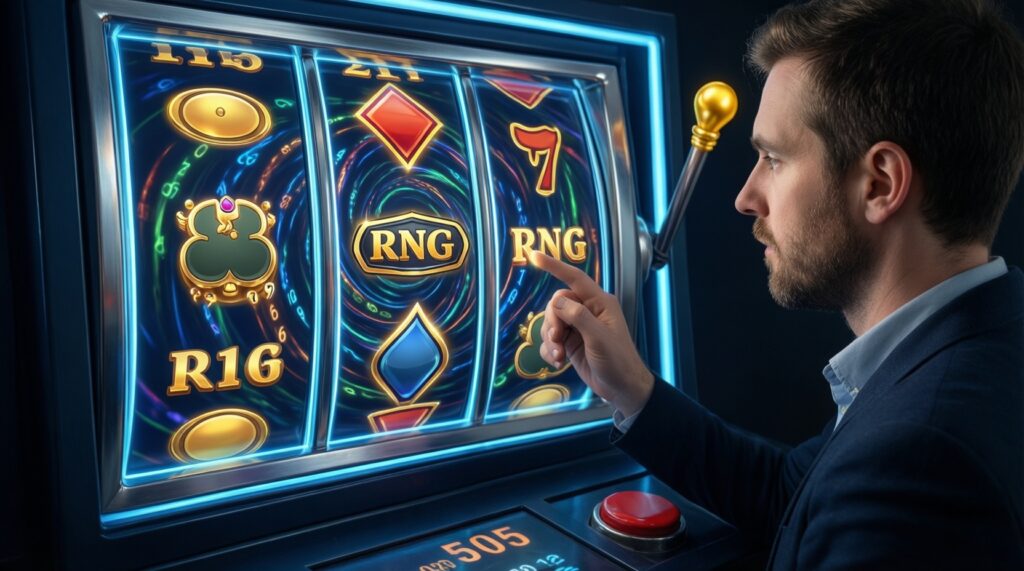
To evaluate whether สล็อตร้อน สล็อตเย็น จริงไหม, you need a clean model of how slots work. In most regulated online slots, outcomes are driven by an RNG (random number generator). In software, this is commonly a PRNG (pseudo-random number generator): a deterministic algorithm that produces unpredictable-looking numbers when properly implemented and seeded.
- Spin request: you press spin; the game asks the server/client RNG for a random value.
- Number generation: the PRNG outputs a number (or a sequence) from a large internal state.
- Mapping to outcome: the random value is mapped to a reel stop / symbol combination based on the game's predefined math model.
- Payout evaluation: paylines/ways/bonus rules are applied to the resulting symbols.
- Result is finalized: the outcome is committed; the next spin repeats the same process.
- Independence assumption: unless explicitly designed otherwise, the next spin does not "remember" the last one.
So when players ask สล็อตออนไลน์ RNG คืออะไร, the operational answer is: it's the mechanism that selects outcomes for each spin, and it's specifically designed so that you cannot reliably infer the next result from the previous results.
Why human perception finds patterns in independent events
After understanding RNG, the key question becomes: why do "hot/cold" stories feel so accurate? Because our brains are excellent at detecting patterns-even when events are independent. These are the most common real-session scenarios where the "hot/cold" belief gets reinforced:
- Clustering illusion: a few wins close together feel like a "phase," even though clustering is normal in randomness.
- Recency bias: the last 20-50 spins dominate your judgment more than the larger sample you never tracked.
- Selective memory: you remember the times "hot" paid off and forget the times it didn't.
- Gambler's fallacy: after many losses, "a win is due," which flips "cold" into a reason to keep playing.
- Outcome-driven switching: you move games right before a natural rebound, then credit the new game as "hot."
This is where searches like วิธีดูสล็อตแตกง่าย สล็อตร้อน often lead players astray: the "method" becomes a pattern narrative built on short-term swings, not a repeatable edge.
What empirical casino data can and cannot reveal about streaks
Data can help you avoid self-deception, but it must be interpreted correctly. If you track spins, you'll definitely see streaks-because streaks are expected in random sequences.
- What data can reveal:
- Your personal risk exposure: how fast you hit your stop-loss in a given volatility style.
- How often you violate rules (tilt markers): increasing bet sizes after losses, extending sessions after wins.
- Session-to-session variance: some sessions will look "hot," some "cold," even with identical settings.
- What data cannot reliably prove from short samples:
- That a specific game instance is "due" or "currently hot" in a predictive way.
- That switching to เล่นสล็อตออนไลน์ เว็บสล็อตแตกง่าย changes the independence of spins (unless the product is unregulated or manipulated-then "patterns" may reflect risk, not opportunity).
- That recent bonus frequency predicts the next bonus without a disclosed, testable adaptive mechanic.
Translating RNG facts into practical bankroll and session rules
Most losses blamed on "cold slots" come from preventable decision errors. Use these fast safeguards to stop the typical "hot/cold" traps:
- Define a stop-loss before you spin: if you don't know the number, you'll negotiate with yourself mid-tilt.
- Set a time cap: long sessions amplify impulsive switching and bet escalation.
- Ban outcome-based bet sizing: don't raise bets "because it's hot" and don't martingale "because it's cold."
- Switch games only for planned reasons: entertainment preference, volatility preference, or budget fit-not because the last 10 spins "look cold."
- Use a two-step pause rule after a big swing: after a large win or a sharp downswing, pause and re-check limits before continuing.
- Track a tiny log: start time, end time, max bet, and whether you broke a rule-this is more useful than chasing "hot slot" signals.
Designing simple tests: experiments you can run and their limitations
If you want a practical way to challenge the "hot/cold" belief without pretending to do laboratory science, run a small self-audit. The point is not to "prove RNG," but to expose how easily you can label any random stretch as hot or cold after the fact.
Mini-experiment: labeling bias check (session journal)
- Pick one slot and keep bet size constant for the whole test.
- Play several short sessions on different days (same game, same stake rules).
- After each session, write one sentence: "I would call it hot/cold/neutral," plus why.
- One week later, re-read your notes and count how often "hot" meant "I just won" and "cold" meant "I just lost."
Mini-pseudocode for a simple streak counter

wins = 0
losses = 0
max_win_streak = 0
current_win_streak = 0

for each spin in session:
  if payout > 0:
    current_win_streak += 1
    max_win_streak = max(max_win_streak, current_win_streak)
  else:
    current_win_streak = 0
Limitation: even if you observe long streaks, that does not validate prediction. It only shows that streaks exist. Your usable output is behavioral: when streaks happen, do you break your rules?
Brief answers to recurring player doubts
Is "hot vs cold slots" a real feature or just a story?
Usually it's a story built on recent results. With RNG-based slots, short-term streaks happen naturally and don't make the next spin more predictable.
So สล็อตร้อน สล็อตเย็น จริงไหม for online slots?
As a description of what just happened, yes. As a reliable predictor of what will happen next, no-independence is the key assumption of RNG-style design.
What does สล็อตออนไลน์ RNG คืออะไร mean in plain terms?
It's the mechanism that picks the outcome of each spin using random-like numbers. In practice, it's designed so past outcomes don't give you a dependable forecast.
Are there any safe วิธีดูสล็อตแตกง่าย สล็อตร้อน signals?
Not as prediction signals. The "safe" part is using signals to manage yourself: stop-loss, time cap, and avoiding bet escalation after any streak.
Does choosing เล่นสล็อตออนไลน์ เว็บสล็อตแตกง่าย increase my chances?

Picking reputable, regulated platforms can reduce risk of unfair manipulation, but it doesn't create a "hot slot edge." Your odds still follow the game's predefined math.
If I just hit a bonus, should I immediately switch because it's "used up"?
No. That's the gambler's fallacy in reverse. Switch only for planned reasons (budget/time/volatility), not because a bonus "can't happen again."
What is the fastest way to prevent hot/cold chasing?
Write two numbers before you start: a loss limit and a time limit. When either hits, stop-no exceptions based on "it's getting hot."