

Chasing losses is the habit of increasing or extending gambling after a loss to "get back to even." Probabilistically, it backfires because each new bet is still governed by the same house edge and variance, while your bankroll shrinks and your risk of ruin rises. Safe steps focus on strict stopping rules, smaller exposure, and early access to problem gambling help.
Core Probabilistic Insights on Chasing Losses
- In chasing losses gambling, past outcomes don't improve the odds of the next bet; independence and house edge persist.
- As bankroll drops, the same volatility represents a larger fraction of your funds, so "recovery" becomes statistically harder.
- Bigger bets can shorten time-to-even in rare lucky paths, but they also sharply increase the probability of hitting zero first.
- "Due" thinking (gambler's fallacy) and "I'm hot" thinking (hot-hand) both distort risk perception and pacing.
- To stop chasing losses, you need pre-commitment: limits set before play, not during emotional tilt.
- If repeated attempts fail, treat it as a risk-management issue and seek problem gambling help early.
Defining Chasing Losses: Behavioral and Mathematical Perspectives
Chasing losses meaning: continuing to gamble (or increasing stake size, bet frequency, or session length) primarily to recover prior losses rather than to follow a planned strategy or budget. The key feature is that decisions are driven by the state of being down, not by a fresh evaluation of risk and expected return.
Behaviorally, chasing often appears after an unexpected loss, a near-miss, or a "should have won" moment. Mathematically, it is a shift in the staking/continuation rule: you condition your next action on a negative bankroll deviation, even though the game's probabilities typically do not change in your favor.
Boundary cases matter. Increasing a stake because your model found new value is not automatically chasing; increasing a stake because you lost is. Extending a session by "just 10 more minutes to recover" is chasing even if you never change bet size.
- Operational test: if you would not place the next bet at the same terms while being even, you are likely chasing.
- Risk flag: any plan that requires "getting back to even" to feel okay is vulnerable to escalation.
Probability Basics That Make Chasing Irrational
Chasing fails for the same reason most gambling is negative-sum for the player: each additional bet repeats the same disadvantage while your capacity to absorb variance declines.
- Independence: in many games and bets, the next outcome is not improved by your previous losses.
- House edge persists: if the expected value per bet is negative, repeating bets compounds expected loss.
- Variance doesn't "owe" you a win: random streaks happen both ways; you can lose again even after many losses.
- Bankroll fraction risk: losing ฿X matters more after you are down; it consumes a larger share of what remains.
- Time exposure: longer sessions mean more trials; with a negative edge, more trials usually means more expected loss.
Numeric bridge example: suppose a simple even-money bet pays +1 unit on a win and -1 on a loss, but the true win probability is 48% (typical "edge" scenario). The expected value is: EV = 0.48·(+1) + 0.52·(-1) = -0.04 units per bet. If you double your number of bets while chasing, you double the expected loss; the math doesn't become friendlier because you feel urgency.
- Chasing is not "trying harder"; it is increasing the number or size of negative-EV trials.
- The more you play while emotionally dysregulated, the more likely you are to abandon limits.
How cognitive biases (gambler's fallacy, hot-hand) distort probabilistic reasoning
Chasing is often powered by predictable reasoning errors. These scenarios are common entry points into escalation.
- Roulette-style "due" thinking (gambler's fallacy): "Red hasn't hit in a while, so it must be next," leading to increased stakes after losses.
- Sports betting momentum (hot-hand belief): after a couple of good reads, you feel "locked in" and try to win back losses with bigger parlays.
- Slots near-miss escalation: a near-win is misread as rising probability, so you extend the session "until it hits."
- Progressive staking after a bad run: you adopt Martingale-like doubling because it feels like a "system," ignoring table limits and bankroll limits.
- Recency override: you overweight the most recent loss and treat recovery as an immediate objective rather than a budgeted activity.
- Gambler's fallacy: assumes probability "balances" in the short run; it doesn't.
- Hot-hand: mistakes variance for skill or a "wave," encouraging oversized risk.
Expected Value, Variance and Why Bigger Bets Don't Recover Losses
Chasing often feels logical because it focuses on a single goal state: break-even. Probability focuses on distributions: many possible paths, including catastrophic ones. Bigger bets widen the distribution; they do not magically improve its average when the edge is negative.
- Expected value is linear in stake: if EV per unit stake is negative, increasing the stake makes the expected loss larger in absolute terms.
- Variance grows with stake: doubling the stake doubles the size of typical swings; it does not guarantee faster recovery.
- Path dependence hurts: once you are down, the same swing can force you to stop (bankroll hits zero or limits), preventing "eventual recovery."
Numeric bridge example: you're down 10 units on a bet with EV = -0.04 per unit. If you try to "fix it" by betting 5 units instead of 1, your per-bet EV becomes -0.2 units. You might hit a quick win and feel validated, but on average you are paying more per spin/hand for the same disadvantage.
- What bigger bets can do: increase the chance of a quick break-even in the next few trials.
- What bigger bets also do: increase the chance you hit your stop-loss or zero before that break-even occurs.
Bankroll Dynamics: Stopping Rules, Ruin Probabilities and Recovery Paths
Most real harm comes from breaking stopping rules under stress. Chasing turns "I lost" into "I must act now," which is exactly when judgment is weakest.
- No pre-commitment: you start without a hard stop-loss/time limit, making it easier to rationalize "one more."
- Moving the goalposts: you set a limit, hit it, then reset it because recovery becomes the new goal.
- Ruin risk ignored: you focus on the chance of winning back losses, not the chance of going broke first.
- Credit as bankroll: borrowing or using "next paycheck money" increases the tail risk of severe outcomes.
- Recovery fantasy: believing you can always "grind back" assumes infinite time and funds, which you don't have.
- Stopping rule to adopt: stop on a preset loss/time threshold, regardless of how "close" you feel.
- Safety constraint: never expand bankroll mid-session; if you must add funds, treat that as a stop signal.
From Theory to Practice: Simulations, Real-World Examples and Preventive Tactics

A practical way to internalize the risk is to compare two rules: (A) fixed stakes with a hard stop-loss, and (B) chasing via stake increases after losses. The second rule often produces occasional dramatic recoveries-and more frequent severe drawdowns.
Mini-simulation pseudocode you can run mentally
bankroll = 100
stake = 1
stop_loss = 30        # stop if down 30
target = 0            # stop if back to even after losses
p_win = 0.48          # negative edge example

while bankroll > 0:
  if bankroll <= 70: break          # hit stop-loss
  outcome = (rand() < p_win)
  bankroll += stake if outcome else -stake

  # chasing rule (risky): increase stake after a loss
  if not outcome:
    stake = min(stake * 2, bankroll)  # table/bankroll limit
  else:
    stake = 1
Safe steps and hard limits (Thailand context)
- Write limits before play: max loss (฿), max time, and a "no top-up" rule; keep it visible.
- Use session separation: if you feel the urge to recover immediately, force a 24-hour pause before any new session.
- Replace recovery goals with process goals: "I will stop at X" beats "I will get back to even."
- Lower volatility exposure: if you choose to play, reduce stake size and avoid high-variance bet types that amplify swings.
- Accountability: tell a trusted person your limits; chasing thrives in secrecy.
- Escalation rule: if you repeatedly break limits or feel unable to stop, prioritize problem gambling help over "better discipline."
How to stop chasing losses gambling in the moment: treat the urge as a cue to execute your stopping rule, not to negotiate with it. If you cannot follow the rule even once, your next step is not a new system-it's removing access, adding friction, and getting support.
Practical Clarifications and Short Answers
Is chasing losses always increasing bet size?
No. Extending the session, adding deposits, or switching to riskier bets primarily to recover losses is also chasing.
Does a "due win" ever become real in independent games?
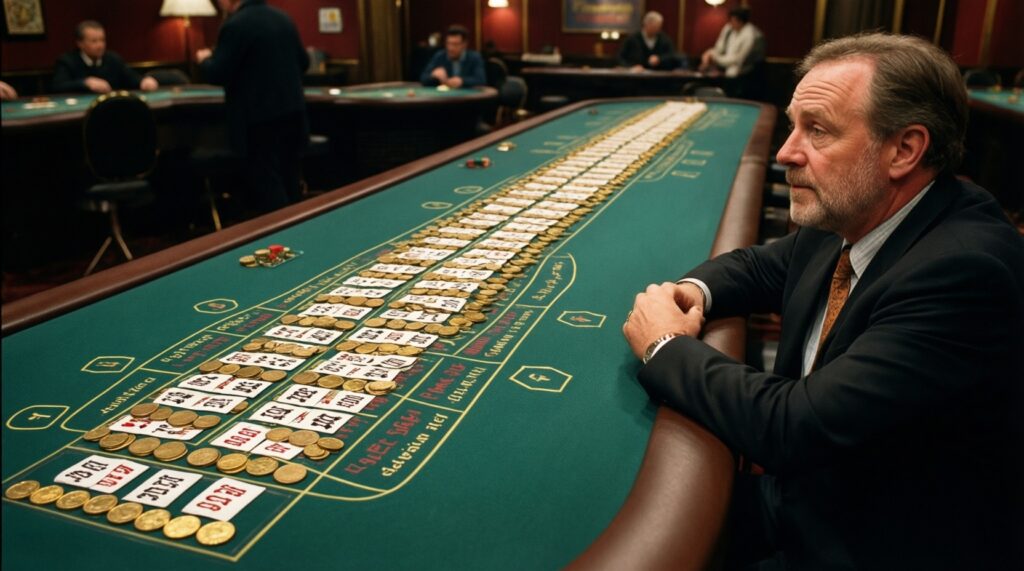
In independent trials, past outcomes don't change the next probability. A streak can continue longer than intuition expects.
Can I chase safely with a strict limit?
If you truly keep a fixed stop-loss and never add funds, you're no longer "chasing" in the escalating sense-you're choosing continued play within a budget. Most failures come from breaking the limit mid-session.
What's the fastest way to stop chasing losses right now?
End the session immediately and put a time barrier (hours or a full day) before you can gamble again. Urges usually decay; access makes them actionable.
Does doubling stakes (Martingale) guarantee recovery?

No. Table limits, bankroll limits, and loss streaks exist, and the strategy concentrates risk into rare but very large losses.
When should I look for problem gambling help?
If you repeatedly gamble longer or larger than planned, borrow to gamble, hide losses, or feel unable to stop, seek help promptly. Early support is a safety measure, not a label.