
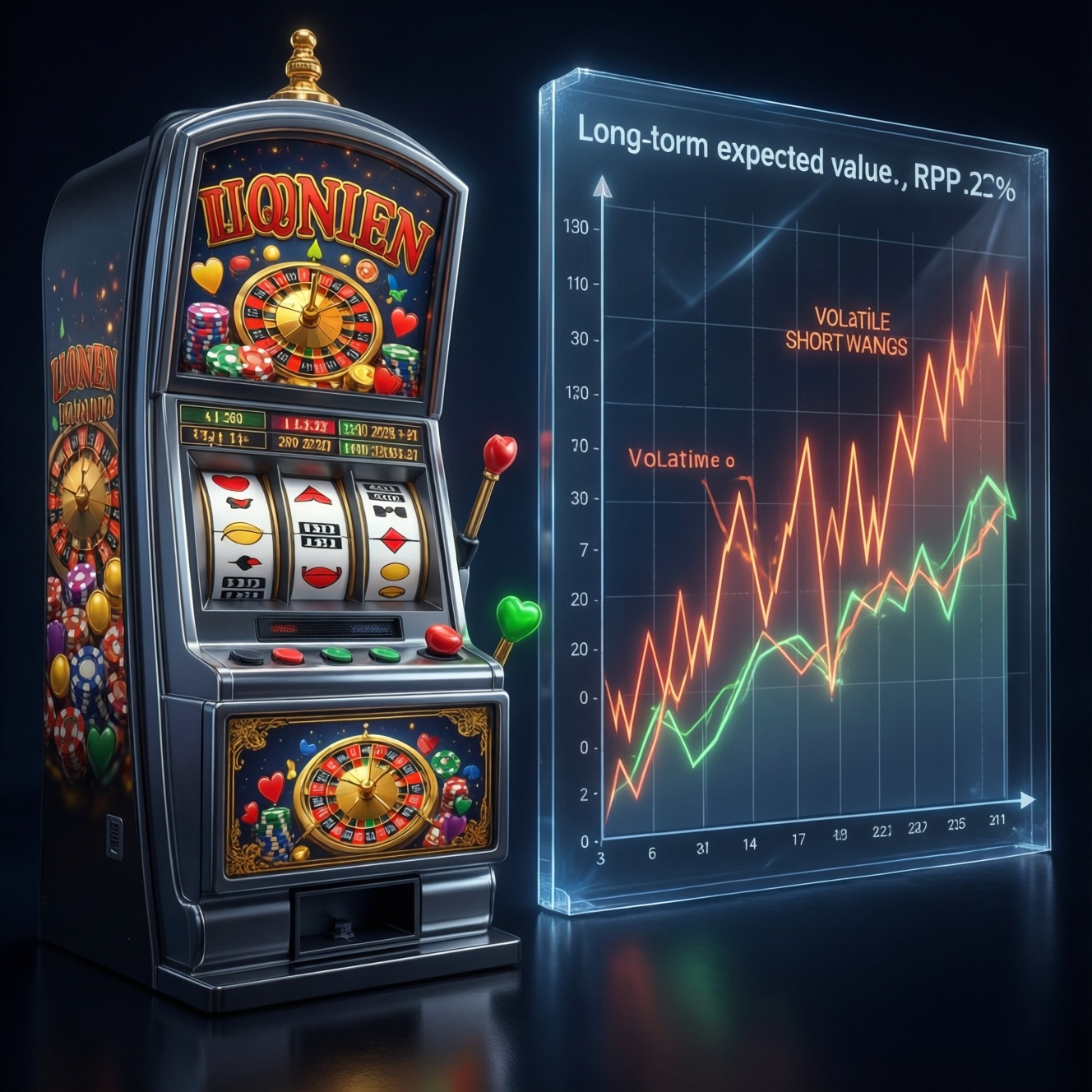
Expected value (EV) in slots is the long-run average net result per spin for a given bet size: EV = (average return) − (stake). In practice, EV in slots is governed by RTP and the payout distribution, while your short-term results are dominated by volatility. Use slot expected value to compare games, not to predict a session.
EV in slots - one-sentence operational summary
- If you want a single number for "average outcome," then use EV per spin: EV = stake × (RTP − 1).
- If two games have the same RTP, then the one with higher volatility will feel more "swingy" even though EV is similar.
- If you're choosing between titles, then compare RTP first, then assess hit frequency and payout distribution for risk.
- If you're planning a session, then treat EV as a baseline and plan bankroll around variance, not around "expected winnings."
- If you're looking for best online slots RTP, then remember RTP is necessary for EV comparison but insufficient for session comfort.
What expected value means for a single slot spin
Slot expected value is the average net result you would get per spin if you could repeat the same spin under the same rules a very large number of times. For a fixed stake s and RTP r (as a decimal), the simplest model is:
EV per spin = s × (r − 1)
If you bet 100 THB on a game with RTP 0.96, then EV = 100 × (0.96 − 1) = −4 THB per spin (average loss in the long run). If you're using "online slots strategy EV" thinking, then this is the core: strategy doesn't change the math unless it changes the rules (bonus terms, comps, constraints).
- If RTP is quoted but your stake varies, then compute EV per stake level (EV scales with stake).
- If you're comparing games, then compare EV at the same bet size (or normalize per 1 THB).
How RTP, hit frequency and payout distribution combine into EV
RTP tells you the average return, but EV in slots is produced by the entire probability model: how often wins occur and how big they are when they occur. In practical terms, slot RTP and volatility are the two levers you feel as "smooth" versus "spiky."
- If RTP increases (all else equal), then slot expected value becomes less negative (or more positive in rare promo scenarios).
- If hit frequency rises but payouts shrink, then EV can stay the same while the experience becomes steadier.
- If jackpots/rare big wins take more of the return, then volatility rises even if RTP is unchanged.
- If a game has many small line wins, then bankroll drawdowns tend to be shallower, but long droughts can still happen.
- If you see "win rate" or "hit rate," then treat it as frequency, not as profitability; EV depends on sizes too.
- If you only have RTP and a volatility label, then use RTP to compare EV and volatility to plan bankroll risk.
Step-by-step calculation: computing EV from paytable and probabilities
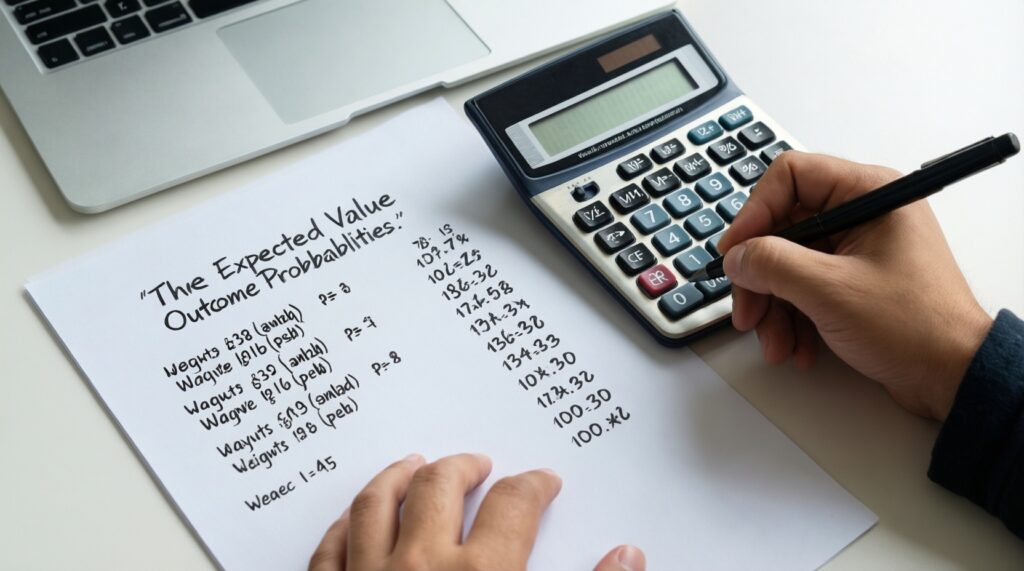
When you have outcome probabilities (from a paytable model, math sheet, or transparent rules), compute EV as a weighted average of net outcomes. General formula:
EV = Σ [ P(outcomei) × net(outcomei) ]
Example (toy model, per 1 THB stake): if P(0 payout)=0.70, P(1×)=0.25, P(5×)=0.05, then average payout multiplier = 0×0.70 + 1×0.25 + 5×0.05 = 0.50, so RTP≈0.50 and EV≈−0.50 THB per spin.
Typical scenarios where this "from probabilities" EV calculation is useful:
- If you're evaluating a bonus buy or feature purchase, then compute EV over the feature's outcome distribution (net of the purchase cost).
- If you're comparing two bet modes (e.g., extra bet, ante bet), then compute EV for each mode separately; mode changes the distribution.
- If you're analyzing a slot with visible prize wheels/collect meters, then treat each stage as an outcome and weight by its probability.
- If a casino promo changes effective returns (cashback, free spins with wagering constraints), then add promo value to EV only if terms make it realizable.
- If you don't have outcome probabilities, then don't "reverse engineer" EV from a short play sample.
- If you do have probabilities, then compute EV on net results (payout minus stake), not gross payouts.
Interpreting EV across sessions: variance, sample size and confidence
EV is a long-run average, but sessions are short-run realizations. The gap between session results and EV is driven by variance (volatility) and sample size (number of spins). If you want to reason correctly about EV in slots, treat EV as a centerline and volatility as the width around it.
- If you play few spins, then your result will mostly reflect variance, not your game's EV.
- If volatility is high, then you should expect longer losing stretches even when RTP is relatively good.
- If you increase spin count, then your average result tends to drift toward EV, but the path can still be rough.
- If your goal is "prove RTP," then you need far more spins than most people play in a session, so don't use personal results as evidence.
- If you're comparing games by feel, then you're mostly comparing volatility and hit frequency, not true slot expected value.
- If you must sanity-check outcomes, then track stake, total return, and number of spins; ignore "near misses."
- If you want less emotional variance, then prioritize lower-volatility distributions over chasing best online slots RTP alone.
Practical use: applying EV to bankroll sizing and session planning
Use EV to set expectations and volatility to set limits. "Online slots strategy EV" becomes practical when you translate it into if-then rules for session control rather than prediction.
- If you choose a higher-volatility slot, then reduce stake size or increase bankroll buffer to avoid forced stops during downswings.
- If your bankroll is fixed, then cap stake so that a normal losing streak doesn't end your session immediately.
- If you're selecting between similar themes, then pick the higher RTP game and the volatility level you can tolerate.
- If you're using bonuses/free spins, then treat them as separate EV items; don't mix promo returns into base-game expectations unless terms are clear.
- If you're trying to "win it back," then stop: chasing increases risk exposure without changing slot expected value.
- If you can't describe your stop-loss and stop-win before starting, then you're not managing variance-only reacting to it.
Common mistakes when using EV to judge slot profitability
The most common error is treating EV like a forecast. Mini-case: two slots both show RTP 96% (same baseline EV), but one is low volatility and the other is high volatility. If you judge "profitability" from a short session, then you'll systematically over-credit the high-volatility game when it spikes and unfairly blame it when it doesn't.
# Session reality (conceptual)
if spins is small:
    observed_return ≈ random_noise(volatility)
else:
    observed_return tends toward RTP

# Decision rule
if comparing games:
use RTP for EV; use volatility for risk; ignore short-term streaks- If you're making a keep/quit decision, then base it on your bankroll plan and volatility tolerance, not on whether you're "due."
Self-check before you use EV to choose a slot
- If you can't state the game's RTP, then you can't estimate EV in slots-find it or pick another title.
- If you only know RTP but not volatility/hit frequency, then assume your session can deviate widely from EV.
- If you're hunting "best online slots RTP," then also pick a volatility level that matches your bankroll and patience.
- If your plan depends on a streak continuing or reversing, then you're not using slot expected value-you're gambling on variance.
Typical confusions and concise clarifications about EV
Is EV in slots the same as RTP?
They're directly related: RTP is the average return as a percentage of stake, while EV is the average net result in currency. If stake is s, then EV = s × (RTP − 1).
Can I have positive slot expected value as a regular player?
For base slots, EV is typically negative because the house edge is built in. Positive EV can exist only when external value (promos, cashback, mispriced offers) outweighs the edge under the actual terms.
Does a higher hit frequency mean better EV?
No. Higher hit frequency can be paired with smaller average wins, leaving EV unchanged or worse. EV depends on the full payout distribution, not just how often something hits.
How does slot RTP and volatility change what I feel in a session?
RTP sets the long-run average; volatility sets how widely results swing around that average. If volatility is high, then short sessions can look amazing or terrible without contradicting RTP.
Are "best online slots RTP" lists enough to pick a game?
They help for EV comparison, but they don't tell you risk. If two games have similar RTP, then volatility and payout structure will dominate your session experience.
Does changing bet size change EV?

It scales EV in currency terms: double the stake and you double expected loss/win per spin at the same RTP. The RTP itself usually doesn't change with stake, but your variance in money terms increases.
What is the simplest online slots strategy EV rule I can follow?
If the rule doesn't change RTP or the payout rules, then it doesn't change EV-so focus on bankroll limits and game selection. Use EV for expectations and volatility for risk control.