

Two slots can share the same RTP yet feel wildly different because RTP is only a long-run average, while payout distribution defines how returns arrive: how often you hit, how big wins cluster, and how rare extreme jackpots are. Distribution drives streaks, bankroll swings, and "dry" sessions-even when the theoretical RTP matches.
Core concept: RTP versus payout distribution
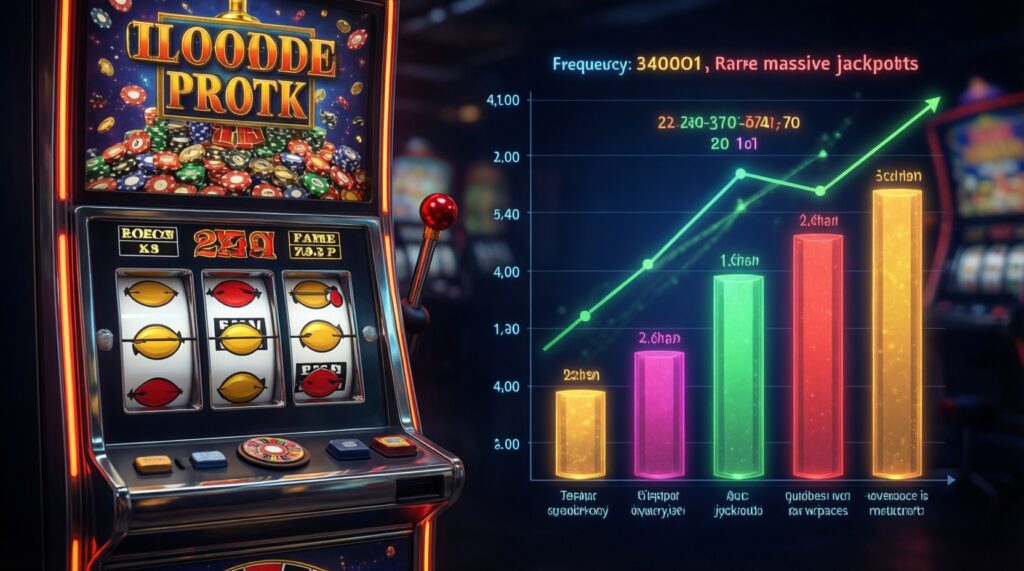
- RTP is an average return over a very large number of spins; it does not describe your next session.
- Payout distribution explains the mix of small, medium, and rare large wins that produce the same average.
- Hit frequency shapes how often you see any win; tail size shapes how brutal or explosive variance feels.
- Two games can both be marketed as สล็อต RTP 96 แตกง่าย ฝากถอนออโต้ yet play opposite: one "chatty" with small hits, one silent then spiky.
- When someone asks เกมสล็อตออนไลน์ RTP เดียวกันทำไมผลลัพธ์ต่างกัน, the answer is almost always distribution + volatility, not "luck patterns."
How RTP is calculated and what it actually represents
Definition. RTP (Return to Player) is the expected value of payouts divided by total wagers over an extremely long run. Conceptually: RTP = E[payout] / bet. It is a property of the math model (paytable + probabilities), not a promise for any session length.
Metric boundary. RTP says nothing about when wins arrive, how long losing streaks can be, or how concentrated value is in bonus features. That "arrival pattern" is the payout distribution, which is why "high RTP" lists such as ตาราง RTP สล็อต ค่ายดัง ล่าสุด can be useful but incomplete.
Example (concise). If a game has RTP 96%, then on average a ฿100,000 total wager would return ฿96,000 in the long run. In a 300-1,000 spin session, the realized return can be far above or below that because the distribution is sampled only a little.
Payout distribution anatomy: hit frequency, cluster size and tail behavior
Definition. Payout distribution is the probability distribution over outcomes (0x, 0.2x, 1x, 10x, 500x, etc.). Two games can have the same mean (RTP) with very different shapes.
Practical metrics to look for. You rarely see the full distribution published, but you can infer it from game feel, volatility labels, bonus structure, and observed win sizes.
- Hit frequency: probability of any win (including tiny "returns"). Higher frequency often feels smoother but can still be negative if wins are small.
- Average win size conditional on a hit: whether hits are mostly 0.2x-0.8x (drip) or often 2x-10x (chunky).
- Cluster size: wins arriving in bursts (e.g., cascades, respins) versus isolated single-line wins.
- Tail behavior: how much of the RTP is "stored" in rare big events (max win, rare bonus multipliers).
- Base/bonus split: proportion of expected value coming from base game versus features (free spins, hold-and-win, buy bonus).
- Near-zero outcomes: games with many 0x and tiny wins create long "dead air," even if RTP is high.
Example (concise). Game A and Game B both target RTP 96%. A may deliver many 0.2x-1x hits (high frequency, thin tail), while B may deliver lots of 0x and occasional 50x-200x spikes (low frequency, fat tail). Same mean, different lived experience.
Mechanics behind identical RTPs producing different streaks
Definition. "Streaks" come from sampling variability plus distribution shape. If most value sits in rare outcomes, you can spin for a long time without touching the part of the distribution that carries RTP.
Where you see it in real play (typical scenarios).
- Bonus-dependent math: two games show the same RTP, but one needs bonus triggers to realize most returns, causing long base-game droughts.
- Different maximum win designs: a slot with a higher max win often implies a heavier tail; same RTP requires lower average returns elsewhere.
- Cascades/cluster mechanics: frequent small cascades can inflate "hit rate" without improving session profitability.
- Multipliers vs extra symbols: multipliers create spiky outcomes; extra symbol mechanics can create steadier mid-sized payouts.
- Buy-bonus optionality: the same RTP headline can hide different RTPs or distributions between normal play and feature purchase modes.
Mini-scenarios: how to use this insight in different situations
- Low bankroll, short session (e.g., 15-30 minutes). Prefer higher hit frequency and smaller tails; otherwise, the "correct" RTP may be unreachable within your sample.
- Chasing big highlights. Pick a fatter-tail distribution (higher volatility) and accept more 0x stretches; don't confuse silence with "rigged."
- Switching providers. Even when you filter for สล็อต RTP สูง สมัครสมาชิก, treat provider-to-provider "feel" as a distribution difference, not only RTP.
- Comparing games from a list. Use RTP tables (like ตาราง RTP สล็อต ค่ายดัง ล่าสุด) as a first filter, then choose by volatility and feature dependence to match your goal.
Example (concise). Two 96% RTP slots: one produces many 0.5x-2x hits; the other produces mostly 0x with rare 100x. In 200 spins, it's plausible to see near break-even in the first and a deep drawdown in the second-without contradicting RTP.
Quantifying variance and volatility for session-level expectations
Definition. Variance measures how spread out outcomes are around the mean. "Volatility" is the player-facing summary of that spread and tail weight. Higher variance means your session result distribution is wider, even if RTP is unchanged.
Upsides of understanding variance (what it helps you do)
- Set realistic session expectations: the mean (RTP) is less predictive than the spread for short runs.
- Align game choice with constraints: bankroll size, time horizon, tolerance for drawdowns.
- Interpret "แตกง่าย" claims better: a slot can feel "easy" because it hits often, not because it's more profitable.
Limits (what variance cannot guarantee)

- No guarantee of a win window: high hit frequency doesn't ensure profit; it can be many small losses.
- Short runs stay noisy: even low-volatility games can underperform for a session.
- Marketing labels vary: "low/medium/high volatility" is not standardized across studios.
Example (concise). If two games both have RTP 96% but one has higher variance, your 500-spin outcomes will be more spread out: bigger ups and deeper downs are more common, even though the average remains 96% in the long run.
Developer levers: RNG, paytables and distribution shaping
Definition. Developers keep RTP constant by adjusting probabilities and paytable awards. The RNG ensures randomness per spin, but the mapping from random numbers to outcomes shapes the distribution.
Common myths and mistakes.
- Myth: "Same RTP means same chances." Same mean does not mean the same probability of any specific payout (e.g., 10x) or the same bonus frequency.
- Myth: "RNG is streak-proof." Random processes naturally produce streaks; distribution tail weight makes them feel harsher.
- Mistake: judging by a tiny sample. A few hundred spins can make a fat-tail game look "dead" or "printing," both misleading.
- Myth: "Auto-withdraw/deposit changes outcomes." Phrases like สล็อต RTP 96 แตกง่าย ฝากถอนออโต้ are operational features; they do not redefine the underlying distribution.
- Mistake: ignoring base/bonus split. Two games with identical RTP can differ mainly in how much return is locked behind rare features.
Example (concise). To keep RTP at 96%, a studio can reduce frequent 1x hits and reallocate value into rarer 50x outcomes. Your average is unchanged; your session swings increase.
Applying distribution insights: player strategies and operator metrics
Mini-case (player choice). The question เล่นสล็อตค่ายไหนดี แจกหนัก โบนัสเยอะ is really two questions: (1) do you want frequent engagement (hits), or (2) are you optimizing for rare big bonus peaks? Choose distribution accordingly, not only "highest RTP."
A practical selection checklist (distribution-first)
- Filter by RTP only as a baseline (avoid very low RTP if disclosed).
- Check volatility label and feature dependence (is most value in bonuses?).
- Decide your target experience: steady hits vs rare spikes.
- Set session rules that match volatility (stop-loss, stop-win, bet sizing).
Operator-side metrics to monitor (what distribution changes affect)
- Session length and churn: long "dead air" distributions can shorten sessions for some segments.
- Bonus-entry rate: low trigger frequency shifts perceived fairness, even at the same RTP.
- Payout concentration: fat tails concentrate returns into fewer players/sessions, changing wallet dynamics.
Pseudo-logic for choosing between two same-RTP slots
if bankroll_small or session_short:
    pick higher_hit_frequency / lower_volatility
else if goal == "big highlight wins":
    pick heavier_tail / higher_volatility
always:
    treat RTP as long-run mean, not a session forecast
Example (concise). With the same RTP 96%, a "steady" distribution might suit a ฿500-฿1,000 session budget, while a fat-tail game is more compatible with a larger buffer because long losing streaks are part of the design.
Short answers about payout distribution effects
If two slots both show RTP 96%, which one is "better"?
Neither is automatically better. If RTP is truly equal, the "better" choice depends on volatility and whether you prefer frequent small hits or rare large spikes.
Why do I lose for hours on a high-RTP game?
High RTP does not prevent long downswings when the distribution has a heavy tail. You may simply not have sampled the rare outcomes that carry much of the expected value.
Does a higher hit frequency mean a higher chance to profit?
No. Many small hits can still net a loss if average win size is low relative to bet; it mainly affects smoothness, not the long-run edge.
Are "RTP tables" enough to pick a slot?
They are a useful starting filter, but they don't describe payout distribution. You still need volatility and feature dependence to predict session feel.
Do deposit/withdraw systems or "auto" modes change RTP or streaks?
No. Payment workflow features don't change the math model; streaks come from randomness and distribution shape, not from cashier mechanics.
Can the same RTP have different RTP in bonus buy mode?
Yes, depending on the game design. Some titles separate normal-play RTP from feature-purchase RTP, which also changes distribution and perceived streakiness.