

Volatility is how much and how fast an asset's price fluctuates, and it often feels like "high risk, high reward" because our brains overweight recent gains, vivid losses, and the thrill of big moves. Understanding volatility means separating price noise from true risk, then using position sizing, timeframes, and exit rules to trade aggressively without letting one swing break your plan.
Core Concepts of Volatility and Investor Behavior
- Volatility describes dispersion of returns (movement), not direction (up or down).
- "High risk, high reward" feels stronger when outcomes are uncertain and feedback is frequent.
- Risk is portfolio-level: a volatile asset can be low-risk in a small size, high-risk in an oversized bet.
- Timeframe matters: intraday volatility can be noise for investors and lethal for leveraged traders.
- Tools like ATR, historical volatility, and implied volatility translate "swingy" into numbers you can manage.
What Volatility Actually Measures (and What It Hides)
If you're asking what is volatility in investing, the practical answer is: volatility measures the variability of returns over a chosen period. A common definition is the standard deviation of returns; higher values mean returns are more spread out around the average.
What it hides: volatility does not tell you whether the next move is up or down, and it does not automatically equal "danger." A stock that trends upward with sharp pullbacks can be high-volatility and still profitable; a slowly declining asset can be low-volatility and still harmful.
One simple formula you'll see is realized volatility as the standard deviation of periodic returns (daily/weekly). The catch is that the number depends on sampling (daily vs weekly) and the lookback window (last 20 days vs last 252 days).
- Define volatility with a timeframe before you act on it.
- Separate "movement" (volatility) from "loss probability" (risk in your sizing).
- Assume volatility regimes change; don't treat one reading as permanent.
Cognitive Biases That Amplify 'High Risk, High Reward' Feelings
Volatility feels emotionally louder than it is mathematically because price changes trigger fast pattern-matching and threat/reward circuits. In practice, this can make you chase "exciting" setups and abandon "boring" risk controls exactly when you need them.
- Recency bias: after a big win/loss, you project the last outcome onto the next trade.
- Availability bias: you overweight memorable stories (a moonshot, a wipeout) over base rates.
- Loss aversion: you hold losers longer to avoid realizing pain, turning volatility into drawdown.
- Overconfidence after streaks: you scale up size because the market "confirms" your skill.
- Action bias: frequent price updates create the urge to intervene, increasing mistakes.
- Gambler's fallacy: you assume a reversal is "due" after a run, ignoring trend strength.
- Write rules when calm; execute rules when stressed.
- Reduce screen time if it increases impulsive interventions.
- Measure performance by process (risk taken, plan followed), not by one outcome.
From Price Swings to Portfolio Impact: Timeframes and Magnitude
Volatility becomes real "risk" when it interacts with your holding period, leverage, and concentration. The same asset can be manageable for a long-term investor and untradeable for a short-term trader depending on how much adverse movement you can tolerate.
- Day trading: small intraday moves matter; spreads, fees, and slippage turn volatility into cost.
- Swing trading (days-weeks): gap risk and news risk can jump over stops during high-volatility regimes.
- Long-term investing: volatility is often drawdown discomfort; the danger is capitulating near bottoms.
- Leveraged products: volatility drag can erode returns even if direction eventually looks right.
- Concentrated bets: one volatile position can dominate portfolio variance and decision-making.
| Where volatility shows up | Main failure mode | Most effective control |
|---|---|---|
| Short holding periods | Overtrading and stop-outs from noise | Wider stops + smaller size, or fewer trades |
| Overnight/news exposure | Gaps that bypass stop levels | Reduce size, hedge, or avoid holding through events |
| Portfolio concentration | One name controls outcomes | Cap position risk; diversify by driver |
| Leverage/margin | Forced liquidation during spikes | Lower leverage; keep cash buffer |
- Match your stop distance to your timeframe's noise level.
- Assume overnight gaps can exceed "normal" daily ranges.
- Track position contribution to portfolio risk, not just P&L.
Practical Risk-Management Tactics for High-Volatility Trades
When you look for high volatility stocks to buy, the safe approach is not "find the wildest chart," but "find a tradable thesis with controlled downside." High volatility can create opportunity (fast mean reversion, large trends), but it punishes sloppy sizing and undefined exits.
Safer steps that scale with volatility
- Volatility-based position sizing: size smaller when ATR/volatility is higher so your per-trade risk stays constant.
- Predefined exit logic: decide stop, time stop, and profit-taking rules before entry.
- Stage entries: split into tranches to reduce timing risk in fast markets.
- Use hard limits: daily/weekly loss limits prevent spirals during volatility spikes.
Limits you must accept (and plan around)
- Stops are not guarantees: gaps and thin liquidity can fill worse than expected.
- Hedging costs money: options protection reduces tail risk but drags returns if overused.
- Signal decay: in high volatility, patterns break more often; expectancy can vanish quickly.
- Psychological load: even "good" risk can be untradeable if it disrupts your execution.
- Risk first: define max loss per trade and per day before scanning tickers.
- Expect worse fills and bigger gaps; size for it, don't hope against it.
- Pick one exit method you can follow under stress, then standardize it.
How Volatility Manifests Across Stocks, Options, Crypto, and Bonds
Volatility is not one thing across markets. The same "big move" can come from liquidity, leverage, macro shocks, or implied-volatility repricing. If you use a crypto volatility trading platform, the operational risks (funding, liquidation, exchange outages) can matter as much as price volatility.
- Myth: higher volatility always means higher expected return. Volatility can be pure noise or crash risk, not a rewarded factor by itself.
- Mistake: treating options like leveraged stock. Options embed time decay and implied volatility; direction alone is not enough.
- Myth: VIX is a tradable forecast. It is a volatility expectation proxy; products tied to it can behave very differently from the index.
- Mistake: ignoring bonds' convexity and rate sensitivity. Bonds can gap on rate decisions; "safe" can still be volatile.
- Mistake: assuming crypto trades 24/7 means safer. Continuous trading can increase fatigue and impulsive execution.
- Identify the driver: liquidity, leverage, macro, or implied volatility repricing.
- For derivatives, manage Greeks and expiration, not just direction.
- Audit platform and liquidation mechanics before sizing up in crypto.
Quantitative Indicators and Simple Tools to Track Volatility
You don't need complex models to be consistent. Start with one realized-volatility tool and one market-implied tool, then tie them to position sizing and exits. If you're researching best volatility index vix trading strategies, treat VIX as a regime indicator for risk-on/risk-off posture rather than a standalone "buy/sell" signal.
Mini-case: You swing trade equities and want a rule that automatically reduces risk when conditions get choppy. Use ATR to set both your stop distance and your position size so that the monetary risk stays stable even when the chart gets wild.
# Inputs
riskTHB = 3000                 # max loss per trade in THB
ATR = ATR_14                   # Average True Range (14)
stopMultiple = 2.0             # stop = 2 * ATR
stopDistance = stopMultiple * ATR

# Position sizing (shares)
shares = floor(riskTHB / stopDistance)

# Optional regime filter
if VIX_or_local_vol_proxy is rising fast:
    shares = floor(shares * 0.7)   # reduce exposure in volatility spikes
For options trading strategies for volatile markets, the same idea applies: define risk in currency first, then select structures whose worst-case loss you can tolerate (e.g., defined-risk spreads rather than naked selling) and size them so one trade cannot dominate your month.
- Pick one metric (ATR or historical volatility) and standardize its settings.
- Connect volatility to sizing and stop distance; don't track it "for curiosity."
- Add a simple regime rule to reduce risk when volatility accelerates.
End-of-article self-check (high-volatility safety)
- Have I defined my timeframe (intraday, swing, long-term) before measuring volatility?
- Is my position size derived from a fixed THB risk, not from conviction or recent wins?
- Do I know my exit conditions (stop, time stop, profit plan) before entry?
- Am I exposed to gaps, leverage, or platform risk that my stop cannot control?
- If volatility doubles tomorrow, do my rules automatically reduce exposure?
Investor Questions on Volatility and Practical Responses
Is volatility the same as risk?
No. Volatility is movement; risk is the chance and size of unacceptable loss given your sizing, leverage, and time horizon.
Should I avoid high volatility stocks entirely?
Not necessarily. Trade or invest only if you can size small enough and define exits so a normal adverse swing does not break your plan.
How do I compare volatility across assets with different prices?
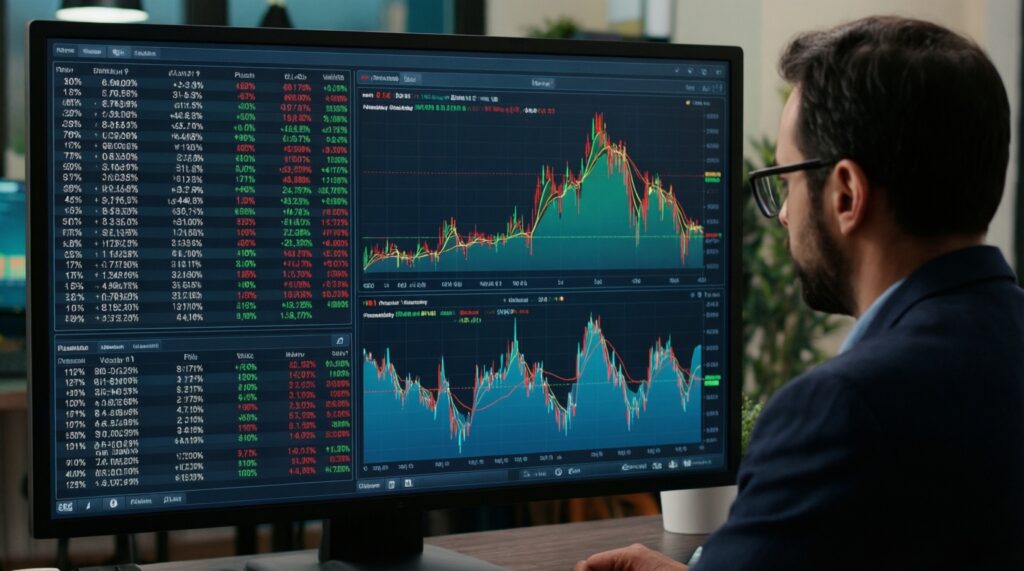
Use percentage-based returns or standardized metrics like historical volatility rather than absolute price changes.
Does a rising VIX mean the stock market will fall?
Not reliably. A rising VIX signals higher expected volatility and stress, which can coincide with declines, but it is not a directional guarantee.
What is the safest way to use options in volatile markets?
Prefer defined-risk structures (spreads) and size by worst-case loss. Avoid selling naked options unless you can absorb rare but large moves.
How can I prevent panic-selling during drawdowns?

Pre-commit to a rebalancing or exit rule and reduce position size to a level where swings are emotionally tolerable. If you can't sleep with it, it's too big.