
Volatility is how widely outcomes swing around an average-price changes in markets or payout swings in gambling. It doesn't tell you direction; it tells you the size and speed of variation. Higher volatility usually rewards disciplined risk controls and adaptive playstyles, while lower volatility favors consistency, tighter edges, and patience with smaller but steadier outcomes.
Core concepts at a glance
- Volatility = dispersion of results, not "up vs down" (trend) and not "risk" by itself.
- High volatility means larger typical swings, more whipsaws, and a higher chance of short-run drawdowns.
- Low volatility means smaller typical swings, fewer shock moves, and slower feedback on whether your edge works.
- Measurement matters: historical volatility, implied volatility, ATR, and range-based measures answer different questions.
- Playstyle impact: tight, aggressive, and passive styles each break in different ways under volatility.
- Control levers: position sizing, time horizon, entry selectivity, and stop/exit logic.
What volatility means in gambling and markets
In plain terms, "ความผันผวน คืออะไร" maps to: how much results fluctuate around what you expect. In markets, it is the variability of price returns; in gambling, it is the variability of outcomes around the game's expected value (EV).
Volatility is not the same as trend. A market can trend strongly with low day-to-day noise, or chop violently with no net direction. It also differs from "risk": volatility describes variability; risk is what that variability does to your goals (ruin, margin calls, forced liquidation, tilt, or missing required cashflow).
Practically, volatility is what determines how "normal" it is to see your strategy look wrong for a while. If you ignore volatility, you tend to overtrade, overleverage, or abandon a valid edge during routine drawdowns.
How volatility is measured and expressed
- Historical volatility (realized): compute returns over a lookback window, then take the standard deviation. A common form is: HV = stdev(returns) × √(annualization factor). This is the backbone of "วิธีวัดความผันผวนของหุ้น".
- Implied volatility: inferred from option prices; it represents the market's priced expectation of future variability, not a guarantee.
- VIX concept: if you ask "ดัชนีความผันผวน VIX คืออะไร", it's a widely cited implied-volatility index derived from S&P 500 options-often treated as a sentiment/fear gauge, but best understood as priced variability.
- ATR (Average True Range): a range-based measure (in price units) useful for stop distance and position sizing; it answers "how far it tends to move," not "how variable returns are."
- Volatility regimes: volatility clusters; calm periods and turbulent periods tend to persist, so your settings (size, stops, cadence) often need regime-aware defaults.
- Timeframe dependence: volatility is different on 5-min, daily, and weekly charts; the "right" measurement matches your holding period.
How volatility shapes tight, aggressive and passive playstyles
Volatility changes which mistakes are most expensive and which strengths actually show up in P&L. Typical scenarios:
- Tight style under high volatility: you may get stopped out repeatedly (death by a thousand cuts) unless your stop logic and position size account for wider routine swings.
- Aggressive style under high volatility: the edge can scale fast, but only if leverage is capped; otherwise a single outlier move can erase weeks of gains.
- Passive/slow style under high volatility: fewer decisions sounds safer, but gap risk and overnight moves can dominate, especially around events.
- Tight style under low volatility: works well when spreads/slippage are small and the market rewards precision; downside is "not enough movement" to pay for costs.
- Aggressive style under low volatility: tends to overtrade (forcing action) and bleed to fees, spreads, and false signals.
| Volatility regime | What breaks first | What tends to work better | Main control knob |
|---|---|---|---|
| High volatility | Overleverage, tight stops, emotional reactivity | Selective entries, wider but fewer stops, smaller size, faster de-risking | Position sizing + stop distance |
| Low volatility | Overtrading, impatience, costs dominating | Range/mean-reversion discipline, cost-aware execution, patience | Trade frequency + cost control |
Bankroll sizing and time-horizon consequences
- Higher volatility demands more buffer: you need extra bankroll (or smaller risk per trade/spin) to survive normal drawdowns without changing behavior.
- Time-to-validate increases: the noisier the outcomes, the longer you need before judging whether you're skilled or just lucky/unlucky.
- Risk-of-ruin goes up nonlinearly: small increases in per-bet risk can sharply raise the chance of catastrophic loss in high-vol regimes.
- Short horizon + high volatility increases the chance of being forced to exit at the worst moment (margin, liquidity needs, tilt).
- Longer horizon lets variance average out, but only if you can keep sizing stable and avoid "strategy hopping."
- Practical takeaway: choose a horizon where your stop logic, funding, and psychology can tolerate routine swings.
Tactical adjustments for high-volatility vs low-volatility games
- Myth: "High volatility = easy profits". Reality: it's easier to make big gains and big mistakes; "กลยุทธ์เทรดหุ้นช่วงตลาดผันผวน" is mostly about risk control, not prediction.
- Stop placement error: using the same tight stop distance in all regimes causes churn in high volatility; use a volatility-aware distance (often ATR-based) and reduce size accordingly.
- Sizing error: keeping the same position size when ATR/HV expands silently increases your risk per trade.
- Signal frequency trap: in low volatility, chasing micro-moves increases costs; increase selectivity or widen targets.
- Instrument mismatch: if you're asking "เทรด Forex ผันผวนสูง ควรใช้อะไรดี", the practical answer is usually: use smaller leverage, volatility-based sizing, and orders/exits that account for spread widening and fast spikes rather than relying on fixed pip stops.
Concrete examples with simple calculations
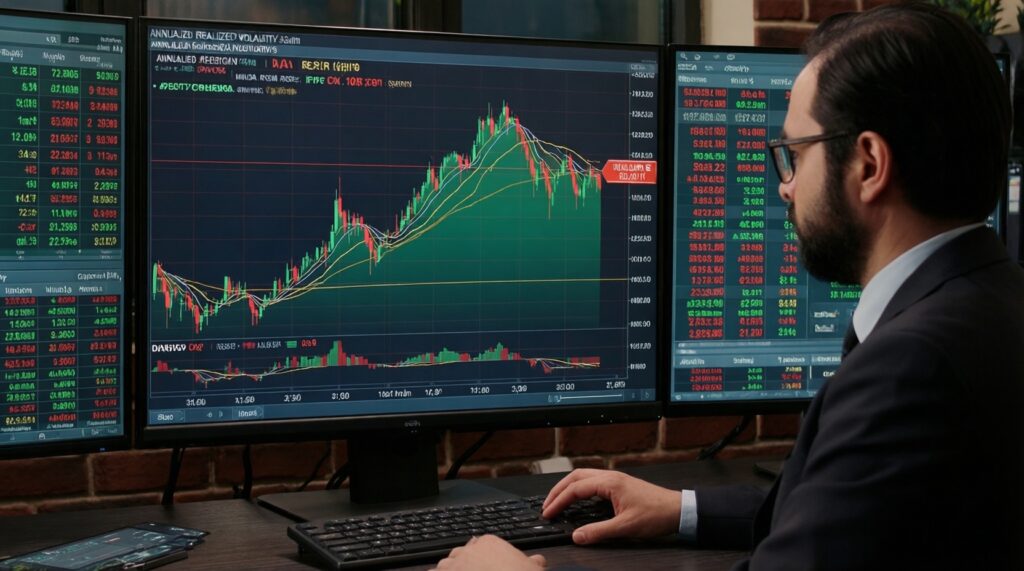
Mini-case (markets): You want to compare two stocks or two time periods. Take daily close-to-close returns (simple or log), compute the standard deviation over the same window, then annualize with √252 (for daily) to get a comparable realized-vol figure. The higher value means you should expect larger routine swings and size down to keep risk constant.
A short algorithm to sanity-check your volatility result
- Match the window to your holding period: intraday traders measure intraday; swing traders measure daily/weekly.
- Compute returns consistently: same method (simple or log) for all comparisons.
- Cross-check with a range metric: compare your realized volatility reading with ATR; both should tell a coherent story (more movement should show up in both).
- Check for event contamination: if one earnings/news day dominates the window, note it separately instead of treating it as "normal."
- Verify the implication: if volatility doubled, your risk-per-trade should roughly halve (all else equal) when using volatility-based sizing.
Simple sizing pseudo-formula (risk-based)

If you risk a fixed fraction of bankroll per trade, you can tie size to volatility:
- Position size ≈ (Risk budget per trade) ÷ (Stop distance)
- Set Stop distance using a volatility proxy (e.g., a multiple of ATR). When volatility rises, stop distance rises, so size must fall to keep risk stable.
Self-checklist before you trade a volatile regime
- I can explain whether today is high or low volatility using the same metric (HV, ATR, or implied) each time.
- My position size automatically decreases when my volatility metric increases.
- My stop/exit logic is volatility-aware (not a fixed distance copied across regimes).
- I have a time horizon long enough to evaluate the strategy without panic changes.
Practical concerns and quick answers
Is volatility the same as risk?
No. Volatility describes variability; risk is the chance variability prevents your objective (ruin, margin call, missing cash needs, or abandoning the plan).
Does higher volatility mean the market will go down?
No. Volatility is directionless; it can rise in both rallies and selloffs.
Which is better for tight trading: high or low volatility?

Usually low to moderate volatility is friendlier for tight execution. In high volatility, tight stops and fixed sizing tend to fail unless adapted.
How do I connect "วิธีวัดความผันผวนของหุ้น" to an actual trade decision?
Use the volatility measure to set stop distance and position size. The goal is constant risk per trade, not constant number of shares.
What does "ดัชนีความผันผวน VIX คืออะไร" tell me in practice?
It summarizes priced expected variability for a major equity index, not your specific stock. Treat it as regime context, then size and select trades accordingly.
If I'm in "เทรด Forex ผันผวนสูง ควรใช้อะไรดี", what's the first change to make?
Reduce leverage and move to volatility-based sizing (ATR or realized vol). Then widen stops only if size is reduced so your monetary risk stays capped.