

Variance is the natural "swinginess" of gambling outcomes around the expected value, and it explains why real sessions can look wildly different even when the rules and odds do not change. In practice, variance determines how big and how long upswings and downswings can feel, especially in slots and short sessions, where randomness dominates.
Core Concepts of Variance in Player Outcomes
- Variance describes dispersion of results, not whether a game is "good" or "bad."
- If the sample is small, then outcomes are driven more by variance than by expectation.
- If payoffs are "spiky" (rare big wins), then variance and perceived volatility increase.
- Standard deviation is the practical scale of typical swings; variance is its squared form.
- If you cannot separate luck from signal, then you will misread streaks as "patterns."
What Variance Means for Real-World Player Sessions
When people ask variance คืออะไร การพนัน, the useful definition is: variance is the random spread of session results around the mathematical expectation, created by payout size and hit frequency. It is about how outcomes fluctuate, not about strategy quality or fairness by itself.
In real play, sessions are short, decisions are noisy, and results are path-dependent (your bankroll can end a session early). If a game has rare large payouts, then two players with identical bet sizes can see opposite stories: one runs into a high payout and looks "skilled," the other doesn't and feels "cursed."
Boundary: variance does not change the long-run expected value; it changes the journey. If you evaluate performance from a handful of sessions, then you are mostly measuring variance, not edge.
Mathematical Foundations: Variance, Standard Deviation, and Distribution Shape
- Expectation (mean): if outcomes are X with probabilities, then E[X] is the average result per bet in the long run.
- Variance: Var(X)=E[(X−E[X])^2]. If outcomes sit far from the mean often, then variance grows.
- Standard deviation: SD(X)=√Var(X). If you want an interpretable "typical swing size," then use SD, not variance.
- Why "distribution shape" matters: if payoffs are heavy-tailed (many small losses, rare big wins), then variance is high even if the mean is the same.
- Session aggregation: if a session is S = X₁+...+Xₙ, then (with independence) Var(S)=n·Var(X) and SD(S)=√n·SD(X). If you play longer, then total swings grow, but swings per bet stabilize.
- Practical note for casinos: when people request สูตรคำนวณ variance และ standard deviation คาสิโน, what they usually need is SD scaling with sample size to set limits and communicate "normal" fluctuation bands.
Comparative metrics you can use (and when)
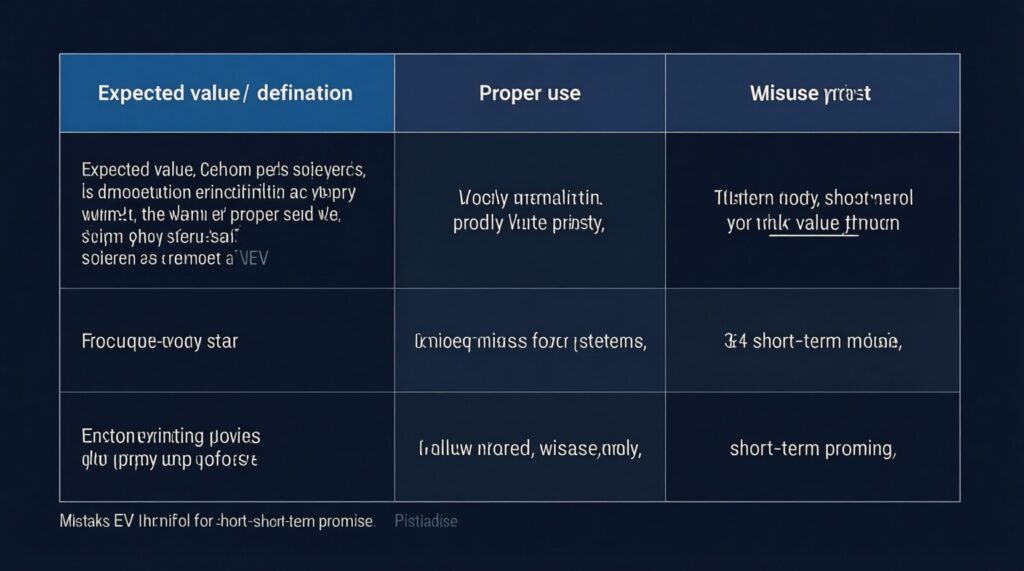
| Metric | What it tells you | Use it when... | If you misuse it... |
|---|---|---|---|
| Expected value (EV), E[X] | Long-run average outcome per bet | You need the baseline to judge whether a swing is above/below expectation | If you treat EV as a short-session promise, then you will think the game is "rigged" during normal downswings |
| Variance, Var(X) | Dispersion in squared units | You are doing modeling or comparing distributions mathematically | If you compare variances without context, then you lose interpretability (squared money units) |
| Standard deviation, SD(X) | Typical swing size in the same units as outcome | You communicate risk bands and "normal volatility" to players/ops | If you ignore SD scaling, then you will under/overestimate session risk |
| Hit frequency & payout multiple profile | How often wins happen and how "spiky" they are | You analyze slot feel and volatility perception | If you focus only on hit rate, then you miss that rare jackpots dominate variance |
| Drawdown (peak-to-trough) | Worst observed decline during a session/run | You set stop-loss/limits and tilt-prevention rules | If you judge skill by drawdown alone, then you confuse variance with decision quality |
Sample Size, Session Length, and the Law of Large Numbers
If you increase the number of independent bets, then the average outcome per bet tends to move closer to the expectation (law of large numbers). That does not mean you "avoid" swings; it means swings become more predictable relative to volume.
- Short slot sessions: if the session is tens to low hundreds of spins, then กลยุทธ์รับมือช่วงขึ้นลงของผลลัพธ์ เกมสล็อต should assume variance dominates the story; do not infer anything from a brief hot/cold run.
- Table-game bursts (few hands/rounds): if you judge a strategy from a small sample, then you are primarily measuring noise; require a larger sample before changing approach.
- Promo/bonus hunting: if the edge relies on rare bonus triggers, then variance is inherently high; plan bankroll and time horizon accordingly.
- Comparing two games: if you compare games by "how often I win," then you may pick the wrong risk profile; compare payout distribution and SD-like measures.
- Stopping rules: if you stop when bankroll hits zero, then your observed results are biased by "ruin"; treat bankroll as part of the process, not a neutral observer.
Practical Impact: Streaks, Tilt, and Perception Bias
- If you see a long losing streak, then it is not automatically evidence of worsening odds; it can be a normal cluster in a high-variance distribution.
- If your last few outcomes are extreme, then your brain will overweight them (recency bias) and you will mis-estimate the real risk.
- If you increase stake sizes after losses, then variance translates into larger bankroll swings and higher ruin risk.
- If you interpret "near misses" as signals, then you will overplay; near misses often change emotion more than probability.
- Upside of understanding variance: if you can label a swing as "within expected fluctuation," then you make calmer bankroll and stopping decisions.
- Limitation: if you lack the game's payout distribution (or a reliable proxy), then you can describe swings qualitatively but not bound them precisely.
- Operational constraint: if players only track wins/losses and not bet volume, then any variance discussion will sound abstract; tie it to number of spins/hands.
- Behavioral constraint: if tilt is present, then the practical variance becomes "variance + bad decisions"; manage both.
Measuring and Visualizing Swings: Tools and Metrics
- If you rely on "I was up/down today" without volume, then you are measuring mood, not variance; always record number of bets and average stake.
- If you assume a single big win defines the game, then you will underestimate downswings; one outlier can dominate short-run results.
- If you compare volatility across games using only hit frequency, then you will miss tail risk; include payout multiples (rare large hits drive variance).
- If you do calculations on session totals only, then you lose portability; normalize per bet (or per 100 spins/hands) to compare fairly.
- If you want repeatable analysis, then use a โปรแกรมคำนวณ variance และความผันผวน สำหรับผู้เล่นพนัน or a spreadsheet to simulate distributions; otherwise you will anchor on a few memorable sessions.
Strategies to Manage Variance: Design Decisions and Player Communication
If your goal is to reduce painful swings, then you must act on exposure (stake sizing, limits, session length) and on interpretation (how you frame outcomes). For players, the most direct lever is bankroll discipline; for operators/designers, it is expectation-setting and risk controls.
If..., then... recommendations (player-side)

- If you cannot tolerate long downswings, then choose lower-volatility products (more frequent smaller wins) and avoid chasing rare "spike" payouts.
- If you want to จัดการ bankroll ลดความเสี่ยงจาก variance, then set a fixed unit size (e.g., 1 unit) and cap stakes per bet; do not scale bets based on recent outcomes.
- If your session ends because bankroll hits zero, then shorten sessions or lower unit size; bankroll exhaustion is how variance becomes irreversible.
- If you feel tilt after a streak, then predefine a cool-down rule (time break or hard stop) before increasing volume.
If..., then... recommendations (operator/design and communication)

- If your game has high volatility, then explain it explicitly in product UX ("rare large wins, long dry spells") to reduce false accusations and churn.
- If players commonly misread streaks, then show volume-aware summaries (spins played, net per spin) rather than only net profit.
- If you run promotions tied to rare triggers, then communicate realistic variance: "most sessions will not hit the feature; occasional sessions will."
- If you need internal controls, then set limits using SD-like scaling: as volume increases, expect wider absolute swings even if average stabilizes.
Mini-procedure (pseudo-logic) for bankroll rules
If (unit_size * planned_bets) is a meaningful fraction of bankroll
  then reduce unit_size or planned_bets
If current_drawdown >= pre-set max_drawdown
  then stop session (no stake increase)
If emotion_score (tilt) is high
  then enforce cooldown and prohibit "chasing"
Self-check before you interpret a swing
- If you did not record bet count and average stake, then do not conclude anything from the session result.
- If your conclusion depends on one jackpot/big hit, then label it as an outlier-driven session.
- If you changed stake sizing mid-session, then separate "variance" from "decision-driven risk."
- If you are evaluating a game/strategy, then require a larger sample before re-optimizing.
Practical Questions on Interpreting Outcome Swings
Is variance the same as "risk" in gambling?
Variance is a mathematical driver of risk (outcome dispersion). Practical risk also includes bankroll limits and behavior (e.g., chasing), so variance is necessary but not sufficient to describe real-world danger.
Why can two players get opposite results on the same slot in the same day?
If the payout distribution is spiky, then short sessions are dominated by whether a rare event occurred. Same rules plus different random paths produces very different outcomes.
Does a longer session guarantee I will recover losses?
No. If you play longer, then average results per bet tend to stabilize, but total swings can still be large and bankroll can be exhausted before "averaging out."
What should I track to understand my swings better?
If you track only net profit, then you miss context. Track bet count, average stake, and the biggest win/loss events to relate outcomes to volume and tail events.
Is standard deviation more useful than variance for players?
Yes, usually. If you need an interpretable swing size in money units, then standard deviation is more actionable than variance (which is squared units).
How do I reduce the impact of variance without changing the game?
If you lower unit size and cap session length, then you reduce bankroll exposure to unavoidable swings. If you add stop rules, then you prevent tilt from amplifying variance.