

A rational stop-loss and stop-win plan defines exactly where you exit when you are wrong and where you take profits when you are right, using volatility and position sizing instead of guesswork. This reduces damage from sudden swings and prevents winning trades from turning into losses. You will set distance with ATR/structure, then convert it into size and exit rules.
Core principles for rational stop placement
- Decide risk first (e.g., 0.5%-1% of account per trade), then derive position size from the stop distance.
- Place stops where the trade thesis is invalidated (structure), not where you "feel pain."
- Calibrate distance to volatility (e.g., 1.5-3.0× ATR) so normal noise does not knock you out.
- Predefine stop-win (profit taking) as a rule set, not a single number, to manage different market regimes.
- Use the same unit across decisions: price points, % move, or ATR multiples-don't mix casually.
- Change stops only for a documented reason (new swing, time stop, scheduled news), never impulsively.
Why stop-loss and stop-win are non-negotiable in volatile markets
- Best fit for: leveraged products, crypto/FX, small-cap equities, and any setup where gaps/spikes are realistic.
- Stop-loss is essential when: you cannot monitor continuously, spreads widen at certain sessions, or news risk exists.
- Stop-win matters when: your edge is timing-based (breakouts/mean reversion) and reversals are fast.
- When you should NOT place a tight hard stop: illiquid instruments with frequent wicks, or strategies that require wide "room" (then reduce position size and use wider, thesis-based invalidation).
- When you might avoid stop-win targets: long-term trend following-use trailing rules instead of fixed take-profit.
Quantifying volatility: ATR, true range and recent price structure
- Chart + timeframe: pick your execution timeframe (e.g., 15m for intraday, 4h/daily for swing) and keep it consistent.
- ATR indicator: use ATR(14) as a baseline; read it in price units (e.g., THB, points, pips).
- True range awareness: confirm if the instrument gaps; if gaps are common, stops must be wider and size smaller.
- Recent structure: mark the last swing high/low, consolidation range, and obvious liquidity levels (prior day high/low).
- Execution constraints: know typical spread/commission and minimum tick/lot size so your stop is not inside costs.
- Optional support: use alerts or an API/broker bracket orders as a "เครื่องมือช่วยตั้ง stop loss อัตโนมัติ" alternative to manual monitoring.
Determining stop-loss distance: entry context, max drawdown and position sizing
- Confirm your entry trigger and invalidation point (structure).
- Pull current ATR(14) on the same timeframe as your setup.
- Decide a hard max account risk per trade (example below uses 1%).
- Choose order type: market (more slippage risk) vs limit (fill risk) vs stop entry (breakout).
-
Define what "wrong" means on the chart.
Place the stop beyond the level that breaks your thesis (e.g., below the last swing low for a long).- Example: Long at 100.00; last swing low is 98.80 → structural invalidation is below 98.80 (not at 99.50).
-
Apply a volatility buffer (ATR multiple).
Add room so normal noise doesn't hit your stop; common starting points are 1.5× to 3.0× ATR depending on wicks.- Example: ATR(14)=0.60. Buffer=2×ATR=1.20. If structure stop is 98.80, buffered stop could be 98.80 − 1.20 = 97.60 (if that still aligns with your thesis).
-
Convert stop distance into position size (risk-first).
Position size = (Account risk per trade) ÷ (Stop distance in price × value per point).- Example: Account 200,000 THB, risk 1% = 2,000 THB. Entry 100.00, stop 97.60 → distance 2.40. If 1.00 price move equals 1 THB per unit, size ≈ 2,000 ÷ 2.40 ≈ 833 units (round down).
-
Set the order as a bracket (stop-loss + profit logic).
If your platform supports it, attach stop-loss immediately to reduce operational risk; then define the initial stop-win rule (next section).- This is the practical version of "ตั้งค่า stop loss อย่างไร": stop placement first, size second, bracket order third.
-
Stress-test against common adverse moves.
Check if a typical intraday swing (e.g., ~1×ATR) would stop you out too often; if yes, widen stop and reduce size.- Rule: never widen the stop without lowering size to keep the same account risk.
Designing stop-win rules: tiered exits, probability weighting and time horizons
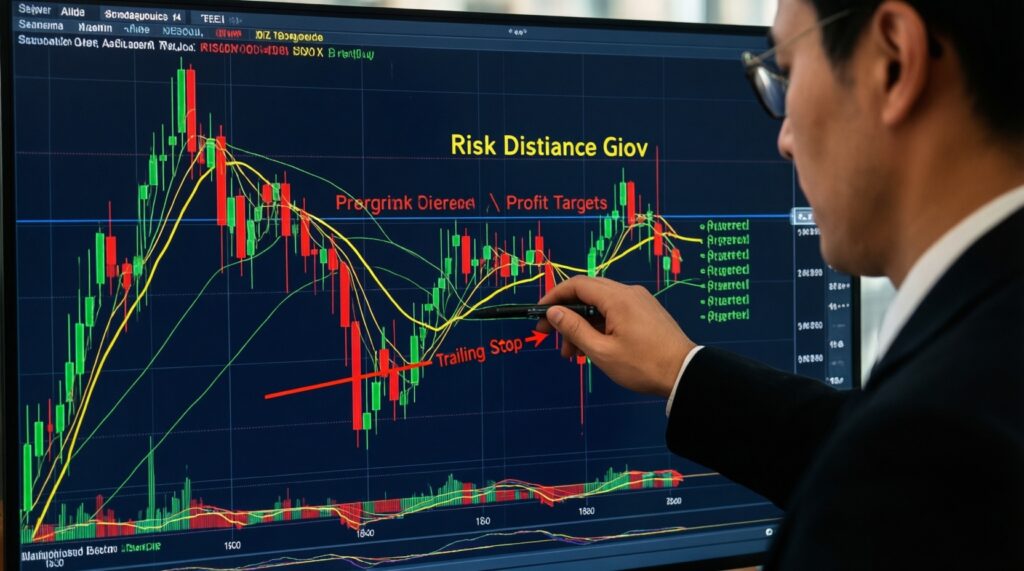
- Define R: 1R = your stop distance (e.g., 2.40). This keeps profit-taking consistent.
- Tiered exits: take partial profits at 1R and 2R, then trail the remainder (example: 50% at 1R, 25% at 2R, 25% trailing).
- Time horizon rule: if price doesn't move in your favor after N candles (e.g., 10-20 on your timeframe), reduce exposure or exit ("time stop").
- Structure-based profit: target the next resistance/support zone first; only then consider extensions (e.g., prior day high).
- Volatility-based take-profit: if ATR expands sharply, shift to trailing (fixed targets become less reliable).
- Break-even logic: move stop to entry only after a clear condition (e.g., close above 1R or a new swing forms), not immediately after entry.
- Practical mapping: this is "วิธีตั้ง stop loss และ take profit" as a rule set: stop defines 1R, then profit actions reference 1R/structure/time.
Pre-trade checklist: concrete thresholds and execution-ready parameters
- Stop too close to spread: if your stop distance is near typical spread/fees, it's noise-driven-widen stop or skip.
- Risk not capped: if you cannot state "I lose X THB if stopped," you're not ready to enter.
- Mixing units: stop in %, take-profit in points, sizing in "lots by feel" leads to inconsistent outcomes-standardize to R and price distance.
- Stop behind a weak level: placing a stop exactly at a swing low/high often invites stop hunts-use a buffer (ATR or ticks) beyond it.
- Ignoring calendar risk: if major news is scheduled, choose: reduce size, widen stop, or wait-don't keep the same stop and hope.
- No stop-win definition: without a rule for profits, winners can revert; define at least one partial take and one trailing condition.
- Platform execution not tested: verify order type (stop-market vs stop-limit), slippage behavior, and whether bracket orders are supported (a common "เครื่องมือช่วยตั้ง stop loss อัตโนมัติ" feature).
- Emotional editing: changing stops because you feel uncomfortable breaks the plan-only adjust per your documented management rules.
Dynamic management: moving, widening or tightening stops around news and swings
- Trailing by structure (useful in trends): move stop under higher lows (long) / above lower highs (short) after a confirmed swing forms; do not trail inside the current swing.
- ATR trailing (useful in fast markets): stop = current close − k×ATR (long) with k commonly 2-4; keeps distance adaptive as volatility changes.
- Event-risk freeze (useful around news): stop stays fixed; reduce position size before the event or close partial. Avoid widening just because news is near.
- Time-based exit (useful in range/mean reversion): if price fails to reach 0.5R-1R within your planned window, exit to free capital and avoid churn.
Quick clarifications and common implementation doubts
stop loss คืออะไร and how is it different from "just selling when it drops"?
stop loss คืออะไร: a pre-set exit level where the trade thesis is invalidated. It's different because it is defined before entry and ties directly to position sizing, not to emotions after price moves.
stop win คืออะไร and is it the same as take-profit?
stop win คืออะไร: a rule to secure profits, often via partial exits and/or trailing stops. A simple take-profit is one version; a stop-win plan is broader and adapts to volatility and time.
How far should my stop-loss be in ATR terms?
Start testing with 1.5-3.0× ATR on your setup timeframe, then validate against recent wicks and structure. If you need a wider multiple, reduce size to keep the same account risk.
When should I move my stop to break-even?
Only after a condition that proves progress (e.g., a close beyond 1R or a new swing in your favor). Moving to break-even too early often turns good trades into repeated small losses.
What's the simplest "ตั้งค่า stop loss อย่างไร" workflow on a platform?

Define thesis invalidation on the chart, add an ATR buffer, calculate size from your fixed risk, then place a bracket order with stop-loss attached immediately. This minimizes manual errors.
Do I need automated tools ("เครื่องมือช่วยตั้ง stop loss อัตโนมัติ")?
They help if you can't monitor continuously or you trade multiple positions. Use them only after testing order types (stop-market vs stop-limit) and confirming how your broker handles gaps and slippage.