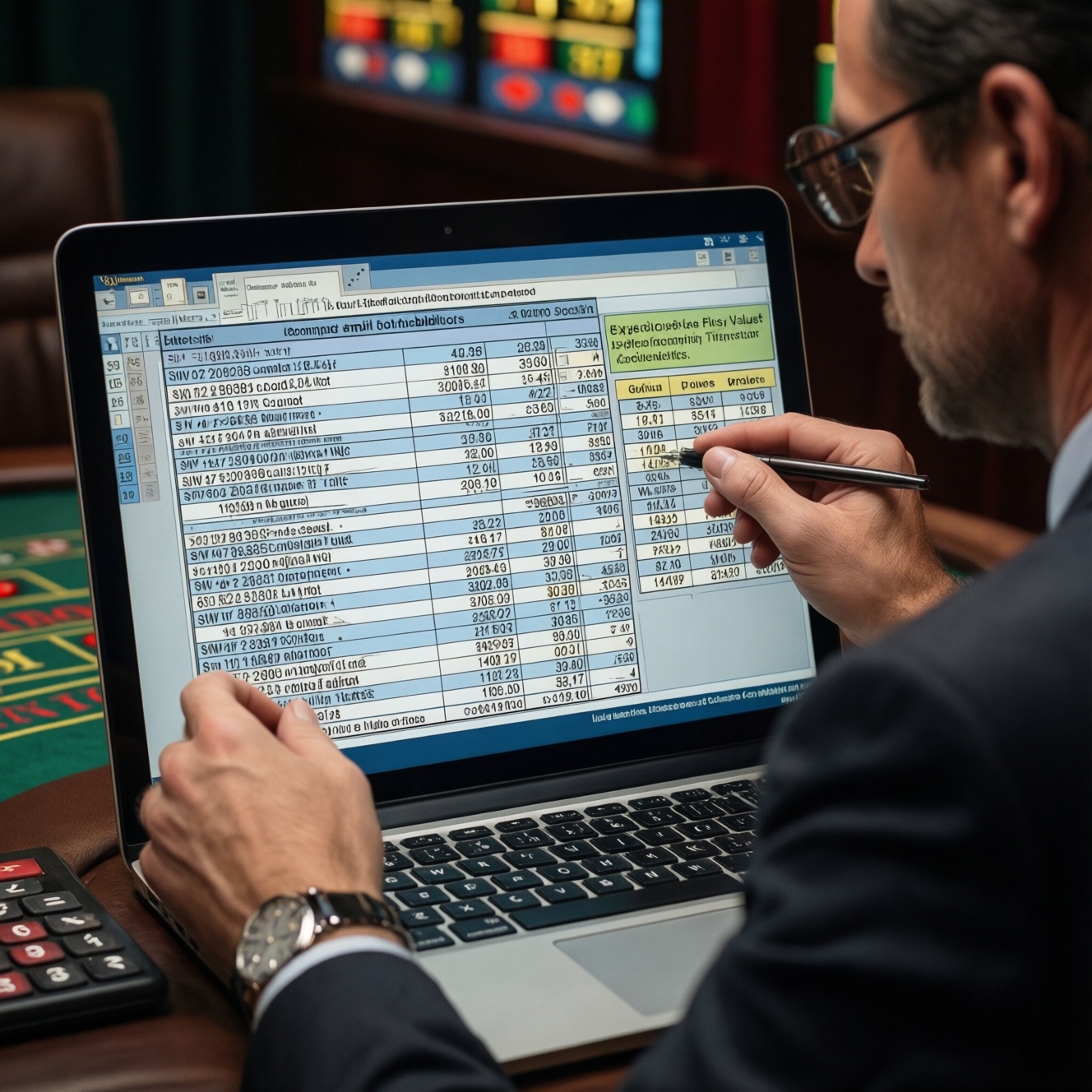

To convert a bankroll into an "expected time to play" for entertainment, pick a game pace (rounds per hour), choose a conservative loss-rate assumption, set a fixed bet size, then compute a burn-rate and divide your session bankroll by it. This creates a realistic time budget, plus stop-loss/time rules so you don't chase losses.
Core principles for converting bankroll into playtime
- Separate trip bankroll from session bankroll; never risk the full amount in one sitting.
- Estimate time from loss rate × bet size × speed, not from "luck" or short-term results.
- Pick bet sizes that survive variance; entertainment time requires smaller bets than profit-seeking.
- Use hard controls: stop-loss, time cap, and a no-reload rule.
- Recalculate only at planned checkpoints (e.g., every 30-60 minutes), not after every swing.
Estimating affordable session length from your total bankroll
This approach fits players who want a predictable entertainment session and are willing to cap losses. It works best when you can keep bet sizing stable and you can estimate game speed (hands/rounds/spins per hour).
Do not rely on "expected time" budgeting if you: (1) plan to increase bets when losing, (2) can't stop reloading funds, (3) are playing while stressed/tired/intoxicated, or (4) need winnings to cover real expenses.
Modeling expected time to play: win-rate, variance and bet sizing
You'll need a few inputs and simple tools. If you prefer automation, look for a casino session bankroll calculator or build your own sheet as a personal expected time to play calculator.
- Session bankroll (B): the maximum you allow yourself to lose this session (in THB).
- Base bet (b): your default stake per round/hand/spin.
- Speed (S): rounds/hands/spins per hour for your play style (auto-play vs manual changes this a lot).
- Loss-rate assumption (L): your estimated average loss per unit bet (e.g., L = 0.03 means ~3% of total wagered over time). Use a conservative value you're comfortable with.
- Volatility buffer (V): extra cushion for swings; use it by budgeting only a fraction of your session bankroll for "time math."
- Tools: phone timer, notes app, and either a spreadsheet or a basic casino bankroll management calculator.
Core model (entertainment-focused): Burn rate per hour ≈ b × S × L. Expected time (hours) ≈ B / (b × S × L). Variance doesn't change the long-run burn rate, but it can end your session early, so you must add a buffer via smaller bets or a lower usable bankroll.
Practical session plans: templates for low, medium and high risk

-
Set the session boundary (B) and split it. Decide a session-loss cap in THB you can comfortably spend as entertainment, then split it into 2-4 "blocks" to reduce the chance of one bad swing ending the whole outing.
- Example: B = 2,000 THB → 4 blocks of 500 THB; stop for a reset between blocks.
-
Choose your risk template (bet sizing rule). Pick one and follow it strictly; this is your gambling bankroll management strategy for the night.
- Low risk (max playtime): b = 0.25%-0.5% of B per round; no increases after losses.
- Medium risk (balanced): b = 0.5%-1% of B; optional small increases only after breaks/checkpoints.
- High risk (shorter, swingy): b = 1%-2% of B; accept that expected time can collapse quickly.
- Estimate speed (S) for your exact setup. Time 5 minutes and count rounds/hands/spins, then scale to an hourly pace. Use the pace you actually play at (chatting, ordering drinks, and side bets all change S).
-
Pick a conservative loss-rate (L) and add a buffer. Select L as a personal planning assumption (higher L = shorter expected time). Then choose a buffer by only using part of B for time math.
- Practical buffer: "usable bankroll" = 60%-80% of B for the expected-time calculation; keep the rest as variance cushion.
- Compute expected time and pre-commit to stop rules. Calculate time = usable bankroll / (b × S × L), then set (a) a hard stop-loss = B, (b) a time cap, and (c) a no-reload rule. This is the operational part of how to budget a casino session.
- Run checkpoints, not constant recalculations. Every 30-60 minutes (or after each bankroll block), check: current bankroll, time spent, and whether rules are still intact. If not, end the session or downshift to the low-risk template.
Fast mode: 60-second bankroll → playtime setup
- Pick B: your session entertainment spend (loss cap).
- Pick b: 0.5% of B for a balanced session.
- Measure S: count rounds for 5 minutes, multiply by 12.
- Assume L + buffer: choose a conservative L; use only 70% of B in the formula.
- Lock rules: stop-loss = B, time cap, and no reloads.
Using tables and calculators to map bankroll → minutes/hands/rounds
If you want a quick spreadsheet, create columns for B, b, S, L, usable bankroll %, then compute burn rate and time. A simple sheet often beats a generic casino session bankroll calculator because you can match your real pace and rules.
| Example inputs (choose your own) | Bankroll B (THB) | Bet b (THB/round) | Speed S (rounds/hour) | Loss-rate L (assumption) | Usable bankroll | Expected time (hours) |
|---|---|---|---|---|---|---|
| Low risk example | 2,000 | 10 | 200 | 0.03 | 70% of B = 1,400 | 1,400 / (10×200×0.03) = 2.33 |
| Medium risk example | 2,000 | 20 | 200 | 0.03 | 70% of B = 1,400 | 1,400 / (20×200×0.03) = 1.17 |
| High risk example | 2,000 | 40 | 200 | 0.03 | 70% of B = 1,400 | 1,400 / (40×200×0.03) = 0.58 |
Validation checklist before you start
- I can afford to lose B and it is separate from bills/savings.
- My base bet b is fixed (no Martingale or loss-chasing).
- I measured S from my real play pace, not a guess.
- I used a conservative L and a usable-bankroll buffer (not 100% of B).
- My expected time still feels worthwhile even if variance ends the session early.
- I set a stop-loss and a time cap and told someone (or wrote it down).
- I know the exact action at the stop point: cash out, leave the table, end app session.
- I have a plan for breaks (water/food) that doesn't involve raising stakes.
Real-time session controls: stop-losses, time alerts and tilt management
- Moving the stop-loss after a losing streak (the plan becomes meaningless).
- Raising b to "get back to even", which sharply reduces expected time and increases bust risk.
- Auto-play without timers: speed S jumps, burn rate spikes, and time collapses.
- Counting a temporary win as "free money" and abandoning the budget.
- Ignoring game pace changes (switching tables, side bets, bonus buys, or faster dealers).
- Reloading funds from ATM/e-wallet; pre-commit to one funding event per session.
- Tilt signals (anger, urgency, numbness) and continuing anyway.
- Checkpoint skipping: no scheduled break means no chance to notice drift.
Adjusting expectations: scaling plans after wins, losses and changing goals
- Downshift after a loss: if you keep playing, cut b by 25%-50% and reduce S (manual play, more breaks) to protect time.
- Lock entertainment time after a win: keep b the same and bank a portion of winnings; don't scale b upward just because bankroll rose.
- Switch to a time-capped plan: decide "I'm playing 90 minutes" and size b so that usable bankroll covers that time; stop at the time cap even if up.
- Change the goal explicitly: if the goal shifts from entertainment to "taking a shot," label it as high risk and shrink B to what you're willing to spend on that attempt.
Quick answers to common session-budgeting problems
Is an expected-time estimate guaranteed?

No. Variance can end a session early or extend it, but budgeting with conservative assumptions makes your time more predictable than playing without limits.
What's the simplest formula I can use at the casino?
Expected hours ≈ usable bankroll / (bet × rounds per hour × loss-rate assumption). If you don't know the loss rate, use a more conservative (higher) assumption and reduce bet size.
Should I use a casino bankroll management calculator or my own spreadsheet?
Use whichever matches your real speed and rules. A generic casino bankroll management calculator is fine for a first pass; a personal sheet is better once you've measured your pace.
How do I estimate rounds per hour quickly?
Count rounds for 5 minutes, then multiply by 12. Re-measure after any change in table, dealer speed, auto-play, or side bets.
What's a safe way to "extend time" without adding money?
Lower your base bet and slow the pace with breaks or manual play. Don't rely on recovery systems; they usually shorten time by increasing variance exposure.
How often should I recalculate during the session?
Use fixed checkpoints (every 30-60 minutes or per bankroll block). Recalculating after every swing encourages chasing and undermines the plan.
What if I'm using an expected time to play calculator and it says my time is too short?
Reduce bet size, lower pace, or reduce the session goal time. If none of those are acceptable, the session bankroll is too small for the experience you want.