

Risk of Ruin (RoR) estimates the probability your bankroll hits a predefined "ruin" level (often near zero) given your edge, bet size, and volatility. To assess it safely, you define a loss threshold, estimate per-bet win rate and payoff variance, then translate your bet fraction into a ruin probability using an analytical approximation and stress tests.
Core concepts and immediate implications
- RoR is meaningless unless you define what counts as ruin (e.g., 70% drawdown vs. account = 0) and the time horizon.
- Bet size (as a fraction of bankroll) usually dominates RoR more than "confidence" in your strategy.
- Volatility and fat tails can break neat formulas; use conservative inputs and add stress scenarios.
- Positive expectancy does not eliminate RoR; it only reduces it when sizing is controlled.
- If you cannot estimate edge and variance credibly, treat RoR as unknown and size down aggressively.
- Use RoR as a policy tool: position limits, stop rules, and sizing adjustments-not as a prediction.
Defining risk of ruin: scope, metrics, and modeling assumptions
Who this is for: intermediate bettors/traders who can estimate win probability and payout (or average return and variance) and want a disciplined way to think about ความเสี่ยงต่อเงินทุน under different sizing choices.
When not to do this: if outcomes are highly path-dependent (martingales, grid averaging), if you cannot estimate your distribution (unknown edge, regime shifts), or if liquidity/fees/slippage dominate results. In those cases, using a "คำนวณ Risk of Ruin" formula can create false certainty-use strict caps and scenario-based stress limits instead.
Pick a ruin definition (choose one):
- Hard ruin: bankroll ≤ 0 (or margin call / cannot place the next minimum bet).
- Soft ruin: bankroll ≤ Bmin (e.g., 30% of start), where recovery is impractical or violates risk rules.
- Time-limited ruin: probability of hitting the threshold within N bets/trades.
Model assumptions you must state: independence (or weak dependence) of bets, stable edge, stable volatility, fixed bet fraction, and no hidden leverage. Any violation increases uncertainty; compensate by sizing down.
Analytical foundations: gambler's ruin, Kelly criterion, and variance-based approximations
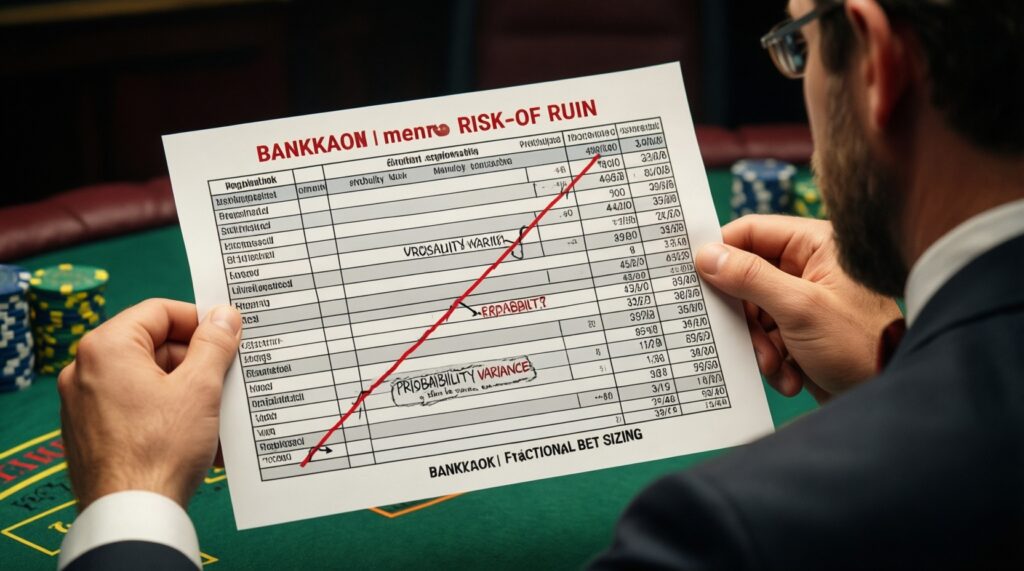
What you need (inputs & tools):
- Bankroll and ruin threshold: starting bankroll B0, ruin level Br (hard or soft).
- Per-bet model: either (a) win/lose with probability p and payoff odds, or (b) mean return μ and variance σ2 per bet/trade.
- Bet sizing rule: fixed fraction f of bankroll (recommended for analysis), or fixed amount (works but is less stable across drawdowns).
- A calculator or sheet: a spreadsheet, Python/R, or any "เครื่องมือคำนวณ Risk of Ruin" you trust-then verify with a manual spot-check.
Core formulas (use with caution)
- Kelly fraction (for a simple win/lose bet): for net odds b (win profit = b per 1 staked), f* = (b·p − (1−p)) / b. Use a fraction of Kelly (e.g., 1/4 to 1/2) to reduce drawdowns.
- Variance-based RoR approximation (continuous/log-wealth style): for small f, if per-bet log-growth has mean g and variance v, an often-used approximation is:
RoR ≈ exp(−2·g·ln(B0/Br)/v)
where g and v can be estimated from your return model. This can be fragile under fat tails; treat as an optimistic baseline. - Gambler's ruin (discrete, stepwise bankroll): useful when bankroll moves in equal "units" and you can estimate p; less realistic for fractional sizing but good for sanity checks.
Failure modes to plan for

- Non-stationarity: your edge changes; RoR spikes exactly when you increase size after a good run.
- Serial correlation: losses cluster; independence assumptions understate drawdown risk.
- Tail risk: rare large losses (gaps, liquidation, bad fills) dominate true ruin probability.
- Hidden leverage: options, margin, or multipliers turn "small f" into large effective exposure.
From bet size to ruin probability: deriving the relationship step by step
Risks and limitations before you start (risk-aware defaults):
- Use a soft-ruin threshold (e.g., Br > 0) to reflect real-world constraints like minimum bet size, margin rules, and psychology.
- Assume your edge is lower than your backtest estimate; run at least one "edge-cut" scenario.
- Assume your volatility is higher than recent history; run at least one "volatility-up" scenario.
- If you cannot estimate tails, add a shock loss scenario (one-off big loss) and see if it triggers ruin.
-
Define bankroll, ruin level, and horizon
Set B0 (starting capital) and Br (ruin threshold). Decide whether you care about eventual ruin or ruin within N bets/trades; if you can't model N well, start with eventual ruin as a conservative screen.
-
Choose a simple outcome model you can defend
Pick either a win/lose bet model (p, b) or a mean/variance model (μ, σ). For many real systems, the mean/variance approach is easier to estimate, but it can hide tail risk.
- Win/lose: estimate p (win probability) and b (net odds).
- Returns: estimate expected return per bet/trade (μ) and standard deviation (σ).
-
Translate bet sizing into log-growth inputs (g and v)
If you size a fraction f of bankroll each bet, approximate log-growth using small-f expansions. For a simple even-money win/lose (+f on win, −f on loss):
- g ≈ p·ln(1+f) + (1−p)·ln(1−f)
- v ≈ p·(ln(1+f)−g)2 + (1−p)·(ln(1−f)−g)2
This connects "สูตรคำนวณขนาดเดิมพัน" (f) directly to expected growth and volatility of log-wealth.
-
Compute a baseline RoR from the ratio B0/Br
Use the variance-based approximation as a baseline:
RoR ≈ exp(−2·g·ln(B0/Br)/v)
If g ≤ 0, treat RoR as effectively high and focus on reducing f or fixing the edge; no sizing trick rescues a non-positive growth process reliably.
-
Stress test: reduce edge, increase volatility, add a shock loss
Recompute RoR under conservative scenarios: lower p (or μ), higher σ, and a one-off loss (e.g., a gap/forced exit). If any scenario makes RoR unacceptable, adjust f and rules before risking capital.
- Edge-cut: p ↓ or μ ↓
- Vol-up: σ ↑ (or widen outcomes)
- Shock: impose an additional −X% event and re-evaluate survivability
-
Set a policy: max f, stop rules, and review cadence
Turn the result into operating limits: a maximum fraction f, a drawdown stop, and a rule for when to re-estimate p/μ and σ. This is where "การจัดการเงินทุนในการพนัน" becomes measurable rather than intuitive.
Worked calculations: example portfolios and how volatility changes outcomes

One short numeric example (illustrative, not a promise): Suppose an even-money bet sized at fraction f, with estimated win probability p. If you set Br as a soft-ruin level (not zero), compute g and v from ln(1±f), then evaluate RoR using exp(−2·g·ln(B0/Br)/v). Increasing f raises both g and v, but v typically accelerates RoR faster under stress scenarios-so your "safe" f should be chosen from the stressed inputs, not the best-case estimate.
Result verification checklist:
- Ruin threshold is explicit (Br) and matches real constraints (min bet, margin rules, platform limits).
- Bet size is expressed as a fraction f of current bankroll (or you explicitly modeled fixed-size bets).
- g is positive under conservative assumptions; if not, you treated RoR as unacceptable rather than "close enough."
- Stress tests include at least one edge-cut and one volatility-up case, not only the base case.
- A shock-loss scenario was checked for survivability (no immediate breach of Br).
- You sanity-checked outputs with a second method/tool (e.g., a simple spreadsheet vs. a "เครื่องมือคำนวณ Risk of Ruin").
- Inputs reflect net outcomes after fees/commissions/slippage where relevant.
- You documented assumptions (independence, stationarity, tails) so you know when the model becomes invalid.
Practical controls: position sizing, stop rules, and drawdown-aware limits
Common implementation mistakes that quietly increase RoR:
- Using full Kelly sizing from optimistic estimates: Kelly is extremely sensitive to p and payout; use fractional Kelly or a hard cap on f.
- Ruin defined as zero only: real ruin happens earlier (margin call, psychological capitulation, inability to place minimum size).
- Scaling up after wins without re-estimating: volatility clusters; your best streak is often when your estimate is most biased.
- Ignoring tail events: a single gap can dominate lifetime RoR even if "average" variance looks moderate.
- Fixed-amount bets during drawdowns: this increases effective leverage as bankroll shrinks.
- No stop rules: without drawdown-based stops, you can drift into a regime where g ≤ 0 while still "following the system."
- Mixing strategies without correlation control: two "good" strategies can be jointly catastrophic if losses coincide.
- Confusing confidence with edge: higher conviction does not reduce variance; it often increases f and therefore RoR.
- Learning-only spending treated as bankroll: separate tuition from operating bankroll; otherwise RoR is understated.
Operationalizing monitoring: dashboards, stress tests, and adaptive sizing
Alternatives and add-ons when a single closed-form RoR number is not enough:
- Monte Carlo simulation (distribution-first): use when returns are not binary and you can sample realistic outcomes (including fat tails). Best for validating "คำนวณ Risk of Ruin" outputs against path-dependent drawdowns.
- Drawdown-triggered adaptive sizing: reduce f after drawdowns (and optionally after volatility spikes). Use when regime changes are common; it is a practical bridge between theory and survival.
- Scenario grid (edge × volatility × shock): maintain a small matrix of conservative cases and require f to be safe across the grid. Use when you lack confidence in any single estimate.
- Structured training / review workflow: if you're moving from discretionary sizing to rules, a "คอร์สสอนการบริหารเงินทุนเทรด" or an internal playbook can standardize inputs, assumptions, and audit trails-focus on process, not promises.
Practical clarifications and concise answers
Is Risk of Ruin the same as maximum drawdown?
No. Maximum drawdown is a realized (or simulated) worst peak-to-trough loss; RoR is the probability of crossing a specific ruin threshold Br under a model.
What should I use as a practical "ruin" threshold?
Use the level where you must stop operating: margin call risk, inability to place minimum size, or a drawdown limit you will actually respect. Soft-ruin is usually more realistic than zero.
Can I rely on a เครื่องมือคำนวณ Risk of Ruin without understanding the formula?
Use it only if you can reproduce at least one spot-check in a spreadsheet and you know what assumptions it makes (independence, tails, fixed sizing). Otherwise treat its output as a rough ranking, not a decision point.
How does สูตรคำนวณขนาดเดิมพัน relate to RoR?
Bet fraction f changes both expected log-growth g and log-variance v; RoR typically worsens rapidly as f increases under stress scenarios. If uncertain, cap f and validate under edge-cut and vol-up cases.
Does having a positive edge guarantee I won't go bust?
No. With aggressive sizing or heavy tails, you can still hit Br. Positive edge mainly helps when combined with conservative sizing and stop rules.
Is this applicable to การจัดการเงินทุนในการพนัน and trading?
Yes, as long as you model outcomes realistically and account for fees, leverage, and tails. The main difference is trading often has fatter tails and correlation spikes, so stress testing matters more.
When should I consider a structured course or playbook?
If you cannot consistently estimate inputs, document assumptions, and follow stop/sizing rules, a process-focused "คอร์สสอนการบริหารเงินทุนเทรด" (or an internal checklist) can reduce operator error-even if it doesn't improve edge.