

To set safer loss limits with math, estimate your per-bet expected value (EV) and variance, scale them to a session horizon, then choose a limit tied to a worst-case quantile rather than hope. This turns "I'll stop at X" into a defensible number based on loss-streak risk and what you can afford to lose.
Core Mathematical Insights for Responsible Limits
- EV describes your long-run average outcome per bet; variance describes how violently results swing around that average.
- Loss limits should be driven by downside risk (variance + horizon), not by today's mood or a recent win.
- Scaling matters: doubling the number of bets roughly doubles expected loss, while uncertainty grows with the square root of bets.
- Quantile-based limits (e.g., "bad but plausible session") are more responsible than "chase-to-even" thresholds.
- Any "expected value variance gambling loss limit calculator" is only as good as your probabilities and realistic horizon.
- Stop rules must be operational (tracked and enforced) or they are not limits.
Translating Game Rules into Probabilities and Payoffs
This method fits intermediate players who can write down outcomes, probabilities, and payouts (sports bets, simple casino bets, promotions with clear terms). It is especially useful when you want responsible gambling loss limits expected value variance rather than vibe-based limits.
Do not use it when any of these are true:
- You cannot estimate true probabilities (e.g., you only have "feel" and no model, or odds are frequently misread).
- Payouts are unclear or conditional (complicated bonus wagering, opaque side bets, unknown rules).
- You intend to "make it back" after losses; math-based limits break if you override them.
- Your play is already harmful; in that case, the responsible choice is not a tighter limit but stopping and seeking help.
Computing Expected Value for Individual Bets
You need consistent inputs and a clear horizon (how many bets/spins/hands you will actually take). This is the foundation for how to set loss limits gambling using expected value in a way you can repeat.
| Preparation item | What you write down | Typical source | Output you will compute |
|---|---|---|---|
| Odds / payout | Net profit if win; loss if lose (per 1 bet) | Bet slip, paytable | Outcome values: xi |
| Probabilities | pi for each outcome (must sum to 1) | Your model / implied odds adjusted for margin | EV per bet: μ = Σ pixi |
| Stake size | THB per bet (or a unit) | Bankroll plan | Scaled EV/variance in THB |
| Session horizon | N bets you will take before stopping regardless | Your routine / time box | Session EV: Nμ; Session variance: Nσ² |
| Risk tolerance | How "bad but plausible" you want to guard against | Your comfort + affordability | Loss limit L from a downside quantile |
Core formulas (single bet):
- Expected value (EV): μ = Σ pixi
- Variance: σ² = Σ pi(xi − μ)²
- Session scaling (independent bets approximation): μN = Nμ, σ²N = Nσ², SDN = √N·σ
Estimating Variance and Assessing Loss-Streak Risk
- Fix a session horizon N (no changing mid-session).
- Express every outcome as net profit/loss per bet (include stake and fees).
- Pick one unit size you will actually use (no "just this one time bigger").
- Decide a downside tolerance level (conservative/neutral/aggressive) before you compute any limit.
-
Model outcomes and probabilities per bet
List all outcomes xi (net profit in THB or units) and assign probabilities pi. For many bets this is binary (win/lose), but you can extend to multiple outcomes (e.g., blackjack pushes, roulette splits).
- Conservative: Use slightly worse probabilities than your estimate. Consequence: higher (safer) loss limit needed for the same risk tolerance, or you reduce stake/horizon.
- Neutral: Use your best estimate. Consequence: limits reflect your model accuracy.
- Aggressive: Use best-case probabilities. Consequence: limits will likely be too loose if you are overconfident.
-
Compute EV (μ) for one bet
Calculate μ = Σ pixi. If μ is negative (as in most casino games), accept that the "average" session drifts down; the loss limit is about controlling tail risk, not turning the game positive.
- Conservative: Treat μ as slightly more negative. Consequence: you will hit limits sooner (less total exposure).
- Neutral: Use computed μ. Consequence: balanced planning.
- Aggressive: Assume μ≈0. Consequence: you may underestimate average drift and overshoot your budget.
-
Compute variance (σ²) and standard deviation (σ)
Use σ² = Σ pi(xi − μ)², then σ = √σ². Variance is the key driver of "how bad it can look" even when EV is modest.
- Conservative: Add a safety buffer to σ (e.g., treat payouts as slightly more volatile). Consequence: tighter exposure or higher limit to maintain the same confidence.
- Neutral: Use computed σ. Consequence: depends on independence and model quality.
- Aggressive: Ignore σ and focus on EV only. Consequence: you will be surprised by normal swings and may break limits.
-
Scale to a session horizon N
Assuming roughly independent bets, scale to session totals: μN = Nμ and SDN = √N·σ. This is the math behind casino bankroll management expected value variance: horizon is as important as stake.
- Conservative: Set N to your maximum plausible number of bets. Consequence: protects against "I played longer than planned".
- Neutral: Set N to your typical session. Consequence: accurate when you actually stop on time.
- Aggressive: Set N small "because I'll stop early". Consequence: your limit is mis-sized if you keep playing.
-
Translate downside risk into a candidate loss limit
Approximate session outcome as Normal: S ≈ Normal(μN, SDN). Pick a downside quantile z (e.g., z = 1, 1.65, 2) and set loss limit L ≈ −(μN − z·SDN), floored at 0. This aligns with what people try to do with a "gambling risk of ruin calculator expected value variance", but expressed as a practical stop-loss for one session.
- Conservative (z=2): Plans for rarer bad sessions. Consequence: larger required budget for the session or smaller stake/N.
- Neutral (z=1.65): Plans for "uncomfortable but plausible". Consequence: reasonable trade-off for many players.
- Aggressive (z=1): Plans for common swings only. Consequence: more frequent limit hits if volatility is high.
Worked example (hypothetical, binary bet): You bet 100 THB each time. You win +95 THB with probability p=0.49 (typical -EV after margin), and lose −100 THB with probability 0.51. Then μ = 0.49·95 + 0.51·(−100) = −4.45 THB per bet. Compute σ² = 0.49·(95+4.45)² + 0.51·(−100+4.45)² ≈ 9526, so σ ≈ 97.6 THB. For N=100 bets: μN≈ −445 THB, SDN≈ 976 THB. With z=1.65, candidate loss limit L ≈ −(−445 − 1.65·976) ≈ 2055 THB. Interpretation: even with a modest average loss, normal variance can produce a ~2k THB drawdown in a "bad but plausible" session-so your responsible limit should be in that neighborhood or you must reduce N or stake.
From Metrics to Money: Converting EV and Variance into Loss Limits

- Your loss limit is pre-committed and written down (THB amount and time box).
- The limit is consistent with your horizon N (no "one more" beyond the planned number of bets).
- You computed μN and SDN using the same stake size you will actually use.
- Your chosen z level matches your tolerance (conservative/neutral/aggressive) and you accept the consequence.
- The limit is affordable as a sunk cost; it does not rely on winning to pay bills.
- You have a stop protocol: stop immediately when cumulative P&L ≤ −L, regardless of game state.
- You also set a time limit (a second independent brake).
- If the computed L feels too high, you adjust stake or N downward-not the math.
- You can reproduce the same number in any expected value variance gambling loss limit calculator you trust by entering the same μ, σ, N, and z logic.
Monte Carlo Checklist: Simulating Sessions and Interpreting Results
- Using too few trials and treating noisy simulation outputs as "truth"; increase trials until results stabilize visually.
- Simulating with the wrong unit size (e.g., forgetting that you sometimes double bets).
- Mixing games/bets with different volatility without modeling the mixture (variance changes).
- Ignoring dependencies (tilt, progressive betting, table limits) while assuming independence.
- Forgetting fees, commissions, or reduced payouts; EV is miscomputed.
- Comparing simulations to the wrong stop rule (limit should be applied during the session, not only at the end).
- Interpreting a "risk of ruin" output as permission to play longer; it is a warning metric, not a target.
- Chasing a higher win rate by changing strategy mid-simulation; your inputs must match what you will do.
Operationalizing Limits: Tracking, Alerts and Adjustment Rules
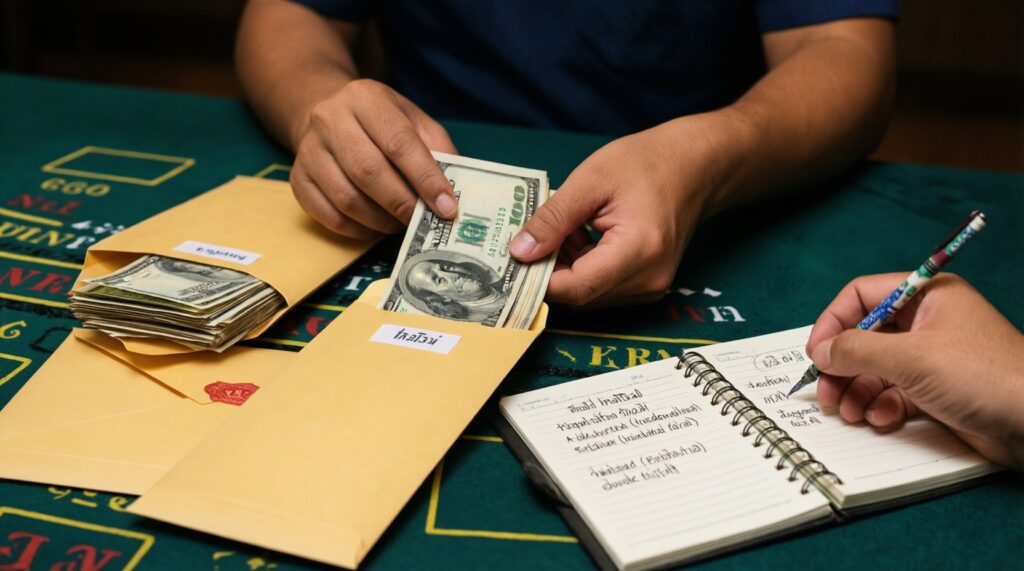
Pick an enforcement method you will actually follow. In Thailand context, keep limits in THB and track net deposits/withdrawals so you do not "forget" earlier losses.
- Hard session envelope (recommended for most): Withdraw/segregate exactly L (plus planned stake float) before play; stop when it is gone. Use when: you want the least loopholes.
- Two-trigger rule (loss + time): Stop at whichever comes first: −L or a fixed time cutoff. Use when: you tend to extend sessions when emotions rise.
- Tiered limits (daily/weekly/monthly): A smaller session limit plus a higher period cap. Use when: you play frequently and need protection against many small sessions adding up.
- Recalibration rule: Recompute μ and σ after a rule change (new game, new stake, new odds source) or after you notice consistent deviations from your planned N. Use when: your behavior is the main driver of risk.
Common Concerns with Practical, Compact Answers
Is EV enough to set a loss limit?
No. EV tells you the average drift; variance determines how far results can swing in a single session, which is what usually breaks limits.
What if I don't know the true probabilities?
Use conservative probabilities or avoid math-based sizing for that bet. If you cannot justify p-values, treat the activity as higher risk and lower the stake/horizon.
How does this relate to a gambling risk of ruin calculator expected value variance?
Risk-of-ruin focuses on going broke over repeated play; this page converts the same inputs (EV and variance) into a practical per-session stop amount you can enforce.
What z value should I choose for the downside limit?
Conservative players use larger z (planning for rarer bad sessions), neutral uses mid-range, aggressive uses smaller z and must accept more frequent limit hits.
If the computed limit is "too big," what should I change?
Reduce stake or reduce N, then recompute. Do not simply pick a smaller L while keeping the same exposure; that usually makes limit breaks more likely.
Can I use an expected value variance gambling loss limit calculator and trust the result?
Yes if you input realistic outcomes, probabilities, stake, and horizon. The calculator cannot protect you from optimistic assumptions or changing behavior mid-session.
How often should I update my casino bankroll management expected value variance plan?
Update whenever you change games, stake sizing, or session length habits. Also update after any repeated pattern of hitting limits earlier than expected.