

The myth of "timing the bonus" is the belief that you can reliably predict when payouts will happen (or when they will be announced) and profit from that timing in performance, staffing, or budgeting. In practice, bonus triggers are mostly contractual thresholds plus operational delays, and the "patterns" people see are usually randomness, selective memory, and calendar clustering.
Core conclusions about bonus-timing myths
- Most bonus "timing signals" are artifacts of how an employee bonus plan is administered, not predictable business momentum.
- A bonus payout schedule often clusters around payroll, close, and audit windows, creating false impressions of cycles.
- Triggers are frequently binary and threshold-based, so small measurement noise flips outcomes near the cutoff.
- After-the-fact storytelling (data snooping) makes normal variation look like a repeatable rule.
- For decisions, process control beats prediction: define triggers, lag assumptions, and contingency actions upfront.
Myths-first overview: what people get wrong about timing the bonus
Myth: "If we watch the right KPI, we can time the payout and act ahead of it." Reality: in a typical performance bonus program, you are not predicting a market event; you are navigating an internal rulebook plus reporting latency. The "event" is often created by measurement and approval steps rather than discovered by forecasting.
Myth: "Bonuses follow a stable rhythm." Reality: many firms operate with a stated annual bonus policy but execute it through variable close timelines, manager sign-offs, and exception handling. These operational dependencies introduce jitter (unpredictable small shifts) that dominates any neat calendar narrative.
Definition (practical): "Timing the bonus" is any attempt to gain an advantage by predicting the date (announcement or payout) rather than improving the drivers (performance, compliance, eligibility, or data quality). This page focuses on why date prediction is usually weak, even when the incentive design is sound.
Mechanics of triggers: contract design, randomness and operational lags
Myth: "A trigger is a single, clean condition." Reality: trigger mechanics are multi-stage: define metrics, measure them, validate them, approve them, then execute payment. Each stage can add randomness (uncontrolled variation) and lag.
- Metric definition gates: A KPI can change mid-cycle (e.g., re-baselining targets), shifting who qualifies without any real performance change.
- Threshold effects: Many plans are "if KPI ≥ X then pay." Near X, tiny measurement noise decides outcomes.
Example: target = 100 points; a late correction of +2 or −2 points flips eligibility for people sitting at 99-101. - Eligibility filters: Hire dates, probation, disciplinary status, leave types, and role codes can delay or cancel payouts, regardless of results.
- Operational lags: Payroll cutoffs, finance close, and audit checks create batching. A bonus payout schedule often follows these internal calendars, not business signals.
- Manager discretion bands: Calibration committees and "budget caps" can override formula outputs, adding non-stationary behavior (rules that change by cycle).
- System integration delays: Sales systems, HRIS, and payroll interfaces may post adjustments after the period ends.
Limited-resources alternative: if you cannot redesign the whole scheme, document a minimal "trigger chain" (metric owner → validation step → approver → payroll cutoff). Even a one-page chain reduces timing myths because it makes lags explicit.
| What people try to "time" | What actually determines it | What you can control cheaply |
|---|---|---|
| Payout date | Payroll cutoff + approvals + exceptions | Submit data early; pre-clear exceptions |
| Trigger achievement | Threshold + measurement noise + definitions | Improve data quality; monitor near-threshold cases |
| Announcement timing | Close/audit readiness + leadership comms | Lock timelines; publish a simple calendar |
Why apparent patterns deceive: data snooping, clustering illusion and selection effects
Myth: "We saw it happen three times, so it's a pattern." Reality: if you look at enough months, teams, and metrics, some streaks will appear by chance. The more you search, the more "rules" you will find that fail later.
- Calendar clustering: Payouts bunch around quarter-end or year-end processes; people mistake this batching for predictability within the cycle.
Example: if payroll runs twice a month, many payouts will land on those two dates even when eligibility is random. - Data snooping: Teams try many hypotheses ("after strong Q1, payout is early") and remember only the ones that fit. In an employee bonus plan, each additional filter (region, grade, tenure) increases the odds of finding a "convincing" but fragile story.
- Selection effects: You hear mostly from those who received payment. Missing cases (no payout, delayed payout, off-cycle corrections) are under-discussed, biasing perception.
- Regression to the mean: Exceptional results often revert toward normal. People attribute the reversion to "post-bonus slowdown" even when it is statistical drift.
- Policy mixing: A single organization may run multiple plans (e.g., annual bonus policy for corporate roles, sales bonus incentives for revenue teams). Combining them produces misleading "average" timing that matches none of them.
Limited-resources alternative: keep a single shared log of exceptions (late approvals, corrections, disputed eligibility). Even a simple spreadsheet can reveal that "patterns" are mostly operational causes.
Empirical checks: reproducing and refuting common timing stories
Myth: "We can validate this by eyeballing last year's calendar." Reality: timing claims need basic tests that separate batching and noise from true predictability. You can do this without advanced tooling.
- Quick checks that usually refute timing stories
- Holdout test: build your "rule" on one period, then test on the next period. If it fails immediately, it was likely data snooping.
- Permutation (shuffle) test: shuffle payout dates within allowed payroll windows and see if the "pattern" still appears. If yes, your rule is not informative.
- Near-threshold audit: examine cases just above and below the cutoff. If many flip due to adjustments, the trigger is effectively noisy.
- Plan separation: analyze each performance bonus program separately (role family, plan type) rather than pooling.
- What these checks cannot prove (limits you must accept)
- Causality: you may observe that a payout follows a close milestone, but that does not mean the milestone predicts performance outcomes.
- Stability under policy change: if the annual bonus policy changes definitions or caps, historical timing becomes a weak guide.
- Small samples: for a small team, "patterns" are dominated by chance.
Example: with only 6 payout cycles, even two consecutive "early" payouts can happen randomly and still look meaningful.
Limited-resources alternative: if you can only do one test, do a holdout test. It is the fastest way to expose overfitted timing rules.
Consequences for decision-making: hedging, forecasting and incentive design
Myth: "Even if timing is noisy, acting on it can't hurt." Reality: timing myths create systematic errors in planning, communication, and incentives.
- Budget whiplash: finance forecasts assume a clean payout month; operational lags move expenses across months and trigger unnecessary "variance hunts."
- Broken expectations: employees interpret delays as unfairness, even when the formula is correct, because the bonus payout schedule was communicated as deterministic.
- Gaming the measurement window: teams shift effort to "look good at cutoff," harming long-run outcomes (especially in sales bonus incentives with end-of-period deal stuffing).
- Misaligned management actions: leaders reward or penalize managers based on payout timing rather than on the actual quality of the employee bonus plan execution (data, eligibility, approvals).
- Overcomplicated trigger rules: adding more conditions to "control timing" usually increases exception volume and delays, making timing less predictable.
Limited-resources alternative: hedge operationally: publish a payout window (range) instead of a date, pre-define escalation for exception cases, and maintain a small "true-up" process for corrections.
A practical protocol to test whether a timing signal survives scrutiny
Myth: "We need sophisticated analytics to know whether the timing story is real." Reality: a lightweight protocol can eliminate most false signals using basic exports from HR/payroll and the plan rules.
- Define the claim in one sentence: e.g., "When KPI A is above target, payouts happen earlier." Avoid vague wording.
- Lock the population: pick one plan (one performance bonus program), one role group, and one measurement period definition.
- Measure timing correctly: use (a) period end date, (b) approval date, (c) payroll execution date. Do not mix them.
- Build a baseline: timing = payroll date minus period end date (in days). Use the same method for all cases.
- Run a simple test: compare the baseline timing between "above target" and "below target," then repeat on the next period as holdout.
Mini example (toy simulation): Suppose approvals take 3-10 days uniformly at random, and payroll runs on fixed cutoffs. Even if performance is unrelated, "above target" groups may look faster if they have fewer exceptions that cycle. If you add a single operational variable (exception count), the performance-based timing effect often disappears.
Low-tool pseudo-steps (spreadsheet-friendly):
For each employee-cycle:
  timing_days = payroll_date - period_end_date
  flag_above = (measured_KPI >= target)
  flag_exception = (any eligibility/adjustment applied)

Check 1: average(timing_days | flag_above) vs average(timing_days | not flag_above)
Check 2: repeat Check 1 within flag_exception = false only
Check 3: run the same checks on the next cycle (holdout)
If the effect vanishes in Check 2 or holdout, treat it as noise/ops-driven.
Common practitioner questions about bonus timing and triggers
Is "timing the bonus" ever legitimate?
Only when the rules explicitly create a timing dependency (e.g., a published processing window tied to a cutoff). Otherwise, you are usually predicting internal throughput, not performance.
What should we publish: a fixed date or a window?
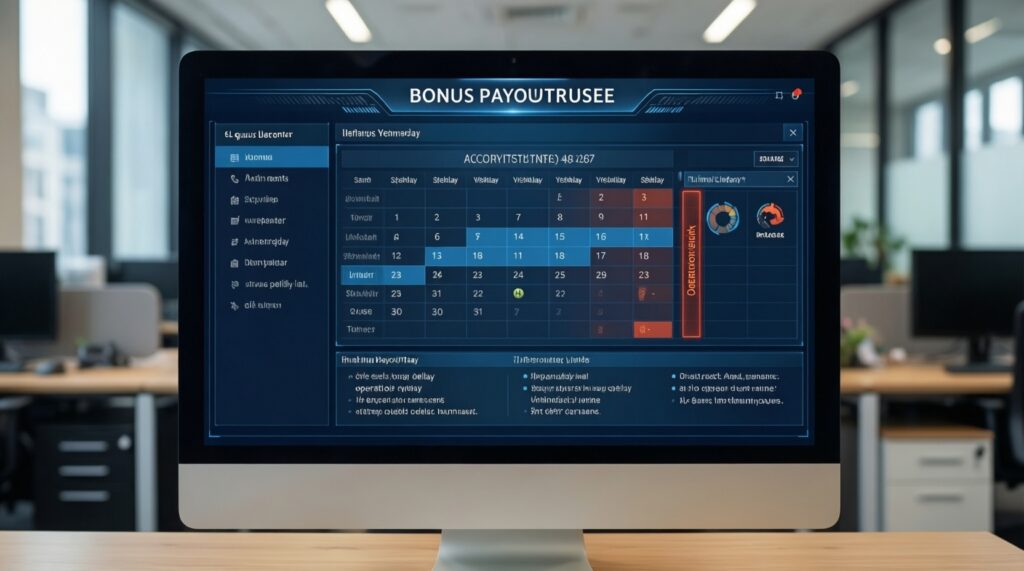
Publish a window aligned to the bonus payout schedule and list the top delay drivers. This reduces perceived unfairness when operational lags occur.
How do we separate annual bonus policy from sales bonus incentives in analysis?
Analyze each plan separately because triggers, data sources, and approval chains differ. Pooling them manufactures patterns that apply to neither.
What is the fastest way to validate a timing claim with limited resources?
Do a holdout test: build the rule on one cycle and test on the next. If it fails, stop investing in the story.
Why do near-threshold employees create outsized timing noise?
Because small corrections can flip eligibility, which changes the approval and exception path. That shifts timing even when true performance is unchanged.
Can we redesign the employee bonus plan to reduce randomness?

Yes: reduce discretionary overrides, simplify eligibility rules, and standardize approval SLAs. This makes timing more stable without pretending it is predictable.
What should managers do instead of trying to time the payout?
Focus on controllables: data readiness, exception prevention, and clear communications. Treat timing as an operational risk to hedge, not a signal to trade on.