

In probabilistic terms, a slot "multiplier" usually does not increase the probability of winning; it rescales the payout conditional on an event. Special symbols (Wild/Scatter/Bonus) change which events count as wins and how outcomes depend on each other. To verify results, model the exact trigger event, then compute probability and expected value separately.
Essential probabilistic conclusions at a glance
- A multiplier most often multiplies value (payout), not chance (probability) of a hit.
- Special symbols reshape the event space: Wild changes matching rules; Scatter/Bonus changes trigger rules.
- "สูตรคำนวณความน่าจะเป็นตัวคูณในเกมสล็อต" must separate (a) trigger probability and (b) payout scaling after trigger.
- Interactions (Wild + multipliers + Bonus) create dependency; you cannot multiply independent-looking probabilities by default.
- "สล็อตออนไลน์ ตัวคูณ (Multiplier) ทำงานอย่างไร" is best answered by writing the payout as a random variable and analyzing E[payout].
- Fast correctness check: compute E[payout] analytically for a simplified model, then confirm by simulation for the same rules.
Debunking myths about multipliers and special symbols in probability
Myth: "A higher multiplier means I win more often." Correction: In most mechanics, the multiplier applies after a win event has already occurred. Probability of winning is defined by symbol-generation and payline rules; the multiplier modifies the payoff mapping, not the symbol distribution.
Myth: "Wild/Scatter/Bonus are just 'extra' symbols so they add chances linearly." Correction: These symbols typically alter the definition of a winning event (Wild substitutes) or define a separate trigger event (Scatter/Bonus), which can introduce strong dependence across reels/positions.
Myth: "Reading a 'รีวิวเกมสล็อตตัวคูณสูงสุด เล่นคุ้ม RTP สูง' tells me the multiplier itself creates the RTP." Correction: RTP (expected return) is an average over all outcomes: hit rates, payout table, bonus frequencies, and how multipliers attach to outcomes. A large max multiplier can coexist with low probability and low contribution to expectation.
Precise definitions: multipliers, wildcards, jokers and symbolic operators
Myth: "A multiplier is one universal thing." Correction: In probability models, a multiplier is an operator applied to a random variable (payout) under specified conditions.
- Base outcome space (Ω): one spin generates a symbol grid (or reels stopping positions). Each outcome ω ∈ Ω has probability P(ω).
- Win event (W): a predicate on ω (e.g., a payline matches). Probability is P(W)=Σω∈WP(ω).
- Payout random variable (X): X(ω)=paytable(ω). Expected payout is E[X]=Σ P(ω)X(ω).
- Multiplier operator (M): often conditional: X′(ω)=M(ω)·X(ω), where M(ω)=1 unless a feature triggers. This is how "สูตรคำนวณความน่าจะเป็นตัวคูณในเกมสล็อต" should be framed mathematically.
- Wild (substitution operator): modifies W by allowing substitutions. In effect it enlarges the set W (more ω qualify as wins) and can also change the payout mapping.
- Scatter/Bonus (trigger operator): defines a separate event B such as "≥k scatters anywhere." This is what people ask in "สัญลักษณ์พิเศษ Wild Scatter Bonus ในเกมสล็อตคืออะไร": they are different operators, not one category.
- Buy Feature: a decision that replaces many future random outcomes with a conditional distribution (you pay a cost C to sample from "bonus-start" outcomes). This is exactly the modeling core of "เกมสล็อตตัวคูณสูง ซื้อฟรีสปิน (Buy Feature) คุ้มไหม".
How multipliers rescale event probabilities - formulas and intuition
Myth: "Multipliers rescale probability." Correction: They rescale payout; probability changes only if the multiplier is tied to symbol rules (e.g., Wild-on-reel that also substitutes).
Use two layers: (1) probability of a trigger, (2) expected payout given trigger.
- Pure payout multiplier (no probability change): if M is independent of "win-ness" and doesn't change matching rules, then P(W) stays the same, but E[X′]=E[M·X]. If M is constant m on event A and 1 otherwise: E[X′]=E[X]+(m−1)·E[X·1A].
- Multiplier that depends on win size: common with "win multiplier" ladders; then M and X are dependent. You must compute E[M·X] directly; E[M]·E[X] is generally wrong.
- Wild increases hit probability by expanding W: if Wild substitutes for any symbol except specials, then more outcomes qualify as a line win, so P(W) increases. The multiplier may still be separate (e.g., sticky Wilds with multipliers) and must be treated as additional conditioning.
- Scatter/Bonus changes the event type: P(B) is computed over symbol counts "anywhere," not paylines. Expected value becomes E[X]=E[Xbase]+P(B)·E[Xbonus | B].
- Buy Feature as conditional expectation: if you pay C to enter bonus, your EV for the purchase is E[Xbonus | B]−C (per purchase), not "bonus RTP" in isolation.
Compound effects: interacting symbols, dependency and nonlinearity
Myth: "I can multiply probabilities for each reel and be done." Correction: Many mechanics create dependence: expanding symbols, cascading wins, sticky Wilds, retriggers, and multipliers that accumulate across a sequence.
Where dependencies typically appear

- Cascades/tumbles: the next grid is conditional on the previous win; spins are not i.i.d. within a paid spin.
- Sticky/locking Wilds: later outcomes depend on earlier placements.
- Accumulator multipliers: Mtotal depends on the path (sequence of hits), not only the final grid.
- Bonus with retrigger: number of free spins is random and path-dependent, inflating variance and complicating closed forms.
Practical constraints when estimating EV and hit rates
- Do not assume independence unless the rules guarantee it (e.g., independent reels, no state, no conditional respins).
- Separate "trigger probability" from "value given trigger"; this prevents the common confusion that a higher max multiplier implies higher average return.
- Cap effects matter: max multiplier caps truncate the tail; the contribution to EV can be much smaller than "max multiplier" suggests (relevant when reading a "รีวิวเกมสล็อตตัวคูณสูงสุด เล่นคุ้ม RTP สูง").
- Costed choices need net EV: for Buy Feature, evaluate net of cost and compare to base-spin EV per same budget.
Worked computations: step‑by‑step examples with numeric simulations
Myth: "One lucky screenshot validates the multiplier." Correction: Verify with a small, explicit model and a reproducible simulation that matches the rules.
-
Define a minimal model (explicit assumptions):
- One spin has a win event W with probability p.
- Conditional win payout is a constant a (so X=a on W, else 0).
- A multiplier event A occurs with probability q, independent of W, and multiplies wins by m (M=m on A, else 1).
-
Compute analytically:
- Base EV: E[X]=p·a.
- With multiplier: E[X′]=E[M·X]=p·a·E[M]=p·a·(q·m+(1−q)·1)=p·a·(1+q(m−1)).
- Note: P(W) remains p; only the conditional win value changes on average.
-
Show the common mistake:
- Wrong: "new win chance = p·m" or "EV = (p·m)·a". Multipliers are not probability scalers.
- Wrong under dependence: using E[M]·E[X] when M depends on win size (e.g., multiplier appears more often on big wins).
-
Short algorithm to check your result (simulation):
# Inputs: p (win probability), a (win payout), q (multiplier chance), m (multiplier value)
# Goal: estimate EV and confirm formula E = p*a*(1 + q*(m-1))

N = 1_000_000
sum = 0
for i in 1..N:
  win = (rand() < p)
  mult = (rand() < q)
  payout = 0
  if win:
    payout = a * (m if mult else 1)
  sum += payout

EV_hat = sum / N
# Compare EV_hat to p*a*(1 + q*(m-1)) within sampling error.
This kind of check is the fastest way to validate "สูตรคำนวณความน่าจะเป็นตัวคูณในเกมสล็อต" for a simplified mechanic before adding Wild/Scatter/Bonus complexity.
-
Extend the model to special symbols (one clear upgrade):
- If Wild increases the set of winning outcomes, model it as p→p′ (changed win probability) and possibly a→a′ (changed average win size).
- If Bonus triggers with probability r and yields expected bonus value b, then total EV becomes E[X]=E[Xbase]+r·b.
Modeling choices and pitfalls: when symbols break standard assumptions
Myth: "Buy Feature is always bad/good." Correction: It's a pricing problem under a conditional distribution; you compare net expectation and risk, not vibes.
Mini-case (Buy Feature): To answer "เกมสล็อตตัวคูณสูง ซื้อฟรีสปิน (Buy Feature) คุ้มไหม", model the purchase as paying cost C to sample from bonus outcomes. The decision rule is: buy only if E[Xbonus | B] − C exceeds the expected value you'd get by spending the same budget on base spins, after accounting for variance tolerance.
# Minimal check for "Buy Feature worth it" under your assumptions
# Given:
#   C = feature cost (in bet units)
#   EV_base_per_spin = estimated base EV per spin (in bet units)
#   EV_bonus_given_buy = estimated EV of bonus when bought (in bet units)
# Compare per same budget C:
buy_is_positive_EV = (EV_bonus_given_buy > C * EV_base_per_spin / 1.0)  # if C equals C base spins cost

# If you also track variance, estimate distribution via simulation and compare risk metrics.
Concise technical clarifications and edge cases
Does a multiplier ever change probability directly?
Only if the multiplier is tied to symbol generation or matching rules (e.g., a "multiplier Wild" that also substitutes). A pure payout multiplier leaves event probabilities unchanged.
What is the cleanest "สูตรคำนวณความน่าจะเป็นตัวคูณในเกมสล็อต" in one line?
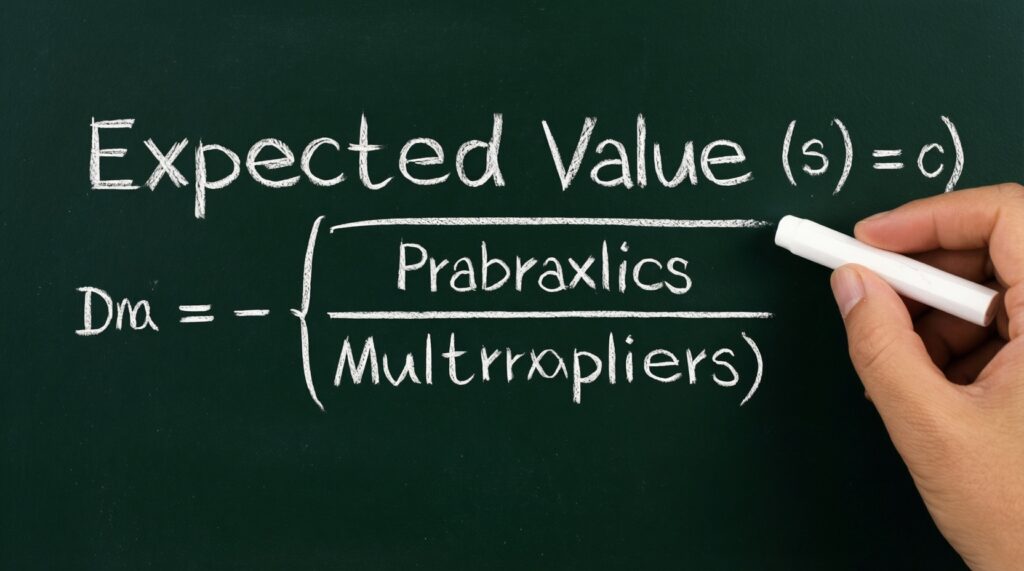
Write payout as X and multiplier as M, then compute E[M·X]. Probabilities belong in P(ω) when summing over outcomes, not inside the multiplier.
In "สัญลักษณ์พิเศษ Wild Scatter Bonus ในเกมสล็อตคืออะไร", what's the key probabilistic difference?
Wild alters which outcomes count as a win (changes the win set W). Scatter/Bonus defines a separate trigger event B that often ignores paylines and can start a different distribution (bonus mode).
Why can't I trust max multiplier claims from a "รีวิวเกมสล็อตตัวคูณสูงสุด เล่นคุ้ม RTP สูง"?
Because max multiplier is a tail event; its contribution to expectation depends on its probability mass. EV depends on the full payout distribution, not the maximum.
When is E[M]·E[X] valid?
Only when M is independent of X (and both are well-defined for the same trial). In many slot features, M depends on win presence/size, so independence fails.
How do cascades affect probability calculations?
They create conditional transitions: the next grid depends on the current win, so you must treat the sequence as a state process rather than independent spins within a single paid spin.
What's the fastest sanity check for "สล็อตออนไลน์ ตัวคูณ (Multiplier) ทำงานอย่างไร" claims?
Build a minimal model, compute EV analytically, then run a simulation with the same rules and confirm the estimates converge. If they don't, the assumed mechanics are wrong.