
A max win cap is a hard limit on the largest payout a game can award per spin/hand/round. A game can still be mathematically fair under the stated rules, yet feel "rigged" because the cap truncates the rare high-end outcomes in the payout distribution, changing what long losing/winning streaks look like to real players.
Essential concepts: max win caps and how they affect fairness
- A max win cap limits the top payout; it does not automatically change lower-tier wins or hit frequency.
- A casino max win cap is a policy rule applied at payout time; it can be game-level, session-level, or account-level.
- A slot max win cap mainly affects the extreme right tail (very rare huge hits), which is where "life-changing" wins would otherwise live.
- Players judge fairness from streaks and memorable outcomes, not from long-run averages; caps change those memorable outcomes first.
- "Fair" can mean rule-consistent (the cap is disclosed and applied consistently) even if it feels harsh or unexciting.
Implementation methods: progressive, fixed and dynamic cap models
In game math, a cap is a rule that maps any raw outcome above a threshold to a maximum payable amount. In implementation terms, it can be applied at the paytable level (no symbol combination can exceed X), or as a post-calculation clamp (compute win, then apply paid = min(raw, cap)).
Fixed caps use a constant limit (e.g., "max win is 5,000× bet"). Progressive caps increase with bet size, time, or a jackpot meter, but still stop at a defined maximum. Dynamic caps depend on session/account limits, VIP tiers, or risk controls-these are the most likely to create perceived inconsistencies if not clearly explained.
When people say "max win cap," they often mix two different things: (1) a game's intrinsic maximum outcome, and (2) an operator policy cap that overrides otherwise-valid outcomes. The second is what typically triggers "it felt rigged" stories.
Mathematical relationships: RTP, volatility, caps and expected value
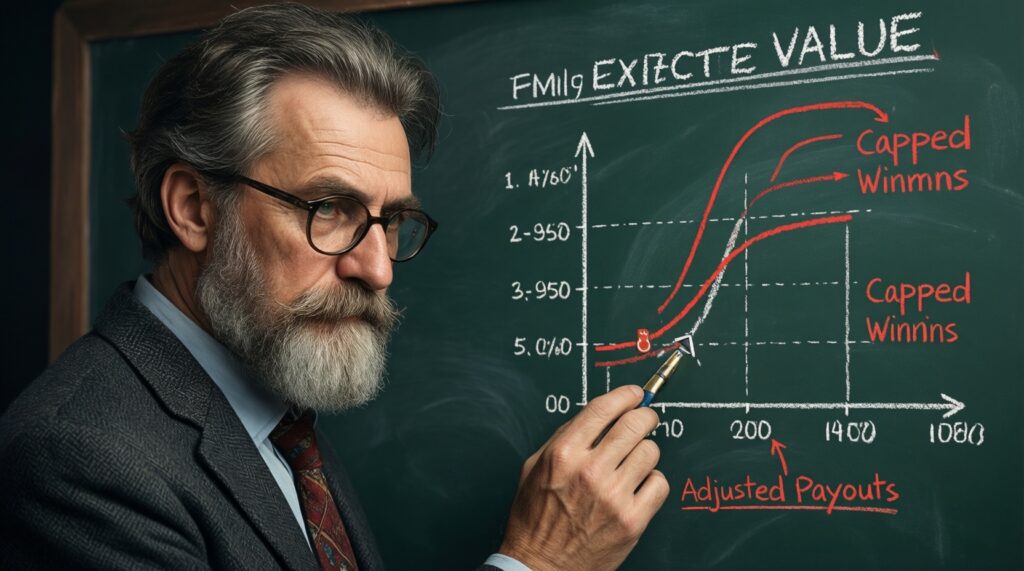
- Expected value (player net): for a unit bet,
EV = RTP − 1. A cap typically reduces RTP unless lower wins are increased to compensate. - Truncation effect: if a win W is replaced by
min(W, C), the right tail is truncated. The lost expectation isE[(W − C)+], which must be "paid back" elsewhere to keep RTP unchanged. - Volatility: caps usually reduce variance by removing rare extreme payouts. Lower variance can feel like "no big wins ever," even if hit rate is unchanged.
- Compensation design: to keep RTP stable under a cap, designers often increase mid-tier wins or frequency of small wins-this shifts how sessions "feel."
- Concrete scenario: suppose a game (per 1 THB stake) has a 1-in-1,000,000 chance to pay 1,000,000 THB, contributing 1 THB of RTP by itself. If you impose a 100,000 THB cap and change nothing else, that component becomes 0.1 THB, dropping RTP unless redistributed.
- Bet scaling: a cap expressed as "X× bet" preserves proportionality; a flat currency cap punishes higher stakes disproportionately and is more likely to be noticed.
Payout distribution mechanics: hit frequency, skew and tail risks
What most players call "luck" is the shape of the slot payout distribution: how often wins happen (hit frequency), how large typical wins are, and how much probability mass exists in the extreme tail.
- High-volatility slots: most EV sits in rare large hits. A cap removes part of the tail, so long "dead sessions" remain, but the "one huge rescue" is less available.
- Bonus-feature funnels: if a large part of the tail comes from a bonus (free spins, hold-and-win, respins), capping can specifically flatten the bonus' best-case outcomes while leaving base-game hit rate intact.
- Progressive/jackpot-adjacent mechanics: "must drop by" or jackpot-like events can be capped at the operator layer even if the internal event triggers; the player experiences this as a mysteriously muted peak.
- Multi-stage multipliers: designs with stacked multipliers (e.g., 10× then 50×) create a heavy tail. A cap turns "stacking" into an invisible ceiling, reducing perceived excitement.
- Buy-feature / ante bets: paying extra to access tail outcomes makes caps more emotionally salient: the player paid for access to the tail, then the tail is truncated.
Player perception: cognitive biases that make fair games feel rigged
- Availability bias: players remember near-peak moments; when capped, those moments cluster at the same top value and feel "artificial."
- Gambler's fallacy: long loss streaks feel like they "should" end with a big win; caps reduce the chance that the eventual win is a dramatic reversal.
- Outcome bias: players judge fairness by results ("I didn't win big") rather than by whether the cap rule was applied consistently.
- Loss aversion: a capped "almost huge" win can feel worse than a smaller normal win because the mental reference point becomes the uncapped amount.
- Where the feeling is valid: if the cap is not clearly disclosed, differs by stake level, or changes between sessions, the player's "rigged" intuition may reflect real inconsistency.
- Where the feeling is misleading: if the cap is fixed, disclosed, and consistently applied, the game can be fair-by-rules even if the experience is less thrilling.
Compliance and operator policies: limits, disclosures and testing
Most "manipulation" allegations arise from policy-layer caps and unclear messaging, not from the RNG itself. When a cap exists, the key question is whether it is disclosed, consistent, and testable.
Quick practical tips for evaluating capped games (players, streamers, reviewers)
- Find the exact cap statement: look for "max win," "maximum payout," or "win limit" in the game info and the operator's terms; note whether it is a max win cap in currency or in "× bet."
- Separate game cap vs operator cap: a slot max win cap in the paytable is different from a cashier/account cap applied after the spin result.
- Check stake dependence: test two stakes and compare whether the cap scales proportionally; flat currency caps can create surprising truncation at higher stakes.
- Watch for "same-top" clustering: repeated top awards equal to the cap can indicate truncation; that's not proof of cheating, but it is evidence the cap is materially shaping outcomes.
- Ask for the verification method: if a game claims provably fair payout distribution, verify that the published method covers the payout calculation including any cap logic (not just the RNG seed reveal).
- Myth: "A casino max win cap proves the RTP is fake." Reality: RTP can be preserved, but only if value removed from the tail is redistributed to other outcomes.
- Myth: "Caps only affect whales." Reality: in high-volatility games, the tail influences everyone's experience because it changes how often a session is "saved" by a rare large hit.
- Mistake: unclear disclosure layers. Game rules show one maximum, operator terms impose another; this is the fastest path to "it's rigged" perceptions.
- Mistake: inconsistent application. If the cap differs by jurisdiction, wallet, or bonus state, the player needs explicit, in-context messaging.
- Mistake: incomplete testing scope. QA verifies RNG but not end-to-end payout settlement, where caps are often applied.
Design trade-offs: preserving excitement while maintaining transparent fairness
Designers can keep a cap while reducing "ceiling shock" by shaping the top end so it feels earned and understandable. Example: instead of allowing raw wins far above the cap and clamping them, design the paytable so the theoretical maximum is near the cap and communicate it in the feature rules.
Numeric mini-case: if a bonus can reach 20,000× but the operator cap is 5,000×, players will often experience a "missing" 15,000× in their mental model. A better approach is to redesign the bonus so its maximum is 5,000× (or visibly gated) and reallocate the removed expectation into mid-tier bonus outcomes.
Pseudocode (end-to-end clarity):
rawWin = evaluateSpin(reels, features)
cap = getCap(gameRules, operatorPolicy, stake, sessionState)
paidWin = min(rawWin, cap)
log(rawWin, cap, paidWin)  // auditable: shows truncation when it happens
Self-check list before you call a capped game "rigged"
- Can you point to the exact place where the max win cap is disclosed (game info and operator terms)?
- Do you know whether it is paytable-based or an external settlement clamp?
- Does the cap scale with stake (× bet) or is it a flat currency ceiling?
- Is the perceived issue about fairness-by-rules, or about transparency and communication?
- If "provably fair" is claimed, does the verification cover payout settlement including the cap?
Addressing common concerns about caps, payouts and perceived manipulation
Does a max win cap automatically mean the game is unfair?

No. If the cap is disclosed and applied consistently, the game can be fair under its rules, even if the experience is less exciting.
Can RTP stay the same after adding a slot max win cap?
Yes, but only if the value removed from the extreme tail is redistributed to other outcomes (more frequent small/mid wins or higher mid-tier payouts).
Why do capped games often "feel" colder even when I see many small wins?
Because the tail is where rare session-changing wins live. If those outcomes are truncated, small wins don't create the same recovery narrative during downswings.
Is repeated hitting of the exact maximum proof of manipulation?
Not by itself. Clustering at the cap is a natural signature of truncation; it indicates the cap is binding, not that outcomes are being selectively edited beyond the stated rule.
What's the difference between a casino max win cap and the game's advertised maximum?
The advertised maximum is usually the game's internal cap. The casino max win cap can be an external policy limit that overrides the internal result at settlement time.
How does slot payout distribution relate to "rigged" accusations?
Players infer fairness from streaks and rare peaks. Caps reshape the distribution's right tail, so real session patterns can deviate from what players expect from similar uncapped games.
What should "provably fair payout distribution" cover to be meaningful?
It should cover the full mapping from revealed RNG inputs to the final paid amount, including any cap logic. Proving the RNG alone is incomplete if settlement can clamp wins.