

Max win and tail risk describe the same practical issue: a payout distribution where a tiny number of rare, huge outcomes dominate what you see in short sessions. This is why a single "max win" can make your expectations feel broken, especially in max win slots and other high payout online slots where extremes are designed to be possible but infrequent.
How one huge payout changes what you should expect
- A single extreme payout can outweigh thousands of normal outcomes, so session results feel "non-representative."
- Short samples make average returns unstable; your personal "RTP experience" swings wildly.
- High volatility pushes outcomes into long dry spells punctuated by rare spikes.
- "I saw it once" is weak evidence; tail events are memorable but statistically thin.
- Risk management must focus on bankroll, stop rules, and reporting uncertainty-not just point estimates.
Defining max win and tail risk in practical terms
Max win is the game's capped upper payout for a single bet (often described as a maximum multiplier). Tail risk is the chance and impact of outcomes far out in the distribution's "tail," where rare hits can dominate totals. In best high volatility slots, the tail is intentionally "thick": many spins cluster near small outcomes, while a few spins can be enormous.
In practice, tail risk is not about whether a max win exists; it's about how much of the total expected value sits in rare events you may never see in a realistic sample. Numeric example: if a game can pay 10,000× but most wins are under 20×, your short-run results will mostly reflect the small outcomes even though the headline number is 10,000×.
Mini-scenarios in TH context:
- Streamer content planning: You pick online slots with biggest jackpots for a "big hit" session; the tail makes the session outcome highly unpredictable even if the game is fair.
- Casual player budgeting: You want to play max win slots real money with a fixed nightly budget; tail risk means "no big win" is a normal outcome, not a failure of the game.
Practical implication: Treat "max win" as a boundary condition, and treat tail risk as the main driver of what your sessions will actually feel like.
Why rare extreme payouts distort averages and probabilities
Rare extremes distort expectations because human intuition tracks frequency, not contribution. When a large part of the expected value lives in very rare events, everyday outcomes look "worse than expected" until (and unless) the tail shows up.
- Average becomes tail-driven: One extreme can pull the mean upward while the median remains low.
- Session length illusion: In short sessions, you sample mostly the body, not the tail.
- Probability stacking errors: People convert "possible" into "due," especially after long dry spells.
- Availability bias: Screenshots of max win slots dominate memory and social feeds, not the silent losses.
- Misread variance: Two games can have similar long-run averages but radically different volatility and tail weight.
Numeric example: if one max-win event adds +10,000 units but occurs once in 1,000,000 spins, then in 10,000 spins it's normal to see zero such events; your observed average will systematically undershoot the long-run mean in most samples.
Practical implication: Use "typical outcome" thinking (median, loss-streak planning) instead of "average outcome" thinking when tails matter.
Mathematical intuition: heavy tails, moments and sample instability
"Heavy tail" intuition: the distribution puts non-trivial probability mass far from the center. Even when the true mean is well-defined, estimates from small samples bounce because extreme values are rare but massive.
Typical scenarios where this matters (beyond slots):
- Game ops / promo evaluation: A bonus campaign looks unprofitable until a handful of tail events arrive and flip the average.
- Affiliate or KOL performance: Revenue per user appears inconsistent because a few rare whales (tail) dominate totals.
- Personal session tracking: Your spreadsheet swings from "this game is dead" to "this game prints" after one spike.
- A/B testing features: Two variants have similar typical outcomes, but one has fatter tails that break naive comparisons.
- Risk of ruin planning: High volatility increases the chance you bust before the tail event arrives.
Numeric example: if 99.9% of spins net around -1 unit (after small wins), and 0.1% net +1,000 units, then a sample of 2,000 spins can easily miss most of the +1,000 outcomes, making the observed result look far worse than the long-run expectation.
Practical implication: When you suspect heavy tails, increase sample size expectations drastically and communicate uncertainty explicitly.
Real-world examples where max wins misled decision makers
Max-win headlines can be useful for understanding product positioning, but they often mislead decisions because they compress a complex distribution into a single extreme number. This is especially common when comparing high payout online slots or selecting best high volatility slots based on "potential" alone.
- What max win is good for:
- Marketing positioning ("big potential" category) and player intent matching.
- Stress testing bankroll and exposure ceilings (what happens if the cap hits).
- Setting expectations that extremes are possible, not guaranteed.
- Where it misleads:
- Player choice: Picking online slots with biggest jackpots and expecting frequent big hits, ignoring hit frequency and volatility.
- Budgeting: Underestimating how long dry spells can last when the tail carries much of the value.
- Product comparisons: Assuming a higher max multiplier implies a "better" return, without considering distribution shape.
Numeric example: Slot A max win 5,000× with frequent medium wins; Slot B max win 20,000× but most value sits in ultra-rare events. A decision maker who optimizes for the "20,000×" headline may deliver a worse typical user experience.
Practical implication: Treat max win as a label, and require at least one "typical-case" metric (median session outcome or expected drawdown) before deciding.
Quantifying and testing for tail risk in limited data
Limited data is the default: you rarely have enough observations to "see" the tail reliably. The main task is to avoid false certainty and use diagnostics that stay informative when extremes are sparse.
- Myth: "I tracked 500 spins, so I know the game." In tail-driven games, 500-5,000 spins can still be mostly "body" behavior.
- Error: using only the mean. The mean is the most tail-sensitive summary; add median, quantiles, and worst-case drawdown.
- Error: treating one max win as proof of high expected value. A single outlier increases your sample mean dramatically but says little about repeatability.
- Myth: "If it hasn't paid, it's due." Independence (or near-independence) means past misses don't create future entitlement.
- Error: comparing two games by short-session ROI. Heavy tails make ranking unstable; results invert frequently across samples.
Numeric example: if you observe one +5,000 unit spike in 2,000 spins, your "average per spin" jumps by +2.5 units from that single event, potentially hiding a negative typical drift.
Practical implication: Use robustness checks (quantiles, trimmed means, stress tests) and present ranges, not single-number claims.
Practical controls: design, hedging and reporting for extreme outcomes
Controls mean setting rules that remain sensible whether the tail shows up or not. This applies to players managing bankroll, and to operators managing payout exposure and communication.
Mini-case (player session policy for max win slots): you plan a 90-minute session on a high-volatility title. Instead of "chasing the max," you define loss limits and stop conditions that prevent tail-risk ruin.
# Simple tail-aware session rules (conceptual)
bankroll = B
session_loss_limit = 0.30 * B
profit_lock = 0.50 * B

while playing:
  if loss >= session_loss_limit: stop
  if profit >= profit_lock: reduce stake or stop
  avoid "recover" stake increases after losses
Numeric example: with bankroll B, a 30% session loss limit ensures one unlucky stretch doesn't consume the whole bankroll while waiting for a rare spike.
Mini-scenarios for different situations:
- Operator / studio reporting: When showcasing a game with "max win" marketing, add a typical-session note (e.g., expected volatility band) to reduce misinterpretation.
- Affiliate content: If you recommend high payout online slots, show both a "common outcome session" and a "tail-hit session," and label them clearly.
- Player choosing what to play: If you plan to play max win slots real money, prefer stake sizing that survives long miss streaks over short-term excitement.
Practical implication: Build decisions around survival and repeatability (limits, ranges, stress tests), not around the rare highlight outcome.
Self-check before you rely on a "max win" story
- Did I separate "possible max win" from "likely session outcome"?
- Did I evaluate more than the mean (median/quantiles/drawdown)?
- Is my sample large enough to plausibly include tail events, or am I guessing?
- Do my bankroll and stop rules survive long dry spells typical of best high volatility slots?
- Did I avoid "due" thinking after misses?
Concise clarifications about rare big payouts
Is a max win the same as a jackpot?
Not necessarily. A max win is the top capped payout for a single bet outcome, while "jackpot" may refer to a specific feature or pool; both create tail risk but aren't identical.
Do high payout online slots pay better on average?
Not from the headline alone. "High payout" often signals a larger tail (bigger possible outcomes), which can increase volatility without improving your typical short-session experience.
Why do best high volatility slots feel "cold" for long periods?
Because much of the return can be concentrated in rare events. Long dry spells are a normal consequence of a tail-heavy design, not evidence that the game is broken.
If I saw a max win once, does that mean it's likely again soon?
No. One extreme outcome is a weak sample and doesn't create a "due" effect; future results are not obligated to repeat the tail hit on your timeline.
Are online slots with biggest jackpots always the riskiest?
Often they are tail-heavier, but "risk" depends on the whole distribution: hit frequency, payout spread, and how much value sits in extreme outcomes.
How should I set stakes if I want to play max win slots real money?

Size stakes so your bankroll can tolerate long losing stretches, then use pre-set stop limits. Tail-heavy games punish aggressive stake escalation when the tail doesn't arrive.
What's the simplest way to communicate tail risk to a teammate?
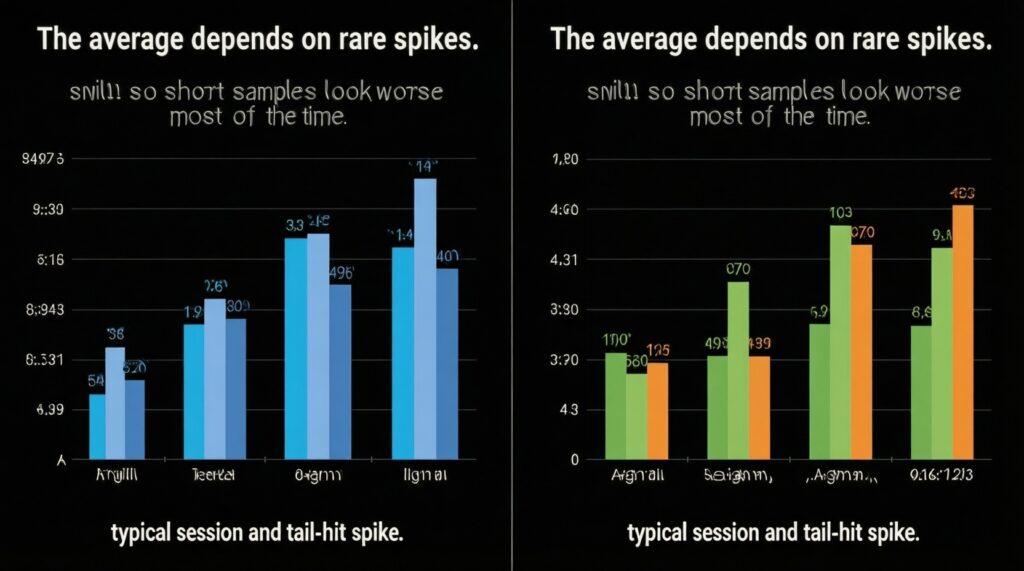
Say: "The average depends on rare spikes, so short samples will look worse most of the time." Then show one typical-session example alongside one tail-hit example.