

House edge is the casino's built-in average advantage, expressed as a percentage of your total bets-not your deposit and not your "likely" outcome in one session. To translate it into expected money loss, multiply the house edge by the amount you wagered. This is the core idea behind any house edge calculator or expected value gambling calculator.
Quick Practical Summary
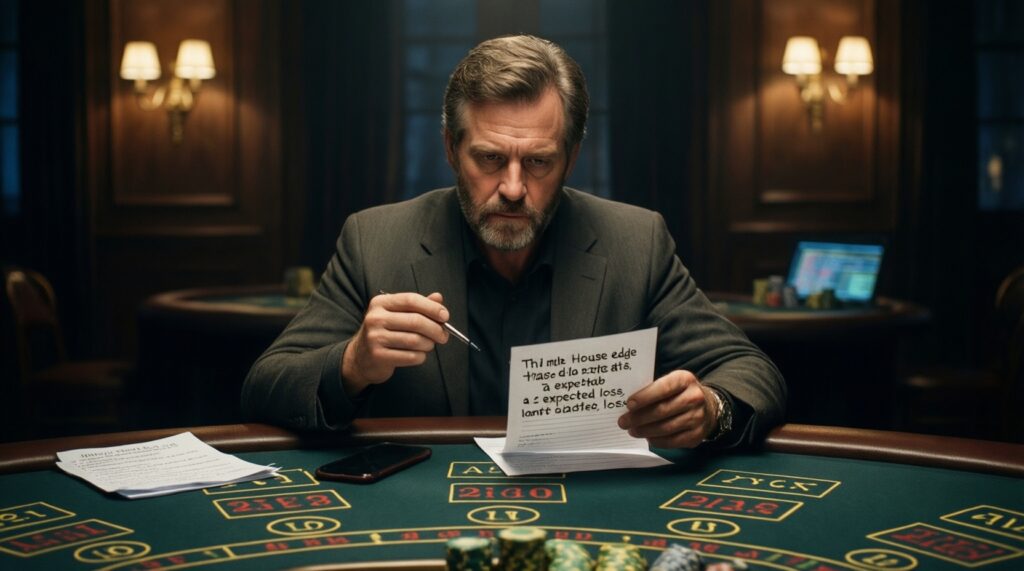
- House edge is an average over many bets; it cannot predict a single session outcome.
- Expected loss is based on total wagering: house edge (%) × total amount bet.
- Compare games by rules + strategy + bet size + speed, not by the headline percentage alone.
- For limited bankroll, control volatility and pace (smaller bets, fewer rounds), not just the "lowest edge" label.
- For limited time, focus on games where you can play correctly with minimal effort.
- Use "casino house edge by game" comparisons as a starting point, then confirm the exact rules and your ability to execute.
Debunking Common Myths About House Edge
Myth 1: House edge is the same as "what you will lose." It's an expectation (long-run average) tied to wagering volume. In a short session you can win or lose far more than the expected loss, in either direction.
Myth 2: House edge is measured on your deposit. It is measured on the amount you bet (your turnover). If you bet the same bankroll repeatedly, your total wagers can be many times larger than what you brought.
Myth 3: A lower edge always means "better" for every player. A low edge game played with poor decisions, confusing side bets, or fast/large wagering can cost more than a slightly higher edge game you can play accurately and slowly.
Myth 4: A "best casino games with lowest house edge" list is universal. The actual edge depends on specific rules, optional bets, and how you play. Treat lists as a filter, not a guarantee.
What House Edge Actually Means - Plain Definition
If you're asking what is house edge, the plain definition is: the casino's average profit per unit wagered, assuming the game is played under stated rules (and, in skill-based games, with a defined strategy).
- It's a percentage of each unit wagered over a large number of bets.
- It's not a prediction of your next result or your "typical" session.
- It assumes a specific way of playing (especially in blackjack-style decision games).
- It applies to the base bet; side bets often have a different (often worse) edge.
- It scales with volume: more total wagering means more expected loss.
- It does not describe volatility: two games can share the same edge but feel wildly different in swings.
Converting a Percentage into Expected Dollar Loss
The translation is straightforward: Expected loss = (house edge) × (total amount wagered). You can do it in your head, or use a house edge calculator when you want to include pace, session length, and varying bet sizes.
Common scenarios where this conversion matters

- Budgeting a session: estimate how much "cost" you're accepting for entertainment before you start.
- Comparing two games fairly: compare expected loss on the same total wagering, not on the same starting bankroll.
- Setting a stop time (limited time): fewer rounds means less total wagering, which can reduce expected loss even if the edge stays the same.
- Checking the impact of side bets: even small side-bet amounts can add noticeable expected loss if repeated many times.
- Evaluating promos or comps: compare the value you expect to receive versus the expected loss you generate through wagering.
Quick mental math (no tools, limited resources)
- Per 100 currency units wagered: expected loss ≈ house edge % of 100. Example: at 2%, you "pay" about 2 units per 100 wagered on average.
- Per hour estimate: expected loss ≈ house edge × (average bet) × (hands/spins per hour). If you don't know pace, ignore it and estimate using a conservative number of rounds.
| What you know | What you compute | Practical use |
|---|---|---|
| House edge (%) and total amount wagered | Expected loss for the session | Set an entertainment budget cap |
| House edge (%) and average bet | Expected loss per 100 units wagered | Compare games without needing pace |
| House edge (%), average bet, approximate rounds/hour | Expected loss per hour | Plan time-limited play and reduce turnover |
Concrete Examples: Slots, Blackjack, Roulette
These are translation examples, not claims about any specific casino's exact percentages. Use the same method with the published edge for the exact game and rules you're playing.
Simple translation examples (using your own edge values)
- Slots: if the game's edge is E and you wager 5,000 THB total across many spins, expected loss ≈ E × 5,000 THB.
- Blackjack: if the edge under your rules and your strategy is E and you wager 10,000 THB total, expected loss ≈ E × 10,000 THB. If you deviate from solid strategy, treat E as higher.
- Roulette: if you repeatedly place the same type of bet, you can translate the edge the same way: total staked across spins × edge. Different bet types in the same wheel share the same structural disadvantage, while side features can change the effective cost.
Practical advantages and limitations by game type
- Slots: easy to play correctly (no strategy errors), but often high variance and fast turnover can inflate hourly expected loss.
- Blackjack: can be efficient when rules are favorable and you play accurately, but decision errors and tempting side bets can erase the advantage of a low baseline edge.
- Roulette: very easy to execute consistently; bankroll swings can still be large, and special side bets can materially increase expected loss.
When House Edge Misleads: Variance and Session Length
- Short sessions distort intuition: you can be up even when the game is negative-EV, or down far more than expectation.
- Variance is separate from edge: two games with the same edge can have very different "swinginess," affecting bankroll survival.
- Speed matters more than most players think: a modest edge with very fast rounds can cost more per hour than a higher edge with slower play.
- Bet sizing changes the experience: same edge, bigger bets → bigger swings and larger expected loss per hour because you're wagering more.
- Side bets and "features" can dominate cost: small add-ons repeated frequently can drive your effective expected loss.
- Misreading "casino house edge by game" charts: the chart's assumptions may not match your table rules, your decisions, or the version offered online.
How to Use House Edge to Shape Real Betting Choices
This is a practical way to decide between two games (or two betting styles) when your resources are limited (bankroll, time, or attention).
Mini-case: choose the cheaper session, not the "best" game headline
- Write down your constraints: bankroll you're willing to lose (e.g., 1,000 THB), and time (e.g., 60 minutes).
- Estimate your total wagering: average bet × approximate rounds you'll play. If you can't estimate rounds, assume a conservative low number to avoid underestimating cost.
- Compute expected loss: edge × total wagering. This is the same math an expected value gambling calculator performs.
- Adjust for limited attention: if a game requires decisions you won't reliably execute, assume a higher effective edge (or avoid it).
- Pick the option with the lowest expected loss that you can actually play consistently and that fits your variance tolerance.
Low-resource shortcut (pseudo-logic you can apply quickly)
Given each option i:
  expected_loss_i = edge_i * (avg_bet_i * rounds_i)

If you cannot estimate rounds_i:
  compare per-100 wagered cost instead:
    cost_per_100_i = edge_i * 100

Choose the option with lower cost that you can execute correctly.
Then reduce avg_bet or rounds to reduce total wagering.
Use this approach before searching for the "best casino games with lowest house edge": first control your turnover (bet size × speed), then optimize the edge.
Practical Questions Players Ask
Does house edge mean I will lose that percentage every time?
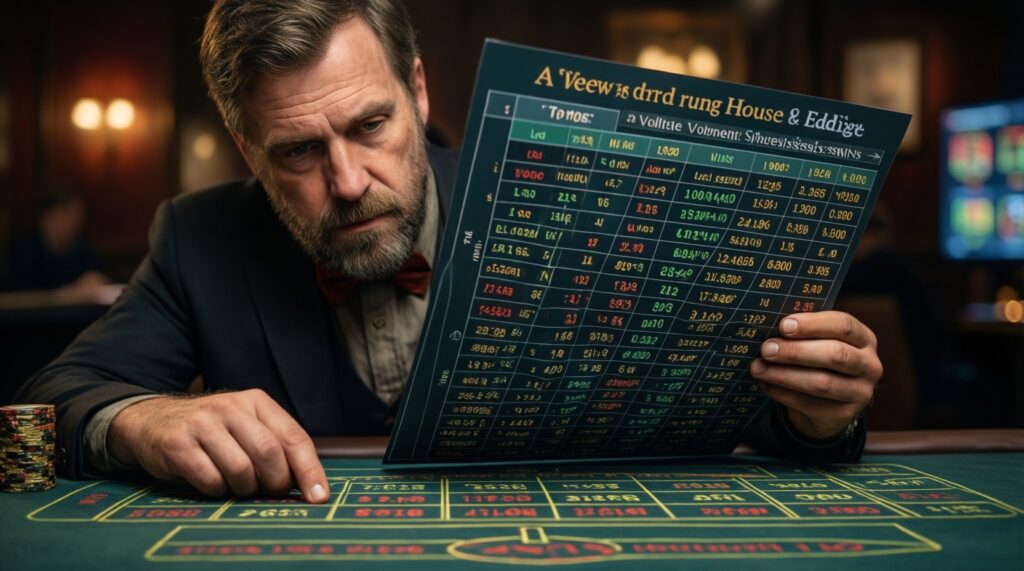
No. House edge is a long-run average over many bets; any single session can be above or below that expectation.
Is expected loss calculated on my deposit or on the amount I bet?
It's calculated on the total amount wagered. If you recycle the same bankroll through many bets, your wagering can be multiple times your deposit.
Can I trust a house edge calculator I find online?
Only if you input the correct edge for the exact rules and include realistic bet size and pace. Treat the output as an estimate, not a promise.
Why do "casino house edge by game" lists disagree?
Because rules, payout tables, optional bets, and assumed strategy differ. Small rule differences can change the effective edge, especially in decision-based games.
What are the best casino games with lowest house edge for someone who plays casually?
Usually the best choice is the game you can play correctly with minimal effort and without frequent side bets. A slightly higher edge can be cheaper in practice if it slows your wagering and reduces mistakes.
Is an expected value gambling calculator useful if outcomes are random?
Yes. It estimates the average cost of your wagering plan over time, which helps you budget and compare options even when short-term outcomes are unpredictable.