

Feature triggers are the rule set that decides when a slot leaves base play and enters a bonus (free spins, pick games, hold-and-spin) and how often it can retrigger. Modeling the odds means turning those rules into explicit probabilities (per spin or per state) so you can estimate bonus round trigger odds, validate RTP/volatility intent, and test changes before release.
Core mechanics and probabilistic summary
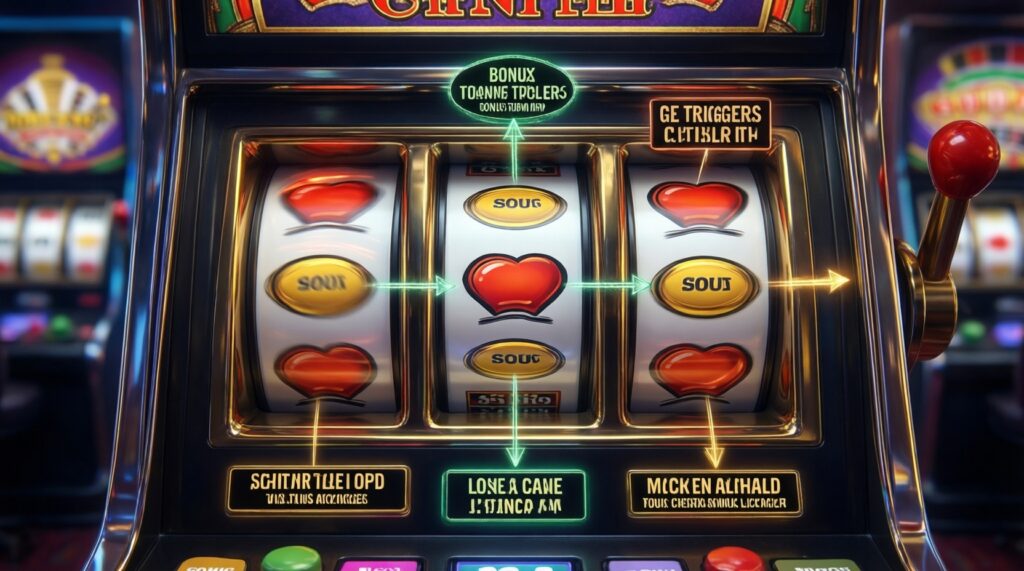
- Most feature triggers bonus rounds can be modeled as either independent Bernoulli trials (per spin) or state-dependent processes (Markov/state machine).
- "Trigger odds" is a definition choice: per spin probability, average spins-to-trigger, or distribution of waiting times.
- Retriggers create path dependence: the chance of extending a feature often depends on the current feature state (spins left, collected symbols, meters).
- Analytical models are fast and explainable; empirical logs are robust against hidden implementation details.
- A slot bonus round probability calculator is only as accurate as its assumptions about independence, sampling, and state.
Defining feature triggers and their role in slot math
A feature trigger is the formal condition that transitions the game from one payout process to another (base → bonus, bonus → extended bonus, bonus → different bonus). In practice, it is implemented as one or more of: symbol-count conditions, meter thresholds, mystery-weighted events, or scripted sequences.
For math and QA, treat a trigger as a measurable event with a clear denominator. The cleanest denominator is "per spin in base mode," but you may also need "per bonus spin," "per paid feature," or "per session" depending on how you report bonus round trigger odds.
Scope boundaries that prevent bad modeling: (1) define the mode in which the trigger is eligible, (2) define the resolution rule when multiple triggers can occur, and (3) define whether any "mystery" event is independent of reels or derived from the same RNG outcome.
- Checklist: confirm the denominator (base spin vs bonus spin) before quoting odds.
- Checklist: document trigger priority when multiple features can fire together.
- Checklist: separate "reel event" probability from "post-reel" mystery weights.
Probability models for bonus-round activation
Common ways to model activation depend on what actually drives the trigger. Pick the simplest model that matches implementation, then validate against logs or simulation.
- Independent per-spin trigger (Bernoulli): each eligible spin triggers with probability p; waiting time is geometric. Use when the trigger is a single weighted event or a simple symbol condition with stable per-spin probability.
- Compound trigger (multiple conditions): trigger if A and B occur (e.g., scatter count AND a coin flip). Compute P(trigger)=P(A)·P(B|A) when the dependency is explicit.
- Meter / collection (stateful): each spin changes a meter; trigger occurs on threshold. This is not memoryless; you need state modeling or simulation.
- Multi-reel or multi-stage: one event unlocks eligibility for another (e.g., "on any win, roll for feature"). Model as conditional probability chains.
- Scripted or guaranteed triggers: e.g., "must trigger by N spins." Model with capped waiting time (hazard schedule) rather than a constant p.
| Model type | Assumption | What it estimates well | Common failure mode |
|---|---|---|---|
| Bernoulli (per spin) | Trigger probability is constant and independent per eligible spin | Average spins-to-trigger; clean trigger odds | Breaks when eligibility/state changes during play |
| Conditional chain | Dependencies are explicit (A then B) | Multi-step triggers and "on win roll feature" setups | Hidden coupling when both use the same RNG outcome |
| State machine / Markov | Finite states summarize all memory needed | Meters, collectables, feature ladders, retriggers | State definition misses a variable (e.g., remaining spins) |
| Empirical (log-based) | Data reflects true live RNG + code paths | Black-box validation; regression detection | Biased samples (wrong mode mix, short runs) |
- Checklist: choose a model whose assumptions match code-level eligibility rules.
- Checklist: express the output as both p per spin and waiting-time distribution, not only an average.
- Checklist: validate with at least one independent method (analytic vs sim vs logs).
Retrigger mechanics: state machines and memory effects
Retriggers are where "simple odds" fail most often. The correct object is usually a state machine: base state, bonus state(s), and transition probabilities that depend on the current state. This is the practical core of retrigger odds slot games.
- Free spins add-on: during free spins, landing scatters adds +k spins. The retrigger probability is per bonus spin, but the total extension depends on remaining spins (state).
- Hold-and-spin resets: landing a coin resets a countdown. Here, the "survival" of the feature is a function of hit frequency relative to the reset timer.
- Collection meters inside bonus: each hit advances a ladder; reaching a tier changes symbol weights. State must include tier and remaining spins.
- Progressive-style "must-hit-by" inside feature: hazard increases as spins elapse, making retrigger odds time-varying.
- Nested bonuses: a bonus can trigger a second mode. If nested eligibility depends on outcomes already constrained by the first mode, independence assumptions are usually wrong.
- Checklist: define states that include everything that changes transition probabilities (spins left, tier, timers).
- Checklist: measure retrigger odds per eligible bonus spin, not per base spin, unless explicitly converting.
- Checklist: confirm whether bonus reels/weights differ from base, because that changes all transitions.
Estimating trigger odds: empirical vs analytical approaches
For production math work, you typically triangulate: compute an analytical estimate, then reconcile with logs or simulation. A "one number" slot bonus round probability calculator is useful only after you lock the definitions (mode, eligibility, and whether you're quoting per-spin or per-session odds).
Analytical (when you can derive it)

- Pros: fast iteration, explains why odds change, good for sensitivity analysis (which reel/weight matters).
- Limits: brittle under stateful logic (meters, resets), hard when RNG reuse couples events, easy to mis-define the denominator.
Empirical (when you can measure it)
- Pros: captures real code paths, catches implementation drift, naturally includes state and priority rules.
- Limits: needs enough data per mode, can be biased by test scripts (auto-spins that don't mimic real mode mix), must segment by eligibility.
Worked numeric example (common and practical)
Suppose a base-game trigger is "3 scatters anywhere," and you estimate the per-spin probability as p = 0.004 from either an analytical reel model or clean logs. Then the average spins-to-trigger is approximately 1/p = 250 spins (geometric waiting time). If you add a post-reel 50% gate ("after 3 scatters, flip a coin to enter bonus"), your effective trigger probability becomes 0.004 × 0.5 = 0.002, and average spins-to-trigger becomes ~500.
- Checklist: keep "raw condition" odds separate from post-condition gates and eligibility filters.
- Checklist: report both p and implied "average spins-to-trigger," labeled by mode.
- Checklist: segment measurements by game state (base vs feature vs feature-buy).
Designing feature schemes consistent with RTP and volatility targets
Trigger design is a balancing act: if you push triggers rarer, you often need higher bonus intensity to keep RTP, which usually increases volatility. If you make triggers frequent, you must control bonus distribution tails to prevent runaway variance and unpleasant bankroll swings.
- Myth: "Lowering trigger frequency doesn't affect feel if RTP stays constant." In practice it shifts wins into rarer events, changing session variance and perceived droughts.
- Error: mixing denominators. Publishing "1 in X" without stating whether X is base spins, all spins, or only eligible spins makes comparisons meaningless.
- Error: retrigger loops without a brake. If reset mechanics and hit rates allow long survival tails, you can accidentally create extreme outcomes that dominate RTP.
- Error: assuming feature-buy mirrors natural entry. Buy bonus feature trigger odds are usually "certain entry," so the relevant odds move to inside-feature outcomes and retriggers, not the base trigger.
- Myth: "A single trigger probability defines volatility." Volatility is driven by the whole payout distribution, especially tail behavior during bonuses and retriggers.
- Checklist: verify every quoted "1 in X" explicitly states mode and eligibility.
- Checklist: cap or dampen retrigger loops (timers, decreasing weights, tier limits) intentionally, not accidentally.
- Checklist: treat feature-buy as a separate product with its own distribution and tests.
Simulating outcomes: Monte Carlo setup and variance diagnostics
When state and priority rules make closed forms messy, Monte Carlo is the practical default: simulate many spins, track state transitions, and estimate trigger/retrigger rates with confidence bounds. This is often the most reliable path when validating bonus round trigger odds and retrigger odds slot games side-by-side.
Minimal simulation skeleton (pseudocode)
state = "BASE"
spins_left_in_bonus = 0

for i in 1..N:
  if state == "BASE":
    outcome = spin_base()
    if triggers_bonus(outcome):          # e.g., 3 scatters + optional gate
      state = "BONUS"
      spins_left_in_bonus = award_spins(outcome)
      count_bonus_entries += 1

  else if state == "BONUS":
    outcome = spin_bonus()
    spins_left_in_bonus -= 1
    if retrigger(outcome, spins_left_in_bonus):
      spins_left_in_bonus += award_extra_spins(outcome)
      count_retriggers += 1

    if spins_left_in_bonus == 0:
      state = "BASE"
Variance diagnostics you should actually check
- Stability over run splits: compare estimates across equal-sized chunks (early vs late). Large drift suggests N is too small or state logic is wrong.
- Mode-conditioned rates: compute triggers per eligible base spin and retriggers per eligible bonus spin separately.
- Tail monitoring: track max bonus length and max win; if rare extremes dominate totals, increase N and review brakes/caps.
- Checklist: log state variables (tier, spins left, meters) to debug why rates differ from expectation.
- Checklist: compute rates per eligible spin in each mode, not blended across modes.
- Checklist: rerun with a fixed RNG seed for reproducible regression tests.
Main-content self-check before you publish odds

- Did you define "odds" as per-spin probability, average spins-to-trigger, or a full waiting-time distribution?
- Did you separate base eligibility from bonus eligibility (and exclude ineligible spins from denominators)?
- Did you validate analytical assumptions with either logs or Monte Carlo using the same trigger priority rules as code?
- Did you treat feature-buy as its own flow (entry is guaranteed; uncertainty shifts to in-feature results)?
Operational clarifications and edge cases
Is "1 in X" the same as trigger probability?
Only if X is defined as eligible spins in the same mode and the trigger is memoryless. Otherwise, "1 in X" can hide state effects and produce misleading comparisons.
How do I convert trigger probability to average spins-to-trigger?
If the trigger is a constant per-spin probability p, average spins-to-trigger is approximately 1/p. For meters or "must-hit-by" schedules, you need a stateful model or simulation.
Why do retrigger odds change during a bonus?
Because the effective state changes: remaining spins, tiers, reset timers, and altered reel weights can all shift the probability of adding spins or resetting counters.
Can I treat scatters and mystery triggers as independent?
Only if they come from independent RNG draws. If a mystery feature is derived from the same outcome evaluation, independence assumptions can overestimate combined trigger rates.
What's the practical meaning of a "slot bonus round probability calculator"?
It's a calculator for a specific model and definition-typically per-spin Bernoulli with constant p. It is not automatically valid for collection mechanics, resets, or nested bonuses.
How should I interpret buy bonus feature trigger odds?
In most designs, buying the feature makes entry certain, so "trigger odds" move from base-game entry to the distribution of outcomes inside the purchased bonus, including retriggers and tails.
What sample segmentation is non-negotiable when measuring odds from logs?
At minimum: separate base spins, bonus spins, and any altered modes (ante bets, feature-buy, different denominations/configs). Mixing modes corrupts denominators and changes apparent rates.