
Cascading reels, Megaways, and multipliers are three common slot design mechanics that change how wins are formed and amplified. Cascades replace winning symbols to create chain reactions, Megaways varies reel heights to produce changing ways-to-win, and multipliers increase payout values. Used together, they mainly shift volatility, hit feel, and session rhythm.
Core mechanics snapshot
- Cascades create multi-win sequences inside one spin by removing winning symbols and dropping new ones.
- Megaways dynamically changes the number of ways-to-win by varying how many symbols land on each reel.
- Slot multipliers are payout amplifiers that can be constant, build up, or stack across events.
- All three can be purely presentation-neutral: outcomes must still be governed by the RNG and the game's math model.
- Player perception is shaped by tempo (how often something happens) more than by any single feature label.
How cascading reels work: step-by-step
Cascading reels (also called tumbling) mean a win does not end the spin immediately. Instead, winning symbols are removed, remaining symbols fall into gaps, and new symbols enter from the top, potentially creating additional wins in a chain.
In practice, cascading reels slots are defined by two boundaries: (1) the "remove-and-drop" loop, and (2) a stopping condition (no new wins, cascade limit reached, or feature rule ends the sequence). Everything else-how symbols enter, whether reels "bounce," whether wins are per-way or per-line-can vary.
Simple loop diagram:
- Evaluate the grid for wins.
- If win: pay it, mark winning symbols.
- Remove marked symbols; drop remaining symbols downward.
- Spawn new symbols into empty cells.
- Repeat until no win (or a cap is reached).
Megaways mechanics: variable paylines and probability
Megaways slots use variable reel heights so the number of ways-to-win changes every spin. Instead of a fixed "25 lines," the engine counts combinations across reels based on how many symbols are visible on each reel.
- Variable reel window: each reel lands with N visible symbols (N may differ per reel and per spin).
- Ways calculation: total ways = (symbols on reel 1) × (reel 2) × ... × (reel R).
- Win evaluation: wins are typically left-to-right, counting matching symbol paths across adjacent reels.
- Symbol distribution still rules: "more ways" does not automatically mean "higher RTP" or "more frequent wins"; it changes how probability is expressed.
- Feature interaction: when paired with cascades, each drop can also change reel heights, multiplying the sense of momentum.
| Mechanic | What changes on a spin | Main player-facing effect | Primary design risk | Best-fit mini-scenario |
|---|---|---|---|---|
| Cascades | One spin can contain multiple evaluations (chain wins). | Longer "spin narrative" and bursty win streaks. | Overlong animations; perceived "near-miss farming" if pacing is wrong. | Mobile-first: quick base game that occasionally erupts into 3-6 rapid hits. |
| Megaways | Number of ways-to-win varies because reel heights vary. | Constant variety; reels feel "alive." | Players misread ways as guaranteed advantage; volatility can spike unintentionally. | Streamer-friendly: big-swing identity where rare high-way spins drive excitement. |
| Multipliers | Payout is multiplied by a factor triggered by rules (fixed or building). | Clear, legible value boost. | Inflated top wins or dead-feeling base game if multiplier is too gated. | Bonus-centric: free spins where every cascade increases a multiplier meter. |
Multipliers demystified: fixed, progressive, and stacked
Multipliers are rules that multiply a win amount after the win is formed. In slot multipliers, the key question is not "is there a multiplier," but where it attaches (per win, per cascade step, per spin, per feature) and how it accumulates.
- Fixed multiplier on specific symbols: a wild lands as 2×/3× and multiplies only wins it participates in. Mini-scenario: a low-volatility base game where occasional 2× wilds keep sessions lively without changing cadence.
- Progressive multiplier per cascade: multiplier increases each cascade step (e.g., step 1 = 1×, step 2 = 2×, etc.). Mini-scenario: play cascading reels slots online with a "one more drop" feeling; the multiplier ladder is the emotional hook.
- Stacked multipliers (additive or multiplicative layers): a reel multiplier (e.g., 2×) combines with a feature multiplier (e.g., +3×) and a symbol multiplier (e.g., 2×). Mini-scenario: high-volatility free spins built for rare spikes and highlight moments.
- Session-based multiplier meter: a gauge fills across spins, then activates a temporary boost. Mini-scenario: retention-focused design where small, frequent progress signals reduce churn during dry streaks.
- Buy-feature / bonus entry multipliers: a purchased bonus starts at a higher base multiplier. Mini-scenario: "expert mode" players trade bankroll risk for faster access to headline math.
Balancing act: volatility, hit frequency, and perceived fairness
These mechanics mostly reshape distribution: how often wins happen, how clustered they feel, and how much of the RTP is allocated to rare events. Players interpret this as "fairness," even when the math is sound.
Advantages you can deliberately target
- More readable excitement: multipliers give a simple reason why a win is big.
- Better pacing knobs: cascades let you tune "event density" without forcing more base-game spins.
- Content variety: Megaways variability reduces repetition; it's easy to market and demo.
- Stronger feature identity: combining Megaways + cascades + multipliers can define a recognizable "signature loop."
Limitations and player-trust pitfalls
- Volatility creep: adding multipliers on top of Megaways can push too much value into extreme tails.
- Tempo fatigue: long cascade chains can feel slow on mobile if animation and sound aren't optimized.
- Misinterpretation risk: players may assume "more ways" means better odds; messaging must be careful.
- UI overload: stacking meters, ladders, and way-counts can confuse mid-session decisions.
Implementation considerations: RNG, symbol pools, and performance
- RNG scope confusion: decide whether outcomes are resolved upfront (one RNG result expanded into cascades) or resolved per cascade step. Both can be valid if your math and certification approach match.
- Symbol pool integrity: when spawning new symbols during cascades, define whether symbols are sampled independently, from weighted distributions, or from prebuilt strips; keep it consistent with the model.
- Megaways reel height coupling: ensure reel-height selection doesn't accidentally bias specific symbols unless intentionally designed (and tested).
- Multiplier stacking order bugs: clearly define evaluation order (line/ways win → symbol multiplier → feature multiplier → total win cap rules) and test edge cases.
- Performance budget: cascades can trigger multiple evaluations and animations per spin; optimize win detection and batching, especially on mid-range Android devices common in TH.
- Compliance-safe wording: avoid UI text that implies guaranteed improvement (e.g., "more ways = higher chance"); stick to descriptive labels.
Measuring success: metrics, testing protocols, and iteration
Evaluate these mechanics with a loop that checks both math outcomes and player-perceived pacing. The goal is not "more features," but a controllable distribution and an understandable reason for big moments.
Mini-case: tuning a cascade + multiplier ladder
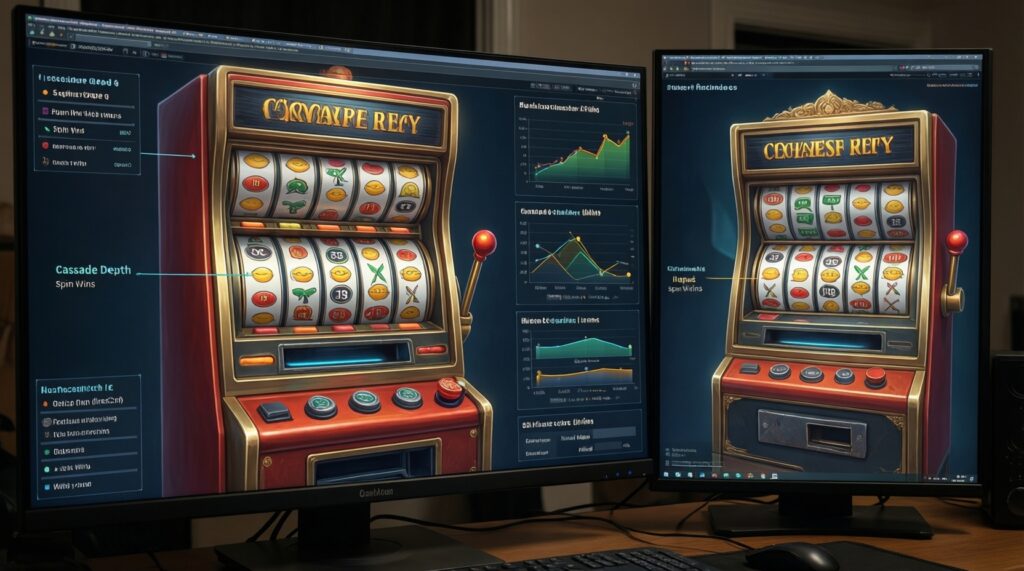
- Prototype: cascades with a per-step multiplier (1×, 2×, 3×... capped).
- Instrument: log cascade length, win per spin, time per spin, and top-10 win event causes (which mechanic contributed).
- Adjust: if sessions feel slow, reduce average cascade depth via symbol weights or stop rules; if wins feel flat, shift value from base hits into mid-ladder multipliers (not only the max).
for each paid_spin:
  grid = roll_initial_outcome()
  multiplier = 1
  while has_win(grid) and cascades < cap:
    pay(win(grid) * multiplier)
    grid = remove_wins_and_drop(grid)
    grid = spawn_new_symbols(grid)
    multiplier = min(multiplier + step, max_mult)
Compact design self-check (before release)
- Does each mechanic have a single, player-readable purpose (pace, variety, or amplification) rather than redundant layering?
- Is the multiplier stacking order documented and test-covered for edge cases (simultaneous wins, capped wins, retriggers)?
- Can the game remain engaging during low-event streaks without misleading "almost" feedback?
- Is performance stable on typical TH devices when a long cascade chain occurs?
- If you promote "megaways slots," is your UI copy careful enough to avoid implying better odds?
Common clarifications and edge cases
Do cascading reels change RTP by themselves?
No. Cascades change how wins are delivered and clustered; RTP depends on the underlying paytable, symbol distributions, and feature allocation.
Are Megaways always more volatile than fixed-line games?
Not always. Many Megaways implementations trend higher volatility, but the final volatility comes from the full math model, especially bonus weighting and multiplier usage.
Can I combine Megaways and cascades without making the game feel too long?
Yes, if you cap cascade depth, speed up animations, and avoid frequent micro-wins that extend spin time without meaningful value.
What's the most common bug with slot multipliers?
Incorrect stacking or order of operations-paying a multiplied win twice, applying a multiplier to the wrong win component, or forgetting caps in one pathway.
How should players choose "best megaways casinos" in Thailand context?
Focus on licensing clarity, transparent bonus terms, and reliable withdrawal reputation; the mechanic label doesn't guarantee a better experience or better odds.
Is it safe to advertise "play cascading reels slots online" as a feature message?
Yes, if the message stays descriptive (cascades/tumbles) and avoids implying improved chances or guaranteed chains.
Do more ways-to-win mean more frequent wins?
Not necessarily. More ways changes the combinatorics, but symbol frequencies and paytable thresholds determine actual hit rate.