

To buy feature options (paid add-ons or capability packages), the numbers make sense only when incremental gross profit reliably exceeds total lifecycle cost within your acceptable payback window, and the risk of not having the capability is material. Model uplift conservatively, include integration and support costs, and stress-test best/base/worst before signing.
When to Consider Purchasing a Product Feature: Quick Financial Snapshot
- Clear, measurable outcome (conversion, retention, ARPA, cost-to-serve) tied to the feature.
- Incremental gross profit plausibly covers purchase + integration + ongoing costs within your target payback window.
- You can validate uplift with a pilot, controlled rollout, or credible historical baseline.
- Implementation risk is bounded (data access, security, operations) and has an owner.
- Opportunity cost of building is higher than buying (time-to-market or scarce engineering capacity).
Define the Feature and Competitive Need
Start by pinning down what the "feature option" actually delivers and what failure looks like without it. This page focuses on product feature options (vendor add-ons, modules, tier upgrades), not feature options trading in financial markets; the financial evaluation discipline is similar, but the risks, rules, and tooling differ.
- Good fit: the capability is commoditized, externally proven, and your differentiation is elsewhere (workflow, distribution, data, brand).
- Not worth it: the feature is core to your unique product advantage, or you cannot instrument outcomes (no baseline, no tracking, no attribution).
- Also avoid: "checkbox" purchases driven by internal pressure with no adoption plan and no accountable owner.
Quantify Incremental Revenue and Conversion Uplift
You need inputs you can defend, not perfect forecasts. Collect access, tools, and baselines before discussing feature options pricing with a vendor.
- Data access: analytics events, funnel reports, cohort retention, CRM pipeline stages, billing/subscription exports.
- Baseline metrics: traffic/leads, activation and conversion rates, churn/retention, ARPA/ARPU, gross margin (or contribution margin).
- Experiment plan: A/B test capability, phased rollout, or matched-cohort comparison; define success metric and duration.
- Attribution rules: how you credit uplift (first-touch/last-touch/multi-touch) and how you handle seasonality.
- A simple "feature options calculator" sheet: inputs, formulas, and scenario toggles (best/base/worst) with locked assumptions.
Compact decision metrics (formulas + practical go/no-go thresholds)
| Metric | Formula (simple version) | Interpretation | Go/No-go rule of thumb (adapt to your policy) |
|---|---|---|---|
| Incremental gross profit / month | (Incremental revenue × gross margin) − incremental variable costs | Cash-like benefit you can compare to ongoing costs | Must be positive in base case; ideally remains positive in worst case |
| Payback period | Upfront cost ÷ incremental gross profit per month | How fast you recover upfront spend | Payback ≤ your internal limit (often 6-18 months; set yours explicitly) |
| 1st-year ROI | (12×monthly benefit − total year-1 costs) ÷ total year-1 costs | Year-1 efficiency including integration | Positive in base case; higher hurdle if risk is high |
| Breakeven uplift | Total monthly cost ÷ (baseline volume × gross profit per conversion) | Minimum required improvement to not lose money | If required uplift is unrealistic vs historical swings, do not buy |
| Adoption feasibility | Target active users × expected adoption rate | Whether the org will actually use the feature | No owner + no rollout plan = no-go regardless of ROI math |
Estimate Costs: Purchase, Integration, and Ongoing
Preparation checklist (before you request a quote or sign anything):
- List systems the feature touches (analytics, CRM, billing, identity, data warehouse) and name technical owners.
- Document data fields needed and where they live; confirm permission/PDPA constraints for Thailand context.
- Define success metric(s), measurement method, and decision date for go/no-go.
- Decide deployment mode (cloud/SaaS, on-prem, hybrid) and security review requirements.
- Write the minimum acceptable scope (what you will not pay for) and the must-have integrations.
-
Itemize the vendor price components
Request a quote that separates license/subscription, usage-based fees, seats, environments (prod/staging), and any "premium support" bundles. This prevents feature options pricing surprises after rollout.
- Ask how pricing changes with volume and what triggers overages.
- Confirm renewal terms, price escalators, and cancellation conditions.
-
Estimate one-time integration and rollout effort
Translate implementation into internal cost (engineering, QA, security, legal, procurement) plus any partner/consulting fees. Include time for documentation, training, and change management.
- Integration: APIs, SSO, data pipelines, web/mobile SDKs.
- Operational readiness: monitoring, on-call, incident process.
-
Quantify ongoing operating costs
Account for recurring costs beyond the invoice: extra cloud spend, support tickets, data storage, and the internal owner's time. If the feature creates more transactions, include variable costs.
- Support: escalation paths, SLA needs, and who handles L1/L2.
- Compliance: periodic audits, vendor reviews, access recertification.
-
Price the risk and exit plan
Add budget and time for vendor failure, roadmap changes, or underperformance. Define how you export data and how you would replace the feature if needed.
- Data portability: export format, frequency, retention.
- Termination: notice periods, post-termination access, and delete confirmation.
-
Lock assumptions into a single model
Put every assumption into one sheet (your feature options calculator): costs, uplift, adoption, margin, and timeline. Keep a separate "inputs" tab and document each input's source (system report, pilot, stakeholder estimate).
Worked numerical example (illustrative only)

| Input | Value | Notes |
|---|---|---|
| Monthly baseline conversions | 2,000 | From current funnel report |
| Gross profit per conversion | ฿600 | Contribution after variable costs |
| Expected uplift (base case) | +3% | Measured in pilot or conservative estimate |
| Incremental conversions / month | 60 | 2,000 × 3% |
| Incremental gross profit / month | ฿36,000 | 60 × ฿600 |
| Vendor subscription / month | ฿20,000 | Recurring invoice |
| Ongoing internal ops / month | ฿5,000 | Support + monitoring time |
| Net benefit / month | ฿11,000 | ฿36,000 − (฿20,000 + ฿5,000) |
| One-time integration cost | ฿120,000 | Engineering + security + rollout |
| Payback period | ~11 months | ฿120,000 ÷ ฿11,000 |
Sensitivity mini-table (best/base/worst)
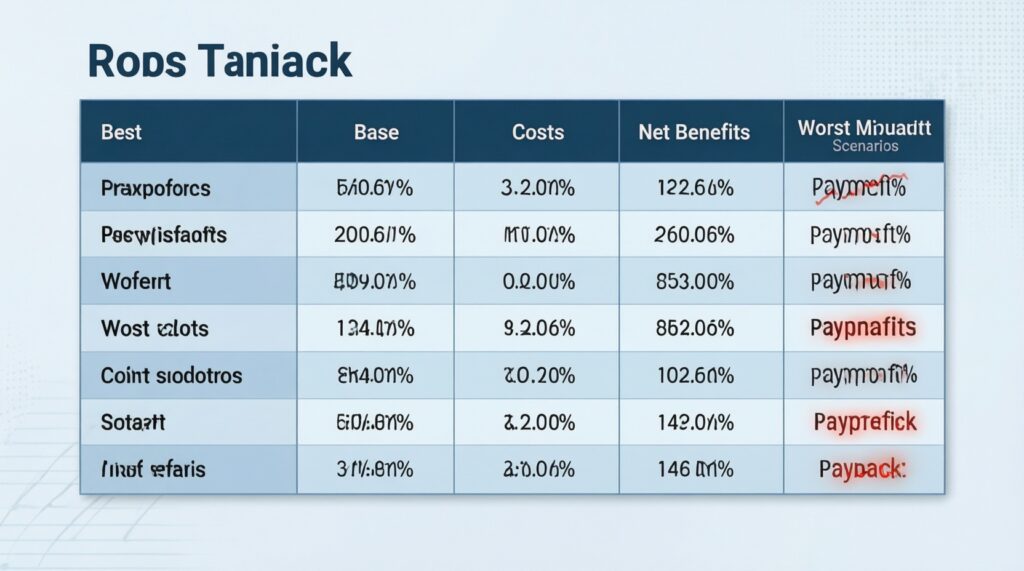
| Scenario | Uplift | Incremental gross profit / month | Total recurring cost / month | Net benefit / month | Payback (months) |
|---|---|---|---|---|---|
| Best | +5% | ฿60,000 | ฿25,000 | ฿35,000 | ~3.4 |
| Base | +3% | ฿36,000 | ฿25,000 | ฿11,000 | ~10.9 |
| Worst | +1% | ฿12,000 | ฿25,000 | −฿13,000 | Not achievable |
Build a Payback and ROI Model with Sensitivity Bands
- Confirm the uplift is incremental (not cannibalized from another channel or plan tier).
- Separate one-time costs (integration, onboarding) from recurring costs (license, ops).
- Use contribution margin, not top-line revenue, for the benefit side.
- Model ramp-up: adoption is rarely 100% in month one.
- Include "do nothing" costs if relevant (lost deals, higher churn, compliance exposure), but keep assumptions explicit.
- Run best/base/worst scenarios with only 2-3 drivers changing (uplift, adoption, volume).
- Check that worst case is survivable (budget impact and operational load).
- Define a kill switch: the metric threshold and the date you stop paying if results don't appear.
Non‑Financial Factors: Time‑to‑Market, Risk, and Product Strategy
- Buying a feature that conflicts with your product's differentiation (you outsource the "why us").
- Underestimating integration risk: identity/SSO, data quality, mobile SDK edge cases, and QA time.
- Security and PDPA reviews treated as afterthoughts, delaying launch and inflating cost.
- Vendor lock-in without a tested export path or documented exit plan.
- Success metrics that are unmeasurable in practice (no event tracking, unclear cohorts).
- No operational owner (incidents, billing disputes, customer support escalation).
- Assuming the vendor roadmap replaces your roadmap; priorities diverge after purchase.
- Comparing vendors by marketing claims instead of a pilot and reference checks.
Decision Checklist: When to Buy, When to Build, When to Delay
Use these yes/no gates. If you hit a "No" in any red-line item, pause and fix inputs rather than forcing a decision.
Option A - Buy (paid feature option / add-on)
- YES: you can measure uplift with a pilot or clean baseline.
- YES: payback in base case meets your policy and worst case is acceptable.
- YES: integrations and security requirements are standard and owned.
- YES: you have an exit path (data export + replacement plan) documented.
Option B - Build in-house
- YES: the capability is a strategic differentiator and will evolve rapidly.
- YES: your team can deliver an MVP fast enough to beat the opportunity cost.
- YES: you need deep customization or unique data/UX not served by vendors.
- NO: building would crowd out more valuable roadmap items.
Option C - Hybrid (buy core, build the differentiating layer)
- YES: vendor provides reliable infrastructure while you build proprietary workflows, scoring, or UI.
- YES: you can isolate the vendor behind an interface to reduce lock-in.
- YES: governance exists for data sharing and ongoing changes.
Option D - Delay / Do nothing (for now)
- YES: required uplift to break even is unrealistic versus historical variance.
- YES: you cannot implement safely (compliance/security blockers, missing data).
- YES: adoption is uncertain and there is no credible rollout owner.
- YES: the decision is being driven by hype (including misunderstandings from feature options trading analogies).
Practical Answers to Common Purchase‑Evaluation Questions
How do I avoid confusing product feature options with feature options trading?
Product feature options are vendor add-ons to a software/service contract; feature options trading refers to financial derivatives. Keep separate tools, stakeholders, and risk controls, and don't reuse trading-style assumptions (like liquidity) in procurement models.
What's the minimum data I need to justify buy feature options?
You need baseline volume, a measurable success metric, gross margin (or contribution margin), and a credible estimate of uplift and adoption. Without these, any ROI output is just a guess.
How should I negotiate feature options pricing without overcommitting?

Ask for a pilot or phased pricing tied to verified usage and outcomes, and separate one-time fees from recurring charges. Ensure renewal terms and overage rules are explicit in writing.
Is there a "best broker for feature options"?
For product add-ons, you usually don't need a broker; you need vendor due diligence, procurement discipline, and reference checks. If you meant financial instruments, use a regulated broker in your jurisdiction and follow local rules, but that is a different decision process.
What should a feature options calculator include?
Inputs for baseline volume, uplift, adoption ramp, gross profit per conversion, one-time costs, recurring costs, and scenario toggles. It should output net monthly benefit, payback months, and a best/base/worst comparison.
When should I stop paying if results don't show up?
Set a decision date and a minimum measurable threshold before signing, then enforce it. If you can't measure outcomes by that date, treat it as a failed implementation and reassess rather than extending by default.
How do I compare vendors safely when claims are hard to verify?
Run a bounded pilot with the same metric definitions, require data export and security documentation, and speak to references with a similar stack. Prefer contracts that preserve your ability to exit without losing critical data.