
Bonus Buy (buy feature) can be "worth it" only when you intentionally trade many small spins for fewer, higher-volatility bonus outcomes and you size bankroll for worst-case streaks. Treat it as a variance tool, not a value booster: compare effective RTP, bonus-entry cost, and your risk limit before deciding.
Quick Evidence: Buy Feature vs Regular Play at a Glance
- Bonus Buy compresses time-to-feature but concentrates variance into fewer events.
- "คุ้ม" depends on your session goal: experience/tempo vs smooth equity curve (not just average return).
- Break-even is formula-based: you need the expected bonus payout to exceed the buy cost (after any fees/conditions).
- Bankroll rules should be stricter for buys: fewer trials means higher chance of ugly short-term outcomes.
- Use buy only when you can tolerate multiple consecutive low bonuses without chasing.
- If you can't define a stop-loss and a maximum number of buys per session, skip.
How Bonus Buy Mechanic Changes Expected Return
If you're asking Bonus Buy สล็อต คืออะไร: it's a paid shortcut that triggers the bonus feature (or a higher chance of it) instead of waiting via regular spins. To judge whether ซื้อโบนัสสล็อตคุ้มไหม, evaluate these criteria first:
- Effective RTP comparison: check whether the game publishes a separate RTP for Bonus Buy vs base game; if not published, assume uncertainty and treat as higher risk.
- Bonus entry price logic: understand the ซื้อฟีเจอร์สล็อต ราคา as "how many base spins it represents" (buy cost ÷ typical stake), then assess how concentrated your outcomes become.
- Hit-distribution quality: does the bonus frequently pay tiny wins (thin middle) or have a more stable mid-range? Thin-middle bonuses punish buying.
- Volatility class: higher volatility + Bonus Buy usually means longer losing streak potential in "bonus units," even if long-run return is similar.
- Feature variability: are there multiple bonus types (good/bad variants)? If yes, buying may land you in the weaker one too often.
- Rules that change mechanics: extra "enhanced" buys, super buys, ante bets, or boosted symbols can change expected value and variance.
- Session objective: entertainment tempo (see more features) vs bankroll growth (avoid concentrated variance).
- Execution discipline: you need preset limits (max buys, stop-loss, stop-win). Without them, buying amplifies tilt.
Volatility Profiles: When Bonus Buys Amplify Risk
Use the comparison below to pick a mode that matches your risk tolerance and why you play. This is also a practical way to interpret สล็อต Bonus Buy แนะนำ without relying on hype.
| Variant | Who it fits | Pros | Cons | When to choose |
|---|---|---|---|---|
| Regular spins (no buy) | Players prioritizing smoother sessions | More trials; less outcome compression; easier stop-loss control | Slower access to features; can feel "dry" | When you want longevity and lower drawdown per minute |
| Bonus Buy (standard) | Intermediate players with defined limits | Fast feature access; consistent "feature-per-session" pacing | Higher short-term variance; fewer data points; streaks feel harsher | When you can afford several low bonuses in a row without increasing stake |
| Super/Enhanced Buy | High-variance seekers who accept swingy results | Potentially higher top-end outcomes and/or improved starting conditions | Even more concentrated risk; can be misleadingly expensive | When you cap attempts tightly and treat it as "shots," not a grind |
| Ante Bet / Feature chance boost (not a direct buy) | Players wanting a middle ground | More frequent features while keeping many trials | Cost increases every spin; can quietly drain bankroll | When you want improved tempo but still want spin volume |
| Hybrid session (spins first, buy later) | Players who manage emotions via structure | Lets you "sample" base behavior before committing to buys | Needs discipline; can become an excuse to chase | When you only buy after pre-defined conditions are met |
Bankroll Sizing and Kelly-style Rules for Bonus Buys
Without published variance data, use conservative, rule-based sizing. Think in "buy units" rather than currency.
- If your bankroll is less than 10× the buy cost, then avoid Bonus Buy and use regular spins or a tiny stake; you have no room for normal streaks.
- If you insist on buying with a small bankroll, then cap at 1-2 buys total for the session and stop immediately if results are poor; do not "average down."
- If you have at least 20× the buy cost, then you can consider a structured plan: fixed stake, fixed number of buys, and no stake escalation.
- If your goal is growth (not entertainment), then use a Kelly-style mindset: risk only a small fraction per "trial," meaning reduce stake so one buy is a low single-digit % of bankroll.
- If you feel compelled to recover losses, then ban Bonus Buy for that session; the mechanic magnifies impulsive decision errors.
Session-Level Modeling: Short-term Spikes vs Long-term Equity
Use this quick selection algorithm before you start, especially when you're deciding เล่นสล็อตโบนัสบาย เว็บไหนดี and want consistent rules across sites rather than emotion-driven play.
- Define your session objective: "feature entertainment" or "bankroll preservation."
- Set a hard session budget and convert it into buy units (budget ÷ buy cost).
- Pick a max number of buys (e.g., 1-5) and write it down before any spin.
- Choose your stop-loss in buy units (e.g., stop when you lose 2 buys worth).
- Choose your stop-win rule (e.g., stop after one strong bonus; don't "press" wins).
- Decide escalation policy: the default should be "never increase stake after losses."
- After the session, review outcomes per buy and whether you followed limits; adjust only the next day.
Practical Decision Tree: Buy Now, Wait for Drops, or Skip
Common mistakes that break the "decision-tree" logic and make Bonus Buy feel unfair (even when it's just variance):
- Buying without knowing the buy cost in bankroll % (you can't control risk if you can't quantify it).
- Switching from spins to buy as a reaction to being "due" (gambler's fallacy).
- Raising stake after a weak bonus to "make the next one count."
- Ignoring multiple bonus variants (buying while hoping for only the best variant).
- Doing too many buys in one session; variance clusters and ruins decision quality.
- Comparing your result to highlight clips; you're benchmarking against outliers.
- Chasing with deposits mid-session; it destroys pre-commitment and turns strategy into impulse.
- Not accounting for any site/game conditions (wagering rules, bet size restrictions, or feature availability).
Empirical Comparisons and Benchmark Table
Because games differ and many providers don't publish complete Bonus Buy math, use a benchmark you can compute yourself. The best option for "smooth sessions" is usually regular play; the best option for "fast feature experience" is a capped, pre-planned standard Bonus Buy; enhanced buys are best treated as rare, strictly limited shots.
Mini decision-tree you can apply in 60 seconds
- If you can't afford at least 10× the buy cost as a session budget, then skip Bonus Buy.
- If your goal is session longevity, then choose regular spins or a mild feature-chance boost.
- If your goal is seeing features fast and you accept swings, then choose standard Bonus Buy with a fixed max number of buys.
- If the game has multiple bonus types and you don't know their quality, then wait: spin first, observe, and only buy under preset conditions.
- If you feel tilt or urgency, then stop; do not buy "to fix the session."
Benchmark table you can fill per game (no guesswork required)
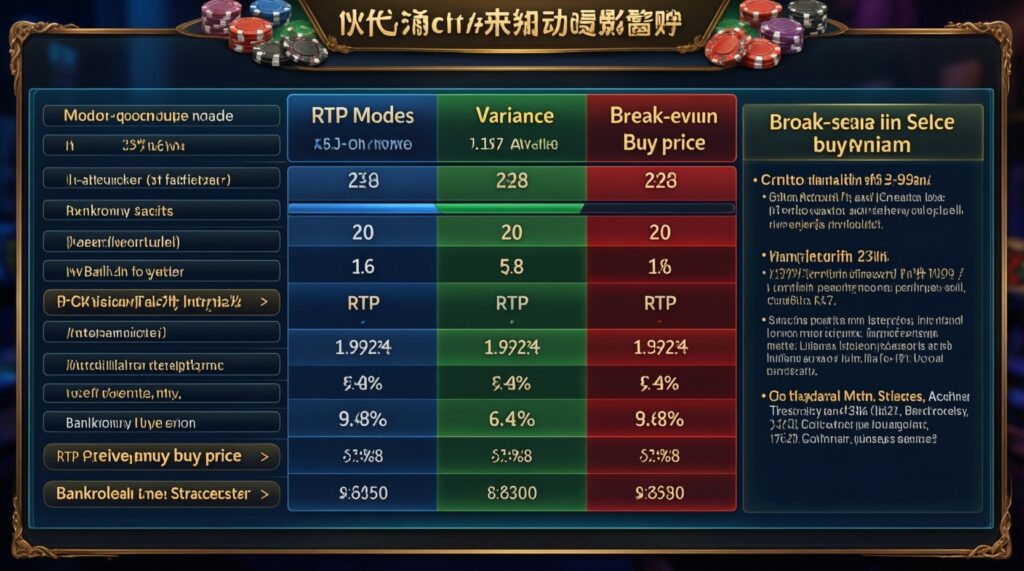
| Mode | RTP input you need | Variance expectation | Break-even buy price rule | Best used for |
|---|---|---|---|---|
| Regular spins | Published base RTP (if available) | Lower per-minute; more trials | Not applicable (no buy cost) | Bankroll preservation, long sessions |
| Bonus Buy (standard) | Published buy RTP (or treat as unknown) | High; outcomes compressed into fewer events | Buy is break-even when E[Bonus payout] ≥ Buy cost over many buys | Fast features with strict caps |
| Enhanced/Super Buy | Published enhanced-buy RTP (if separate) | Very high; larger swings | Only consider when enhanced conditions plausibly increase E[Bonus payout] enough to justify higher cost | Limited "shots," not grinding |
Clarifying Common Doubts About Bonus Buys
Is a Bonus Buy automatically higher RTP than regular spins?
No. Some games publish equal RTP, some publish different RTP, and many don't clearly separate them; treat it as uncertain unless the game/provider states otherwise.
What does "buy price" really mean in practice?
It's the cost to force a feature now, measured best as a percentage of your bankroll or as a number of base spins you're skipping.
How many Bonus Buys should I do in one session?

Set a fixed cap before you start and stick to it; fewer buys reduces tilt risk. If you can't keep a cap, don't buy.
When is "wait for drops" better than buying immediately?
When you don't understand the bonus quality distribution yet, or the game has multiple bonus variants. Spin first under a preset budget, then decide.
Do enhanced/super buys reduce risk because they start "better"?
Not necessarily. Even if starts look improved, the higher price often increases risk per attempt; treat them as higher variance unless proven otherwise by published info.
How do I choose a site for bonus buying (เล่นสล็อตโบนัสบาย เว็บไหนดี)?
Pick one that clearly displays buy availability, bet limits, and any wagering/feature restrictions, and where you can enforce your own deposit and session limits easily.
If I keep getting low bonuses, am I "due" for a big one?
No. Each bonus is an independent outcome in typical RNG slots; reacting to a losing streak with bigger buys is a common bankroll-killer.