

To choose between bonus frequency and bonus value, focus on how often a feature triggers (hit rate), how much it pays when it does, and how payouts are distributed across players. Optimize for your constraint first: budget stability, retention feel, or headline jackpots. Then tune triggers (timers, meters, volatility gates) to shape variance without breaking expected value.
Core distinctions: hit rate, bonus value, and payout shape
- Bonus frequency vs bonus value is a trade-off between how often rewards occur and how large they are when they occur.
- Hit rate describes how often a meaningful event occurs; it does not tell you how much it pays.
- Payout distribution determines whether most players see small wins or a few players see very large wins.
- Trigger rules (meters, timers, symbols, eligibility) are the main "control knobs" for shaping frequency and award sizing.
- Variance drives bankroll risk and "feel"; it can rise even when expected value stays constant.
- Measurement must separate base-game hits from feature hits, otherwise conclusions about bonus tuning are unreliable.
Precise definitions: hit rate, bonus value, triggers, and payout distribution
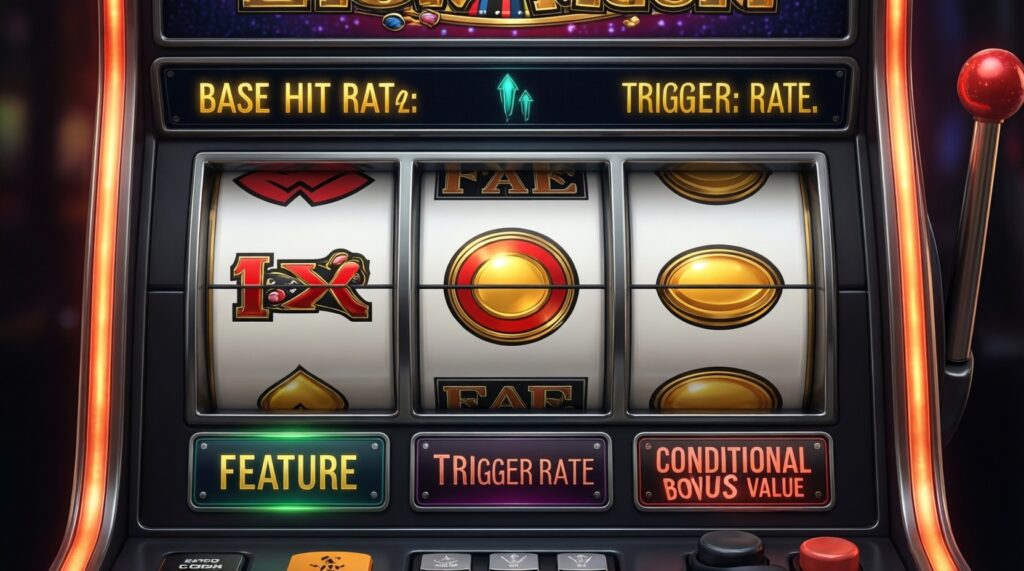
- Base hit rate: probability of any paying outcome per spin/round; useful for pacing, not for feature economics.
- Feature trigger rate: probability a bonus/feature activates (e.g., free spins, respins, pick bonus, multiplier mode).
- Bonus value (conditional): average payout given the feature triggered; this is where "big bonuses" live.
- Bonus contribution (unconditional): the share of total expected return attributable to the bonus layer.
- Eligibility rules: constraints such as min bet, max win caps, session gating, or only-on-specific-stakes logic.
- Payout distribution shape: how returns spread from small frequent awards to rare extreme awards (tail heaviness).
- Volatility/variance: the dispersion of outcomes; critical for bankroll needs and for "dry streak" tolerance.
- Player-facing vs system-facing events: a "bonus" can be a visible feature or an invisible enhancement; track both distinctly.
Trigger design: how mechanics control frequency and award sizing
Mechanics define the practical balance between online casino slots with frequent bonuses and slots where bonuses are rarer but potentially larger. If you want to "buy bonus feature online" (feature purchase) as an option, treat it as a separate economy with its own eligibility and limits, because it changes session variance and perceived fairness.
| Variant | Who it fits | Pros | Cons | When to choose |
|---|---|---|---|---|
| Pure RNG scatter trigger (fixed probability) | Teams needing simple balancing and clear math | Transparent; easy to simulate; predictable trigger frequency at scale | Can feel streaky; hard to guarantee pacing in short sessions | When you want classic behavior and straightforward compliance/testing |
| Meter/collection trigger (incremental progress) | Retention-focused products needing visible progress | Smoother pacing; reduces long no-bonus streaks; strong perceived control | More state to track; pacing can be exploited if not bounded | When you need frequent engagement beats without inflating average payout |
| Time-gated or session-gated bonus window | Ops teams aligning features to promos or session goals | Reliable scheduling; supports campaign planning | Risk of "forced" feel; can distort natural volatility patterns | When bonus moments must align with events, missions, or daily cadence |
| Volatility gate (only triggers after conditions) | Designers controlling tail risk and headline wins | Allows bigger prizes while controlling frequency; protects bankroll targets | Complex to explain; can frustrate if conditions feel hidden | When you need large top-end bonuses but must cap how often they appear |
| Dynamic trigger (adaptive odds based on state) | Advanced systems with strong telemetry and guardrails | Can stabilize pacing and reduce churn from dry streaks | Harder to validate; risk of perception issues if not consistent | When you can prove fairness/consistency and can monitor for anomalies |
| Feature purchase (bonus buy) | Players who want immediate feature access; high-intent sessions | Shortens time-to-fun; clear proposition; can be segmented by risk appetite | Amplifies variance; changes session economics; needs strict limits and messaging | When you want an explicit alternative path to features with controlled exposure |
Quantitative models: expected value, variance, and simple formulas
Use simple math to connect slots hit rate and payout distribution to budget risk. Separate (1) how often a bonus happens and (2) what it pays when it happens.
- Expected value (EV) per spin:
EV = (1 − p) × E[Base] + p × E[Bonus]
wherepis the bonus trigger probability per spin (or per paid unit). - Variance per spin (conceptual form):
Var(X) = E[X²] − (E[X])²
Higher bonus size dispersion increasesE[X²]sharply, even if EV is unchanged.
Numeric example (units in "bet multiples"): Suppose the base outcome has E[Base]=0.20. A bonus triggers with p=0.02 and has E[Bonus]=20. Then EV = 0.98×0.20 + 0.02×20 = 0.196 + 0.4 = 0.596. If you halve frequency to p=0.01, you must roughly double conditional bonus value to keep EV similar-yet variance typically rises because payouts become more "lumpy."
Scenario rules you can actually use:
- If you need stable daily budget, then bias toward higher frequency, lower conditional bonus value and narrower payout distributions.
- If you need marketing-friendly peak moments, then allow lower frequency, higher conditional bonus value with a heavier tail-but add caps and monitoring.
- If you are targeting high RTP slot games real money positioning, then keep EV steady but move the "feel" via variance controls (meters, gates, or bonus composition), not by silently shifting return.
- If players complain about dry streaks, then increase pacing using meters/collection or controlled windows rather than simply inflating payouts (which can break budget).
- Budget-first option: If you must minimize bankroll spikes, then reduce tail risk by splitting one big bonus into multiple smaller feature awards (more triggers, smaller prizes).
- Premium option: If you can tolerate higher variance for high-intent spenders, then keep triggers rarer but increase the top-end via gated super-features, while protecting exposure with hard limits.
Budget-first optimization: constraints, trade-offs, and prioritization
- Fix your constraint: pick one primary limit (daily payout volatility, retention pacing, or peak-win appeal).
- Choose a payout shape: decide whether you want many small feature wins or fewer large ones (tail policy).
- Set a target trigger cadence: define a practical range for how often players should see a bonus moment.
- Back-solve conditional bonus value: adjust average bonus payout to hit EV while respecting caps and variance.
- Pick the trigger mechanic: RNG, meter, gating, dynamic, or bonus buy-based on operational complexity you can support.
- Add guardrails: max-win caps, eligibility rules, state resets, and anti-exploit checks.
- Validate in simulation + limited rollout: confirm EV/variance behavior and player-path consistency before scaling.
Implementation checklist: instrumentation, sampling, and A/B configuration
- Logging only "bonus triggered" but not the full bonus payout distribution (you need the whole shape, not just the average).
- Mixing base-game wins with feature wins, then drawing conclusions about "hit rate" from a blended metric.
- Not separating trigger rate from bonus value; you cannot tune what you cannot isolate.
- Ignoring stake segmentation: the same mechanic can behave differently across bet levels, especially with caps or thresholds.
- Running A/B tests without enough exposure to observe rare events (large bonuses), leading to false confidence.
- Changing multiple levers at once (trigger cadence, bonus table, caps), making attribution impossible.
- Implementing feature purchase without tracking it as a distinct path (entry cost, outcomes, and churn impact).
- Not monitoring "time-to-first-bonus" and "spins-between-bonuses" distributions; averages hide painful streaks.
- Over-optimizing for short-session metrics and accidentally worsening long-session bankroll risk.
Reading results: statistical significance, lifetime impact, and rollouts
For budget stability, the best fit is usually higher trigger cadence with smaller, tighter bonus awards; for peak moments and premium segments, the best fit is typically lower cadence with gated, larger bonuses plus strict guardrails. For experience-driven pacing, meter-based designs often win if you can instrument state cleanly and roll out gradually.
Operational clarifications for deployment and measurement
Is hit rate the same as RTP or EV?
No. Hit rate is frequency of hits (or triggers), while RTP/EV is the average return; you can raise hit rate and still lower EV if payouts shrink.
How do I compare bonus frequency vs bonus value without bias?
Measure trigger probability and conditional bonus payout separately, then recombine them into EV and variance; don't rely on blended win-rate metrics.
What's the most practical metric for "payout feel"?
Track distributions like spins-to-trigger and bonus payout percentiles, not just averages; this reveals whether players experience long droughts or frequent small hits.
Does a bonus buy change the game's underlying balance?
It can change session economics and variance even if EV is intended to be similar; treat "buy bonus feature online" as a separate entry path with its own monitoring.
How should I evaluate online casino slots with frequent bonuses?
Confirm whether "frequent" means base-game hits, small features, or meaningful bonus rounds; then inspect how that frequency interacts with the payout distribution.
Can I claim "high RTP slot games real money" based on bonus design alone?
No. Bonus design mainly shapes when and how payouts arrive; any RTP/EV claim must be supported by verified math and consistent implementation.