
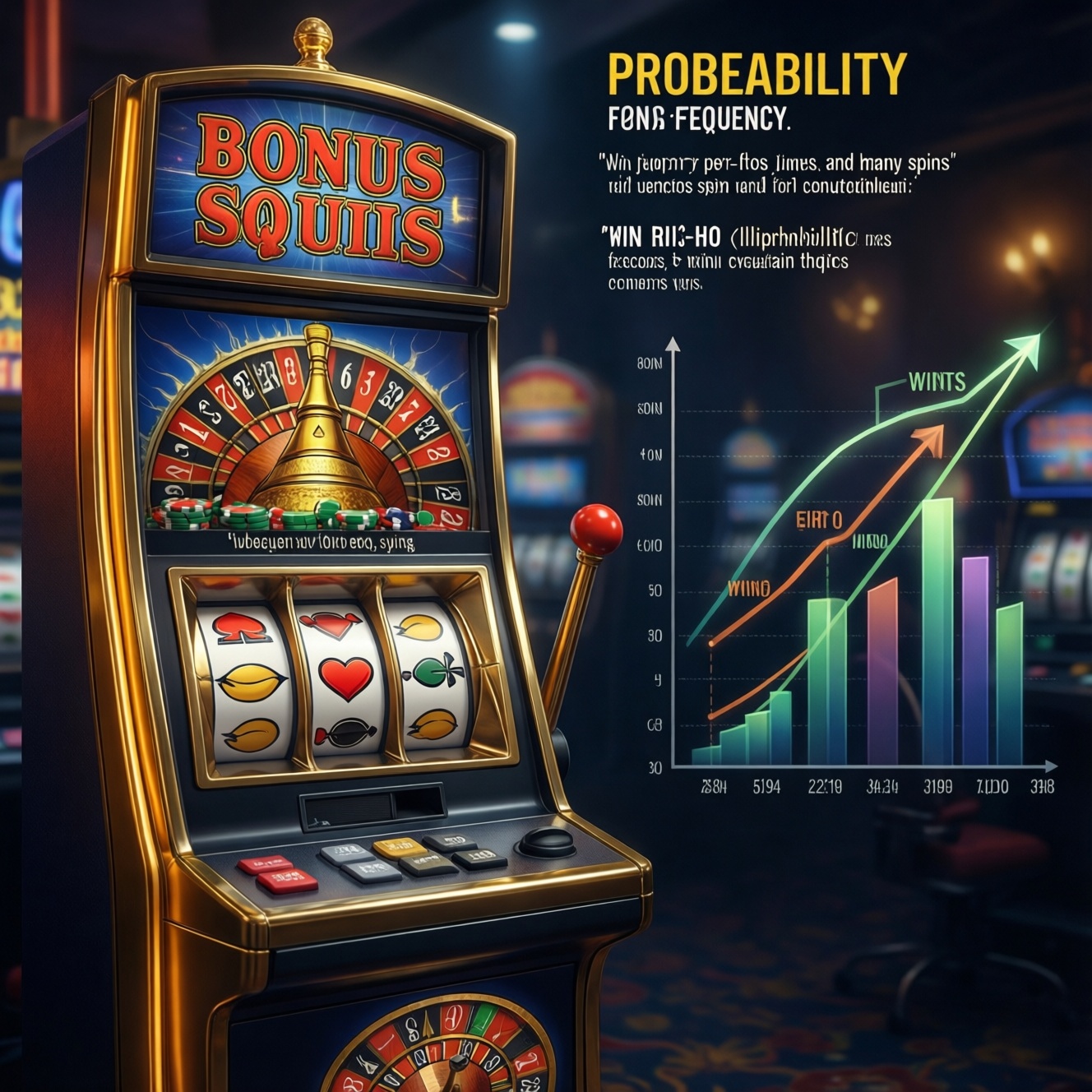
Bonus frequency (often discussed as hit rate or bonus frequency) describes how often a slot produces a defined "hit" (any win) or triggers a defined "bonus" (free spins/feature) over many spins. Read it as a probability, not a promise: it helps you estimate how often you may see action, but it cannot predict short streaks or profit.
Quick orientation: what hit rate conveys at a glance
- It is a frequency metric (events per spins), not a payout metric (money back).
- A higher hit rate usually means more frequent small wins, not necessarily bigger wins.
- Bonus Frequency is narrower than hit rate: it counts bonus triggers, not every win.
- Short sessions can look "wrong" even when the published rate is correct (variance).
- Use it to plan experience and bankroll pacing, not to identify "slots that will definitely hit."
Defining bonus frequency and how it differs from payout rate
When players ask ความถี่โบนัส สล็อต คืออะไร, they usually mean one of two related but different measures: (1) hit rate, how often a spin returns any win; and (2) bonus frequency, how often a specific feature triggers (free spins, hold-and-spin, pick bonus, etc.). These are event-counting metrics.
RTP (return to player) is different: it is a long-run payout ratio, not how often anything happens. Two games can share the same RTP while feeling completely different because their hit rate/bonus frequency and average win size differ.
Practical definition (always check which one the source uses):
- Hit rate = hits ÷ spins (a "hit" might mean any win > 0, or sometimes any win ≥ bet, depending on the provider/site).
- Bonus frequency = bonus triggers ÷ spins (a "bonus" must be clearly defined: only free spins, or any feature including respins/lockers?).
How hit rate is measured: sample size, time windows and event definitions
If you search Hit Rate สล็อต อ่านค่าอย่างไร, the key is to read the fine print behind the number. Measurement differences explain most disagreements between "official" and "what I saw." Use this checklist:
- Define the event: "any win" vs "win ≥ bet" vs "feature trigger." Do not mix hit rate with bonus frequency.
- Fix the denominator: count spins, not time. Autoplay speed changes time but not probability.
- Separate base game from feature: some trackers count feature retriggers as extra "hits," inflating hit rate.
- Use a meaningful sample: small samples are dominated by streaks. Treat early results as noise.
- Keep bet and mode consistent: ante bets/buy-bonus options change feature odds and can change your observed bonus frequency.
- Track by spin ID, not by "screen events": cascades/avalanche games can create multiple payouts in one paid spin; you still count one spin.
Statistical pitfalls: variance, streaks, and the law of large numbers
Players often decide Bonus Frequency สล็อต สำคัญไหม based on a short streak. That's exactly where variance is the strongest. Typical real-world scenarios where people misread the metric:
- "It didn't bonus in 200 spins, so it's broken." A bonus frequency is a long-run average; long droughts are normal in many games.
- "It hit constantly, so it must be low volatility." High hit rate can still pair with high volatility if most hits are tiny while rare hits are huge.
- "After a long dry run, a bonus is due." Past outcomes don't increase future chance in RNG slots (gambler's fallacy).
- "My friend bonused twice quickly, so this slot is hot." Clustering happens naturally; it's not evidence of a higher underlying probability.
- "I changed the bet and it started bonusing more." Often a coincidence; the only consistent change is when you enable an ante feature or buy a bonus.
Translating hit rate into short‑term expectations and bankroll planning
Hit rate and bonus frequency are most useful for setting realistic session expectations (pace of wins/bonuses), not for forecasting profit. A practical way to translate the number:
- Expected spins per event (rough planning tool) = 1 ÷ frequency. Example: if bonus frequency is 1% (0.01), the long-run average is about 100 spins per bonus trigger.
- Expected events in a session (rough planning tool) = spins × frequency. Example: 500 spins at 0.01 implies about 5 bonuses on average over very long repetition, but any single session may vary widely.
- Pacing: higher hit rate usually means more frequent feedback (small wins), which can reduce the feeling of long dead time.
Limitations and fast prevention of common planning mistakes:
- Don't budget as if the average must happen: plan for fewer bonuses/hits than the average in a short session.
- Don't confuse "more hits" with "lower cost": lots of micro-wins can still lose money quickly if average win size is low.
- Use a stop rule: define a loss limit and time/spin limit; frequency metrics don't protect you from downswings.
- Track net result, not hit count: a session with many hits can still be strongly negative.
Using hit rate with other metrics: RTP, volatility and average win size
The question วิธีเลือกสล็อตจากความถี่โบนัส is best answered by combining frequency with payout structure. Frequent errors (and how to prevent them quickly):
- Error: Treating hit rate as "chance to profit." Prevention: pair hit rate with average win size and volatility; profit depends on distribution, not just frequency.
- Error: Assuming higher RTP means more frequent bonuses. Prevention: separate RTP (payout ratio) from bonus frequency (event rate); they can move independently.
- Error: Comparing numbers from different definitions. Prevention: only compare hit rates if "hit" is defined identically (any win vs win ≥ bet; base-only vs including features).
- Error: Ignoring ante/buy-bonus modifiers. Prevention: treat "normal mode" and "ante mode" as different configurations with different bonus frequency.
- Error: Concluding "สล็อตแตกบ่อย ดูจากค่า Hit Rate และ Bonus Frequency" alone. Prevention: "แตกบ่อย" (frequent pay-outs) depends on hit rate, but meaningful "แตก" (big spikes) depends on volatility and max win structure; use all together.
| Metric | What it answers | What it does NOT answer | Typical misuse to avoid |
|---|---|---|---|
| Hit rate | How often you get any defined win event | How much you win overall | Equating "many hits" with "easy profit" |
| Bonus frequency | How often a specific feature triggers | How valuable the feature is when it hits | Assuming frequent bonuses means big bonuses |
| RTP | Long-run average return ratio | Short-session outcomes | Using RTP to predict today's results |
| Volatility | How "swingy" outcomes are | Exact timing of wins | Calling a slot "safe" just because it hits often |
Practical checks: validating documented hit rates with data and audits
If a site lists a hit rate/bonus frequency, you can sanity-check it with your own tracked spins-without fooling yourself. The goal is not to "prove it wrong" from a short run, but to detect definition mismatches and logging errors.
Mini workflow: track, normalize, compare
- Pick one definition: decide whether you measure "any win" or "bonus trigger," and write it down.
- Log spins consistently: count paid spins only; for cascades, still count 1 paid spin even if multiple payouts occur.
- Tag modes: normal vs ante vs feature buy must be separate datasets.
- Compute observed frequency: observed = events ÷ spins.
- Compare to the published definition: if your number differs, first check the event definition and whether the published number refers to hits or bonuses.
Pseudocode you can adapt to a spreadsheet or script
spins = 0
events = 0

for each paid_spin in session:
  spins += 1
  if paid_spin.triggers_bonus == true:   # or "paid_spin.win_amount > 0" for hit rate
    events += 1

observed_frequency = events / spins
expected_spins_per_event = 1 / observed_frequency
Concise clarifications and common misconceptions
Is hit rate the same as bonus frequency?
No. Hit rate usually counts any win event, while bonus frequency counts only feature triggers. Mixing them is the most common reason people misread slot stats.
Can I use bonus frequency to predict when the next bonus will trigger?
No. It's a long-run average, not a schedule. Short-term streaks (both droughts and clusters) are normal.
If two slots have the same RTP, will they have similar hit rates?
Not necessarily. RTP describes average return; hit rate describes how often events happen. The same RTP can be delivered via frequent small wins or rare large wins.
Does a higher hit rate mean the slot is "safer" for bankroll?
Not always. A high hit rate can still lose quickly if most hits are small relative to the bet and volatility is high.
Why does my tracked hit rate differ from the number on a website?
Usually because the definitions differ (any win vs win ≥ bet) or because features/cascades are counted differently. Separate base game, features, and modes to align definitions.
Is "ante bet" just a convenience, or does it change bonus frequency?
It can change the effective odds of triggering features, so you should treat it as a different configuration when comparing bonus frequency.
What's the fastest way to use these metrics to choose a slot?
Decide whether you want frequent feedback (higher hit rate) or feature-centric play (bonus frequency), then check RTP and volatility to understand whether wins are likely small-and-often or rare-and-big.