

High volatility means larger, faster price swings (bigger opportunity and bigger risk), while low volatility means smaller, steadier moves (easier risk control but slower payoff). To choose, match volatility to your holding period, risk budget per trade, fees, and your ability to execute. In practice, many Thai traders blend both.
Concise contrast: high vs low volatility in practice
- Speed of outcomes: high volatility can reach targets quickly; low volatility often needs more time or leverage.
- Stop-loss realism: high volatility typically needs wider stops (or lower size); low volatility allows tighter, cleaner stops.
- Fee sensitivity: frequent trading in high volatility is more fee-sensitive; low volatility often suits lower turnover.
- Psychological load: high volatility stresses discipline and execution; low volatility tests patience and overtrading control.
- Strategy fit: momentum/breakouts thrive in high volatility; mean-reversion/quality trend following often prefers lower volatility regimes.
Measuring volatility: indicators, timeframes and interpretation
Use measurable criteria, not labels. Volatility is timeframe-dependent: an instrument can be "low vol" intraday but "high vol" on weekly swings (and vice versa). Evaluate with these criteria before you decide เลือกความผันผวนสูงหรือต่ำสำหรับเทรดเดอร์:
- ATR (Average True Range) in price units: compare ATR to your stop size and typical target size.
- ATR% (ATR divided by price): helps compare different instruments; higher ATR% implies larger relative swings.
- Annualized standard deviation of returns: use daily/weekly returns; higher annualized stdev usually means bigger drawdown potential.
- Average range by session: for intraday trading, measure average high-low range during your trading hours (Thailand time).
- Gap/overnight risk frequency: how often opens differ materially from prior close; critical for swing/position holding.
- Liquidity and slippage proxy: typical spread, depth, and how often market orders slip in fast moves.
- Volatility clustering: whether high-vol days tend to follow high-vol days (affects sizing and stop placement).
- Event sensitivity: reaction to earnings, macro releases, or policy headlines (especially relevant if you cannot monitor continuously).
High-volatility assets: mechanics, opportunities and pitfalls
If you're asking เทรดความผันผวนสูงคืออะไร, think "outsized price movement per unit time." It can amplify both edge and errors. In Thailand, high-vol access also depends on account type and โบรกเกอร์เทรดความผันผวนสูง conditions (margin rules, spreads, execution quality).
| Option | Who it fits | Pros | Cons | When to choose |
|---|---|---|---|---|
| Crypto majors (spot/perp) | Active intraday/swing traders with strict risk caps | Large moves; frequent trends; 24/7 markets | Overnight risk is constant; liquidation risk with leverage; execution differs by venue | When you can monitor often and size small enough to survive spikes |
| Single stocks with catalysts | Swing traders who can research events and manage gaps | Directional opportunities around news; clear technical levels break often | Gaps can skip stops; headline risk; borrow/short constraints | When you have a defined catalyst window and can tolerate gap risk |
| High-beta sector ETFs / thematic baskets | Traders wanting equity volatility with diversification | Diversified vs single names; cleaner liquidity than small caps | Can still gap; correlations spike in stress; may lag "best" single winner | When you want high-vol exposure but with simpler risk than one stock |
| FX majors during news (via CFD) | Scalpers with fast execution and news calendar discipline | Deep markets; many setups; two-way trading is easy | Spread widening; slippage on releases; overtrading risk | When your broker execution is proven during volatility bursts |
| Index CFDs / futures in high-vol regimes | Day traders who prefer broad-market exposure | Typically liquid; smooth trends in panic/relief phases | Fast reversals; margin calls if oversized; session gaps possible | When the index is in a clear "risk-on/risk-off" cycle and you trade the main session |
| Options (buying premium) | Traders who want defined downside (premium paid) | Limited risk; convex payoff in sharp moves | Time decay; implied volatility pricing can be expensive; complex greeks | When you expect a move within a time window and can manage decay |
Low-volatility instruments: stability, hidden risks and use cases
Low volatility reduces noise and helps risk control, but "quiet" markets still carry regime-change risk. If you're deciding ความผันผวนต่ำเหมาะกับใคร, the answer is usually: traders prioritizing consistency, tighter stops, and lower emotional load-provided they avoid leverage creep.
- If you trade part-time and cannot watch screens, then prefer lower-vol instruments and longer timeframes to reduce forced exits from intraday spikes.
- If your edge is trend-following with wide confirmation (weekly/daily), then low-to-moderate volatility instruments often keep you in the trend with fewer stop-outs.
- If fees and spreads are a major drag on your account size, then choose lower-vol products that require fewer trades rather than chasing every high-vol swing.
- If you tend to revenge trade after losses, then lower-volatility environments reduce "stimulus" and can improve rule adherence.
Budget vs premium implementation emphasis

- Budget-leaning choices: liquid broad-market instruments and spot products with tight spreads and low turnover; focus on fewer entries, larger timeframe signals, and strict per-trade risk caps.
- Premium-leaning choices: tools that improve execution and risk definition (for example, higher-quality routing/liquidity venues, robust options analytics, or professional platforms). The goal is not "more trades," but more predictable fills and clearer risk.
Impact on returns, drawdowns and Sharpe-like metrics
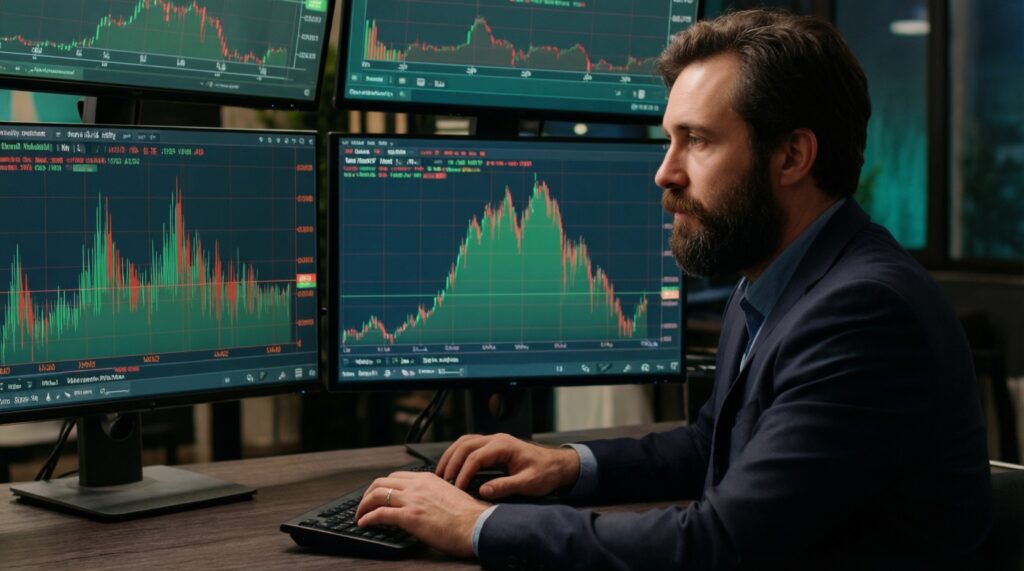
Higher volatility can raise raw returns if you have edge, but it often raises drawdowns more. A "Sharpe-like" mindset rewards returns per unit of risk, not excitement. Use this quick selection algorithm:
- Define a fixed risk budget per trade (as a fraction of account) before choosing the instrument.
- Estimate typical stop distance using ATR (e.g., a multiple of ATR for your timeframe).
- Compute position size so that stop-hit loss equals your risk budget; if size becomes too small to execute efficiently, volatility is too high for your account.
- Stress-test gap risk: assume a worse-than-stop fill (slippage) and re-check whether loss is still survivable.
- Compare net expectancy after fees: higher turnover strategies must overcome spreads/commissions more consistently.
- Pick the volatility regime where you can keep maximum drawdown tolerance within your psychological and financial limits.
Choosing volatility by strategy: scalping, swing, position and passive

Your selection should align with กลยุทธ์เทรดความผันผวนสูงและต่ำ, not personal preference alone. Common selection mistakes:
- Scalping high volatility without execution proof: if spreads widen or fills slip, your edge can disappear.
- Using low-vol instruments with scalping targets: targets become too small relative to fees and random noise.
- Copying leverage levels from high-vol markets into low-vol markets: it often leads to leverage creep and blowups when volatility suddenly expands.
- Placing "tight" stops in high volatility: you get stopped out by normal noise; sizing and stop width must match ATR.
- Ignoring time-of-day volatility: the same product can behave differently in Asia vs US sessions.
- Swing trading high-vol names through known events: earnings/macros can gap beyond stops; plan exits or hedge.
- Over-diversifying high-vol positions: in stress, correlations rise and you effectively hold one big risk.
- Confusing calm with safety: low volatility can precede sharp breakouts; maintain a rule for volatility expansion.
Budget-first implementation: position sizing, commissions and sample setups
Best fit tends to be: high volatility for traders who can execute actively, size down, and tolerate wider stops without overpaying in fees; low volatility for traders optimizing consistency, lower turnover, and predictable risk. A blended approach-core low-vol exposure plus a small, strictly capped high-vol "satellite"-often matches intermediate budgets.
Targeted answers to common volatility trade-offs
How do I know if volatility is "too high" for my account size?
If a realistic ATR-based stop forces your position size so small that fees/slippage dominate, or a gap would exceed your max loss tolerance, volatility is too high for your current budget.
Is high volatility always better for making money faster?
No. It can speed outcomes, but it also increases error cost and drawdowns. Faster opportunities only help if your execution and sizing are consistent.
What should I check when choosing a broker for volatile markets?
For โบรกเกอร์เทรดความผันผวนสูง, focus on spread behavior during spikes, slippage on stop orders, margin/liquidation rules, and platform stability in fast markets.
Who typically benefits most from low volatility?
ความผันผวนต่ำเหมาะกับใคร: part-time traders, rule-based position traders, and anyone prioritizing smoother equity curves and simpler risk control.
Can I mix high- and low-vol instruments in one portfolio?
Yes. Use low-vol as the core and cap high-vol positions with strict risk limits so one spike cannot dominate your account variance.
What timeframe makes volatility easiest to manage?
Longer timeframes reduce noise but increase gap exposure; shorter timeframes reduce gap exposure but demand execution quality. Choose the one you can monitor and execute reliably.
Which is more important: volatility level or liquidity?
Liquidity often comes first because it determines real tradability (spreads and slippage). High volatility with poor liquidity is usually a costly combination.