

Martingale ("เพิ่มเดิมพันหลังแพ้") is risky on slots because slot outcomes are independent, losses can cluster longer than your bankroll can tolerate, and casinos impose bet caps that break the recovery math. Even if short streaks look profitable, one extended downswing can erase many sessions. Treat it as a high-ruin progression, not a reliable system.
Primary dangers when applying Martingale to slot play
- Slots don't "owe" a win after losses, so doubling is not a corrective mechanism.
- Bet caps and max win limits stop the sequence exactly when it needs to continue.
- Bankroll drawdown accelerates non-linearly; one long losing stretch dominates outcomes.
- Variance can mask risk: small wins create false confidence before the large loss arrives.
- Chasing losses triggers impulsive decisions, reducing stop-loss discipline.
- "ทดลองเล่น" results don't transfer well to real money conditions (time pressure, limits, behavior).
Why Martingale assumes outcomes slots don't have
When people apply สูตรมาร์ติงเกล สล็อต, the following symptoms usually appear:
- You feel a win is "due" after several dead spins, so you escalate stakes.
- You recover small losses often, then suddenly hit a session-ending drop.
- Different games "feel" hot/cold, but switching doesn't stabilize results.
- Your average session looks fine until one bad run wipes previous gains.
- You start compressing decision time: fewer breaks, faster spins, larger jumps.
Core mismatch: Martingale implicitly relies on a mechanism where probability improves after losses, or where you can always continue doubling until a win occurs. Slot spins are independent; there is no memory and no guarantee a win arrives before you hit a limit.
How betting limits and finite bankrolls make Martingale fail
Use this read-only diagnostic checklist (no changes to game settings yet). It's designed for กลยุทธ์เพิ่มเดิมพันหลังแพ้ สล็อต troubleshooting.
- Sequence budget check: Write your base bet and the doubling ladder (1-2-4-8...). Can your bankroll cover the next 6-10 steps without deposits?
- Bet cap check: Confirm the game's max bet and your platform's max stake per spin. Does your ladder hit the cap before the step where you expect recovery?
- Win cap/feature cap check: Note any max win per spin or restricted feature buys that can limit "one-win recovery."
- Net recovery math: Include the base stake and all previous stakes. Verify that one average win at the escalated bet actually covers total losses (often it doesn't on low-hit sequences).
- Stop-loss absence: Do you have a hard stop for the session (money/time), or do you plan to "play until it turns"?
- Step size creep: Are you doubling exactly, or are you jumping more when stressed (e.g., 1 → 3 → 10)?
- Speed factor: Are you increasing spins/minute when losing, accelerating drawdown?
- Denomination mismatch: Are you changing coin value/lines, unintentionally increasing risk beyond the plan?
- Autoplay risk: Are you letting the ladder run automatically without verifying the next step against remaining bankroll?
- Platform friction: Delays, reconnections, or missed spins that disrupt your "intended" step tracking.
If you fail any of the first three checks, Martingale is structurally broken for that slot and stake range-regardless of how often you "usually" recover.
RTP, variance and why short-term wins are misleading
RTP is a long-run property; Martingale operates in the short run where variance dominates. A few recoveries can convince you the method "works," but the risk is concentrated in rare-but-inevitable longer losing stretches. This is why the question มาร์ติงเกล สล็อตได้เงินจริงไหม is better reframed as: "How large is the worst-case drawdown before a recovery win arrives?"
| Symptom | Possible causes | How to verify (read-only) | How to fix (minimize harm) |
|---|---|---|---|
| Many small "rescues," then one huge loss | High variance; recovery depends on avoiding long losing clusters | Review your session log: count how often you reached step 4+ and what ended sessions | Cap steps (e.g., max 3-5), accept partial losses, and switch to flat betting |
| Doubling no longer recovers previous losses | Average payout per win is too small; long dead-spin runs | Track payout multiples on "wins" during the ladder (not just green spins) | Stop using strict doubling; use smaller increments or fixed bet with predefined stop-loss |
| Hit max bet before recovery | Game/platform bet cap; ladder too steep | Check max bet in the game UI and your planned ladder step where it breaks | Lower the base bet so the ladder fits under the cap (or abandon Martingale) |
| "Demo works, real fails" | Behavior changes under stress; different limits; different session length | Compare: time spent, spins/minute, step discipline demo vs real | Enforce the same discipline rules; reduce speed; shorten sessions |
| Switching slots doesn't stabilize results | Independence of spins; confirmation bias ("hot/cold") | Note whether switching happens after losses and whether it improves net results | Stop reactive switching; choose one plan and one exit rule per session |
Practical adjustment: if you insist on progression, treat it as an exposure tool, not a recovery guarantee. Define (1) maximum steps, (2) maximum time, (3) maximum cash loss, and (4) a rollback path to a safer baseline when any limit is hit.
Session length, drawdown speed and ruin probability
Longer sessions and faster spins increase the chance of encountering a losing stretch that exceeds your ladder capacity. Use the steps below in order; stop at the first step that stabilizes behavior and losses.
- Freeze the plan (read-only first): For the next session, do not change denomination, paylines, or speed mid-session. Only observe and record step reach (e.g., max step hit).
- Set hard boundaries: Define a cash stop-loss and a time stop. When either triggers, end the session-no exceptions.
- Limit progression depth: Choose a maximum number of increases (for example, stop after 3-5 escalations). Once hit, revert to base bet or stop entirely.
- Slow the drawdown: Reduce spins/minute (disable turbo/autoplay if it encourages laddering). This lowers impulsive overshooting.
- Lower the base bet: If you still use doubling, the base must be small enough that the full ladder fits under both bankroll and bet cap.
- Use a rollback trigger: After any session that reaches your max step, the next session must be flat betting only (no progression) for a fixed period.
- Segment bankroll: Allocate a strict session budget. Do not "top up" mid-session to continue a ladder.
- Switch from doubling to capped increments: If progression remains, replace doubling with smaller, predefined steps (still risky, but drawdown is slower).
Compact scenario comparison for planning (qualitative ruin risk)
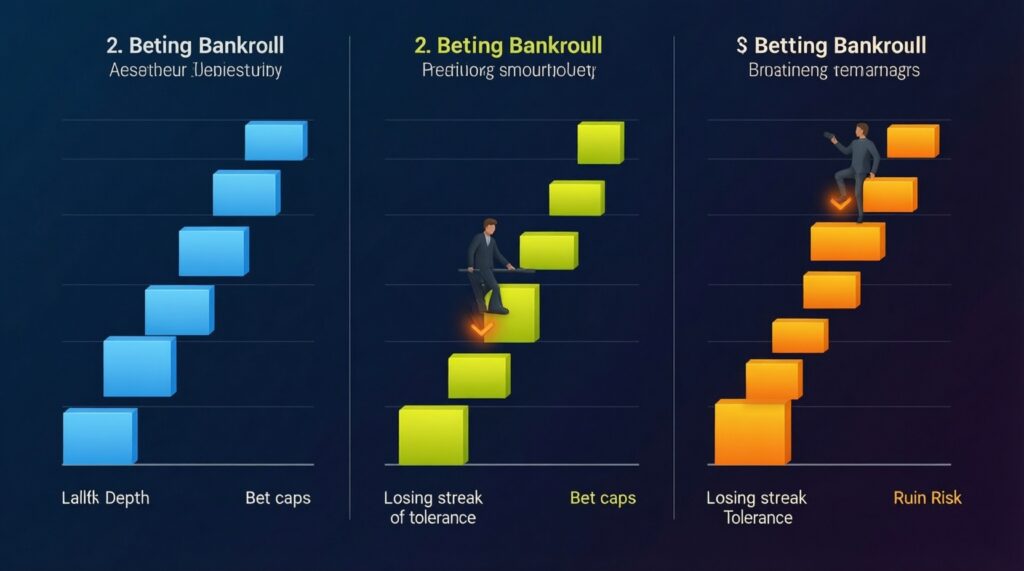
| Scenario | Bankroll vs base bet | Bet cap tightness | Losing streak length you can survive | Ruin risk if you keep playing |
|---|---|---|---|---|
| A: Shallow ladder | Large (many base bets) | Loose (cap far above ladder) | Short-to-medium | Medium |
| B: Cap-constrained | Moderate | Tight (cap reached early) | Short | High |
| C: Underfunded | Small (few steps possible) | Any | Very short | Very high |
| D: Flat-bet with stops | Any (bounded exposure) | Any | Not applicable (no ladder) | Lower (still gambling risk) |
Behavioral biases triggered by progressive losses
Progressions amplify stress. Escalate to outside help or stricter controls when you see any of the following:
- You repeatedly break your own stop-loss or time limit "just this once."
- You deposit to continue a ladder step you couldn't afford (classic chase behavior).
- You hide or minimize losses, or feel unable to stop even after recovering.
- You rely on สล็อต เว็บตรง ทดลองเล่นมาร์ติงเกล results to justify higher real-money stakes.
- Losses affect sleep, work, relationships, or you feel panic when not playing.
Action path: pause sessions, enable platform responsible-gambling tools (limits, cool-off, self-exclusion), and consider contacting a qualified support service in Thailand if control is slipping. If you're playing on an operator, also contact their support to clarify stake limits and available limit-setting features before you continue.
Practical exit strategies and rollback plan for mitigating losses
Use this rollback-first approach before "trying harder." It directly addresses วิธีแก้ทุนหมดจากมาร์ติงเกล สล็อต by preventing the next ladder from draining the entire bankroll.
- Immediate stop rule: If you hit your max step or max loss, end the session. No game switching to "win it back."
- Rollback to baseline: Next session must be flat-bet only (same base stake) with the same stop-loss/time stop.
- Reduce exposure window: Shorten sessions; schedule a fixed end time.
- Lock parameters: One denomination, one bet size, one speed setting for the whole session.
- Pre-commit budget slices: Split bankroll into multiple sessions; never exceed the slice for a single session.
- Cap "recovery attempts": Allow only one progression attempt per session; after that, flat-bet or stop.
- Write the ladder on paper/notes: Prevent accidental overshoots under stress.
- Post-session review (2 minutes): Record max step reached, stop trigger used, and whether you followed it. If you broke rules, reduce stake next time or take a cooling-off day.
Quick answers to practical concerns and adjustments
Is Martingale ever safe on slots?
No. It can only feel controlled when the losing stretch stays shorter than your bankroll and the bet cap; eventually you can encounter a run that breaks the sequence.
What's the fastest way to reduce damage if I'm already using "เพิ่มเดิมพันหลังแพ้"?
Set a maximum step count and a hard stop-loss, then enforce a rollback: after hitting the max step once, switch to flat betting for the rest of the day.
Does higher RTP make Martingale reliable?
No. RTP doesn't remove variance in the short run, and Martingale fails mainly due to clustering losses plus limits, not because RTP is "too low."
If I lower the base bet, does that fix it?
It reduces how quickly you hit bankroll and bet-cap limits, but it doesn't eliminate the core risk: long losing stretches can still exceed your allowed steps.
Should I switch games after a losing streak?

Switching is usually a reaction to frustration and doesn't change independence of spins. If you switch, do it only between sessions and keep the same stop rules.
How do I know my bet cap is the real blocker?
Write your ladder until the next recovery step and compare it to the game's max bet. If the required step exceeds the cap, the method is structurally unable to "recover."
What should I do if I keep breaking my own limits?
Stop playing for a cooling-off period and turn on platform limits or self-exclusion. If it's affecting daily life, seek professional support.