Bonus frequency is the rate at which a slot's bonus feature triggers-free spins, pick-and-win, respins, or a bonus wheel-per a defined "atomic" event (usually one paid spin). It matters because it shapes session rhythm, perceived fairness, and bankroll swings, especially in online casino slots with bonus rounds where volatility can be driven more by features than base-game wins.
Frequency at a Glance: what bonus trigger rates tell you
- Frequency is about how often a feature appears; it is not the same as feature value or RTP.
- Two games can have the same bonus frequency slots number while feeling very different due to payout spread (variance).
- High-trigger features can still be high volatility slots bonus features if outcomes are extremely uneven.
- Reliable measurement needs enough spins and a consistent definition of the "trigger" event.
- For practical decision-making, pair trigger rate with average feature payout and distribution, not just counts.
Defining bonus frequency and the atomic trigger event
Bonus frequency is the probability (or rate) that a specified feature triggers for a specified unit of play. The key is defining the atomic trigger event: most commonly a paid spin, but it can also be a bonus buy purchase, a completed spin including cascades, or a bet round in multi-step mechanics.
Define the feature precisely. "Bonus" can mean:
- Primary bonus: the main bonus round (e.g., free spins).
- Secondary features: respins, hold-and-win, random multipliers, mini-games.
- Access mechanisms: scatter triggers, mystery triggers, collection meters, bonus buy.
Example (definition-level): If a slot awards free spins when 3+ scatters land, then "bonus frequency" for that feature is the chance that condition is met on a single paid spin. If the game has a collection meter that can fill over multiple spins, your "atomic event" is still a paid spin, but the trigger condition depends on state.
How to measure trigger rates: metrics, sampling and data sources
To measure how often features trigger, treat it like an event-rate problem: count triggers, count eligible trials, and compute a rate that matches your definition.
- Pick the unit: per paid spin, per 100 spins, per session, or per THB wagered (helpful when players vary bet sizes).
- Define eligibility: exclude spins where the feature cannot trigger (e.g., during free spins if scatters don't retrigger).
- Count triggers: log a trigger when the feature starts (not when it pays), unless you explicitly measure "paying bonuses."
- Compute the rate: trigger rate = triggers / eligible spins. Convert to "1 in N" as N = 1 / rate (if rate > 0).
- Sample enough: small samples swing wildly; set a minimum spin count before trusting comparisons.
- Use consistent data sources: game telemetry, server logs, or controlled autoplay tests; mixing sources breaks comparability.
- Low-resource alternative: if you lack logs, record manual tallies from a fixed number of spins with consistent bet and settings, then repeat across multiple short runs.
| Metric | What you count | Best for | Common pitfall |
|---|---|---|---|
| Triggers per spin | Feature starts / eligible paid spins | Comparing games' bonus frequency slots | Including ineligible spins (inflates "rarity") |
| Spins per trigger (1 in N) | Eligible paid spins / feature starts | Communicating "how often" to non-technical teams | Using N from a tiny sample as if it were stable |
| Triggers per 1,000 THB wagered | Feature starts / wager amount | Mixed bet sizes; operator monitoring | Comparing across different denominations without normalization |
Simple numeric example: If you observe 12 free-spin triggers over 6,000 eligible paid spins, the estimated trigger rate is 12/6,000 = 0.002 per spin, or roughly 1 in 500 spins. That's a measurement, not a promise for any single session.
If you want a lightweight slot bonus feature frequency calculator without engineering work, a spreadsheet is enough: columns for spins, a 0/1 trigger marker, and a pivot table to summarize triggers and eligible spins by game, bet, or mode.
Sources of variation: randomness, design, and player behavior
Even with a clear definition, observed frequency varies for reasons that are normal (randomness) and reasons that are actionable (design and player behavior). Typical scenarios you'll see in practice:
- Short sessions look "unfair": a player runs 100 spins and sees no bonuses; another hits two. Both can happen in the same underlying configuration.
- Stateful mechanics skew timing: collection meters, persistence, or "must-hit-by" style progress (if present) changes when triggers cluster.
- Mode differences: base game vs free spins may have different retrigger rules; counting both together muddles the rate.
- Bet and feature access choices: bonus buy (if available) converts rarity into a direct purchase; frequency "per paid spin" becomes irrelevant for that feature.
- Volatility masking: games marketed as the best slots with frequent bonuses can still feel harsh if most features pay small and a few pay huge.
Mini scenario: Two titles both trigger a feature about once every few hundred spins. Game A pays small prizes most of the time; Game B pays nothing often but occasionally pays very large. Players often label Game B as "less frequent," when the actual difference is payout distribution, not trigger rate.
From probability to value: modeling expected payouts and variance
Trigger frequency becomes meaningful when you connect it to expected value and risk. A practical model decomposes a slot round into base-game outcomes plus feature outcomes.
- Expected feature contribution: EV(feature per spin) ≈ P(trigger per spin) × Avg(feature payout).
- Volatility intuition: for a fixed EV, lower P(trigger) generally forces higher Avg(payout) and increases swings; higher P(trigger) with lower Avg(payout) feels steadier.
- Limitation 1 (distribution matters): "Avg feature payout" hides whether results are tight or extremely skewed; skew drives variance.
- Limitation 2 (dependence): features can change future probability (meters, sticky symbols), breaking simple independent-spin assumptions.
- Limitation 3 (measurement bias): if you only observe streamer highlights or curated sessions, your apparent trigger rate will be overstated.
Quick example: If P(trigger) = 0.002 and Avg(feature payout) = 50× bet, then EV from the feature is 0.002 × 50 = 0.1× bet per spin (on average). Whether that feels smooth or brutal depends on how that 50× average is distributed across outcomes.
Design trade-offs: perceived fairness, excitement and economic sustainability
- Myth: "More frequent bonuses = better." Frequency can increase engagement, but if average payouts shrink too much, players perceive bonuses as meaningless.
- Mistake: mixing triggers across modes. Reporting a combined rate across base game and free spins can make features look more common than they are for paid spins.
- Myth: "High volatility means rare bonuses." Many high volatility slots bonus features trigger often; the volatility comes from highly uneven feature payouts.
- Mistake: optimizing only for short sessions. Tuning to make early bonuses common can cause long-run economics to drift unless the full distribution is controlled.
- Low-resource trap: relying on anecdotal testing. A few hundred spins is fine for a sanity check, not for ranking "best slots with frequent bonuses." Use repeated runs and consistent eligibility rules.
Operationalizing frequency: testing, monitoring and anomaly response
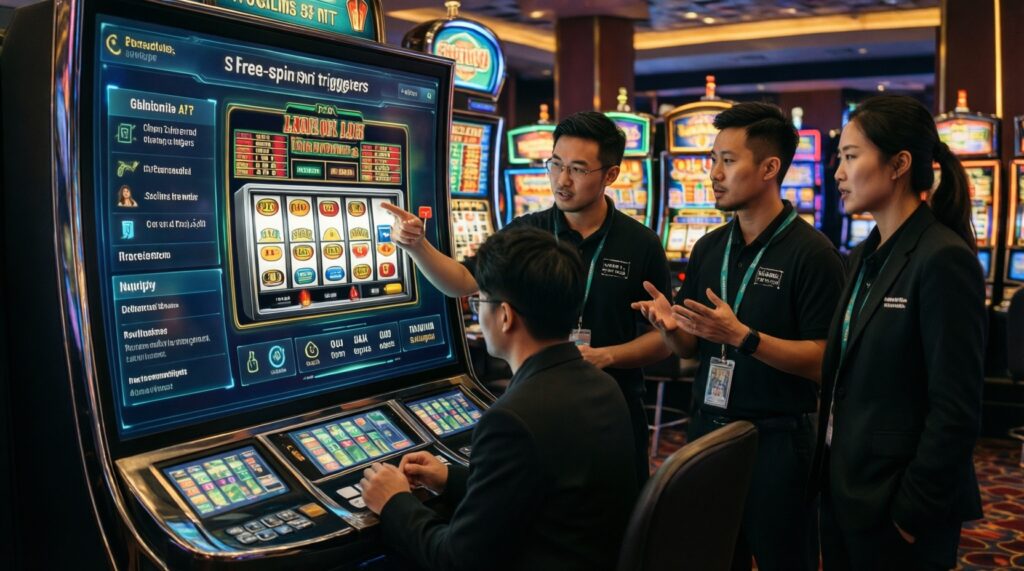
To make trigger frequency actionable, treat it as a monitored KPI with a definition, a baseline, and an alerting rule-even if you're working with limited resources in a small team.
- Lock the definition: "Free spins start per eligible paid spin" (write it down; don't change it midstream).
- Build a baseline: compute a rolling trigger rate from controlled tests (or production logs if available).
- Monitor drift: compare recent windows to baseline; investigate sudden shifts (configuration, math model, integration bugs, regional settings).
- Respond: verify eligibility filters, confirm RNG/event wiring, then run a targeted replay test on the suspected feature.
Mini pseudocode (log-driven, low complexity):
eligible_spins = 0
triggers = 0

for event in game_events:
  if event.type == "PAID_SPIN_END" and event.mode == "BASE":
    if event.feature_eligible == true:
      eligible_spins += 1
  if event.type == "FEATURE_START" and event.feature_name == "FREE_SPINS":
    triggers += 1

trigger_rate = triggers / max(1, eligible_spins)
Limited-resources alternative (no telemetry): run 10 short test blocks (for example, 200 spins each) with the same bet and settings, record triggers per block, and review the spread. If one block is wildly different, repeat it; if the pattern persists, treat it as a candidate anomaly rather than a "lucky/unlucky" story.
Common implementation and interpretation questions about trigger frequency
Is bonus frequency the same as RTP?
No. Bonus frequency is how often a feature triggers; RTP is the long-run return across all outcomes. A game can have frequent bonuses but low average bonus value, or rare bonuses with high average value.
Why do players say a game has "no bonuses" if the measured rate looks normal?
Because short sessions and variance create long dry spells, especially when payout distribution is skewed. Perception is driven by streaks, not by the long-run average.
How should I compare bonus frequency across online casino slots with bonus rounds?
Use the same atomic event (typically eligible paid spins) and count "feature starts," not "feature pays." Also separate base-game triggers from retriggers inside free spins if retriggers are possible.
Can I label a title as one of the best slots with frequent bonuses from a few hundred spins?
Not reliably. A few hundred spins can validate that triggers exist and are wired correctly, but ranking games needs larger, repeated samples and consistent eligibility rules.
Do high volatility slots bonus features always trigger less often?
No. High volatility often comes from the spread of feature payouts, not from low trigger probability. A feature can trigger often but still produce rare, very large outcomes.
What is a practical slot bonus feature frequency calculator setup for a small team?
A spreadsheet that logs eligible spins and a 0/1 trigger marker per spin is enough to compute triggers per spin and "1 in N." Add separate columns for game mode and feature name to avoid mixing definitions.
What's the biggest implementation mistake when measuring bonus frequency slots?
Counting the wrong denominator-such as including ineligible spins or mixing base game with bonus modes-because it silently shifts the rate and breaks comparisons across builds or titles.