

Hit frequency and RTP describe different parts of slot math: hit frequency tells you how often any paying outcome occurs, while RTP (return to player) is the long-run average return over a very large number of spins. The common mistake is treating frequent small wins as proof of a higher RTP, or expecting RTP to appear in short sessions.
Core Distinction: Hit Frequency Versus RTP
- Hit frequency = how often you get a payout event (any win), not how much you win when it hits.
- RTP = long-run expected return; it does not predict your next 100-1,000 spins.
- Two slots can share the same RTP but feel completely different because their win distribution differs.
- High hit frequency can coexist with low average win size, creating a "busy" bankroll curve without improving expectation.
- To evaluate hit frequency vs rtp slots, always add volatility/variance into the picture, otherwise conclusions are incomplete.
Defining Hit Frequency: What It Measures and What It Doesn't
What is hit frequency in slots? It's the probability that a spin produces a win (a payout greater than zero). In simplest terms: Hit Frequency = Wins / Spins. Some games publish it; many don't, so players infer it from observed play (which is noisy).
Hit frequency is about occurrence, not value. A "hit" could be a 0.1× bet win or a 50× bet win; both count as one hit. That's why hit frequency alone cannot tell you whether the game is generous.
Numeric example: If you spin 200 times and see 60 paying outcomes, your observed hit frequency is 60/200 = 30%. That does not imply anything about RTP unless you also know the average payout size across those wins and the frequency of large wins.
RTP Explained: Long‑Run Return Versus Short‑Term Outcomes
What is rtp in slot machines? RTP is the expected average return of total wagers over an extremely long run (think "statistical lifetime," not a session). Conceptually: RTP ≈ Total Paid Out / Total Bet as the number of spins becomes very large.
- RTP is an expectation, not a promise. In short play, results vary widely around the expectation.
- RTP is driven by the full payout distribution. Small wins, medium wins, and rare large wins all contribute.
- RTP does not equal win rate. A slot can have frequent wins but low RTP if wins are tiny on average.
- RTP does not set your "session luck." A cold streak does not imply the RTP is "broken."
- Bonuses and features matter. A large portion of RTP can be concentrated in free spins/bonus rounds.
Numeric example: If a slot has 96% RTP, the expectation is that over a very large sample you get back about 0.96 units per 1 unit bet on average. Over 300 spins, you might be far above or far below that-both are consistent with the same RTP.
How Hit Frequency Interacts with Variance and Volatility
Players often collapse everything into one idea, then ask about slot volatility vs rtp and hit frequency. The missing link is that volatility describes how spread out outcomes are, while hit frequency describes how often you get any payout event.
- High hit frequency + high volatility: many small "keep-alive" wins, but meaningful profit/loss swings still come from rare big events.
- Low hit frequency + high volatility: long dead stretches, then occasional large payouts; session experience feels harsh but can still share the same RTP as smoother games.
- High hit frequency + low volatility: frequent, modest wins; bankroll drains slower but upside is capped (big wins are rarer/smaller).
- Bonus-dependent volatility: base game hits often, but most RTP sits in features; without triggering bonuses, short-run RTP can look "worse than advertised."
- Stake sensitivity: if features are expensive to "reach" (rare), lower bankrolls feel volatility more even when hit frequency looks fine.
Numeric example: Two slots both at the same RTP can differ like this: Slot A hits 35% with mostly 0.2×-0.8× wins; Slot B hits 18% but occasionally pays 100×+. Same expectation, very different ride.
Typical Misconceptions and Their Practical Impacts
- Myth: "More hits means higher RTP." Reality: RTP depends on average payout per spin, not just how often you hit.
- Myth: "RTP should show up in my session results." Reality: RTP stabilizes only over huge samples; short sessions are dominated by variance.
- Myth: "A slot is due because it hasn't paid." Reality: past spins don't change future probabilities in standard RNG slots.
- Myth: "Small wins prove the game is safe." Reality: frequent tiny wins can mask a negative expectation in the short run and still lead to steady bankroll decline.
- Practical impact: you may overvalue "busy" games and ignore that the average win size is too small to offset losses.
- Practical impact: you may quit a high-RTP game too early if most RTP is concentrated in rare bonus events.
- Practical impact: you may chase losses because you misread variance as a "broken RTP."
- Practical impact: you may pick games poorly when searching for best online slots high rtp and hit frequency without checking volatility and feature contribution.
Design Choices: How Developers Balance Hits, Payouts and Player Experience

- Win-size shaping: designers can raise hit frequency by adding many micro-wins while reducing average payout size to keep RTP constant.
- Feature concentration: they can allocate a large chunk of RTP to bonuses, lowering base-game "feel" while preserving the published RTP.
- Near-miss and anticipation mechanics: these change perception (engagement) without increasing RTP or true hit frequency.
- Bet-structure effects: multiway/cluster/payline systems can create more frequent but smaller hits compared to fewer-line structures.
- Volatility targeting: the same RTP can be delivered through many small hits or rare large hits-chosen to match the intended player experience.
Numeric example: If a game adds extra 0.1× wins, hit frequency rises, but unless larger wins are reduced elsewhere, RTP would increase-so in practice the paytable distribution is adjusted to keep RTP where it is.
Evaluating a Slot: Practical Checklist for Informed Decisions
Use a simple "session reality check" to avoid confusing hit frequency with RTP. This is not a proof of a slot's true RTP; it's a quick algorithm to validate whether your observed results are driven by hit rate, win size, or volatility.
Quick algorithm to check what your results are really saying
- Record for a fixed sample: N spins, total bet B, total return R, number of wins W.
- Compute observed hit frequency: HF = W / N.
- Compute average win size per winning spin: AWS = R / W (if W>0).
- Compute return per spin: RPS = R / N and compare it to your bet per spin (to see if you're running above/below expectation, without assuming it should match RTP).
- Interpret:
- High HF + low AWS usually means frequent small hits (smoother feel, not necessarily better value).
- Low HF + high AWS suggests outcomes depend on rarer, larger wins (higher volatility feel).
- RPS swings a lot at small N; don't "validate RTP" from short samples.
Mini-case (one line) to separate "more wins" from "better return"
If Game A hits 35% with average win 0.3× bet, and Game B hits 18% with average win 0.7× bet, Game A can feel better while Game B can return more in the sample-neither alone proves the true RTP.
End-of-check self-review
- Did I measure both how often I won (HF) and how much I won (AWS), not just one?
- Did I avoid concluding anything about RTP from a short run of spins?
- Did I consider whether most value is locked behind bonus triggers (volatility driver)?
- Did I compare games using the trio: hit frequency vs rtp slots plus volatility, rather than a single number?
Common Player Questions on Hit Frequency and RTP
Can a slot have high hit frequency and still feel "tight"?
Yes. Many hits can be micro-wins that don't offset losses, so bankroll still trends down even though you "win" often.
Does higher RTP mean I will lose less in a short session?
Not reliably. RTP is a long-run average; short-run variance can dominate for hundreds of spins.
Is hit frequency the same as volatility?
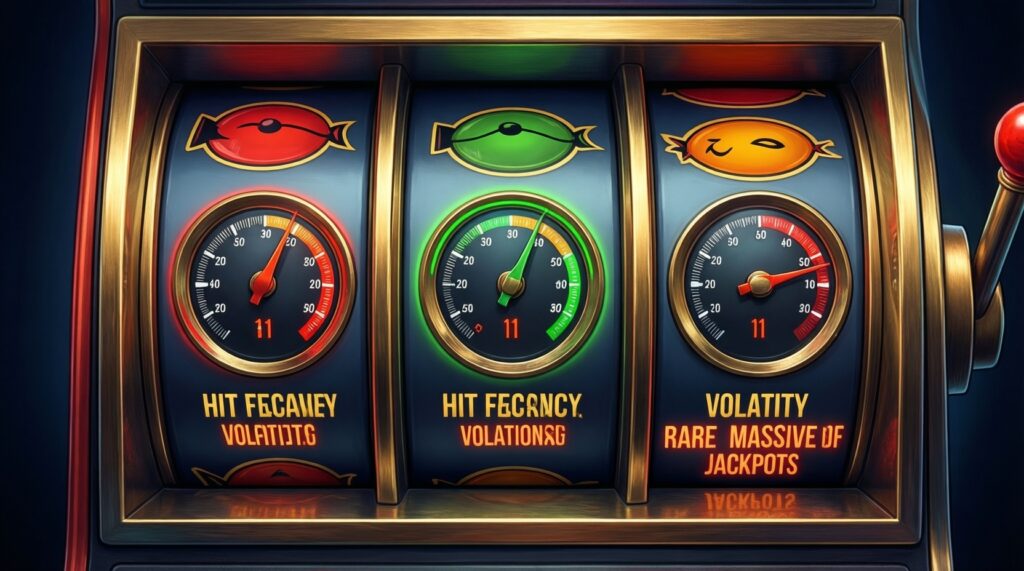
No. Hit frequency is how often you get any win; volatility is how widely outcomes vary, especially due to rare large wins.
If two slots have the same RTP, are they equally good?
They can be equally strong in expectation but very different in experience. The distribution of payouts (volatility and win size) can make one feel much harsher.
Why do "best online slots high rtp and hit frequency" lists still disappoint?

Because high RTP plus high hit frequency can still mean small average wins, and volatility/bonus concentration may drive most of the value.
How many spins do I need to confirm a slot's RTP?
You generally can't confirm it from personal play in any practical session length. Use RTP as a spec and use your tracking only to understand your short-run variance and play experience.