

Slot payouts are built by combining a pseudorandom number generator (RNG) with an outcome-mapping layer that converts raw random numbers into reel stops, symbol probabilities, and paytable wins. The RNG supplies unpredictable numbers; mapping tables and virtual reels decide what those numbers mean, which ultimately defines RTP, volatility, and hit frequency.
Core mechanics at a glance
- A slot machine RNG continuously generates numbers, independent of spins or player actions.
- Each spin samples the next RNG output(s) and maps them to reel-stop indices via fixed rules.
- Virtual reels (weighting) shape symbol frequencies without changing the visible reel art.
- The paytable turns symbol combinations into payouts; probabilities determine long-run return, not short sessions.
- Slot RTP explained: RTP is a mathematical average over many spins, not a promise of near-term balance.
- Quality controls focus on reproducibility, distribution checks, and edge-case handling (ties, rare events).
How pseudorandom number generators generate continuous streams
An RNG in a slot is typically a deterministic algorithm that produces a long sequence of numbers that look random. It does not wait for a spin to start generating; it runs continuously and the game simply reads the next value(s) when a spin is initiated.
This is the key boundary: the RNG's job is to generate uniformly distributed values over a range (for example, 0 to 232−1). The game logic's job is to interpret those values as reel stops, bonus triggers, or other events.
If you're asking "how do slot machines work", the most accurate simplified answer is: the RNG selects an outcome, then the reels and animations reveal that preselected outcome; the spinning visuals are presentation, not the randomization itself.
Seeding, entropy sources and their impact on unpredictability
Because most PRNGs are deterministic, unpredictability depends on how they are seeded and refreshed. In practical slot implementations, seeding and entropy management are designed to prevent prediction or replay.
- Seed initialization: the PRNG starts from an internal state (the seed). Different seeds create different sequences.
- Entropy inputs: implementations may mix in timing jitter, hardware noise, or system-level randomness to reduce predictability.
- State size matters: larger internal state generally makes it harder to infer future outputs from past outputs.
- Reseeding strategy: some designs periodically reseed or stir state to defend against state compromise.
- Separation of concerns: RNG output should be kept separate from presentation code (UI, animation) to reduce accidental biases.
- Reproducible test mode: developers often use fixed seeds in QA to reproduce specific outcomes; production should not expose this.
Mapping RNG outputs to reel stops: algorithms and tables
Outcome mapping converts a uniform RNG value into a discrete reel stop (or multiple stops). The mapping is typically done with either modulo arithmetic or a range table. A range table is common because it supports weighting cleanly and avoids subtle modulo bias when the RNG range does not divide evenly.
| RNG range slice | Assigned reel stop | Implied probability (illustrative) |
|---|---|---|
| 0-499 | Stop A | 50% |
| 500-799 | Stop B | 30% |
| 800-949 | Stop C | 15% |
| 950-999 | Stop D | 5% |
Typical places where this mapping is applied:
- Base-game reel stops: one RNG draw per reel, or a single draw expanded into multiple reels using independent streams.
- Bonus entry: a separate mapping that decides whether a bonus triggers on a given spin.
- Pick/hold outcomes: RNG drives the content behind selections (unless it is purely player-choice cosmetic).
- Feature modifiers: deciding multiplier values, extra wild placements, or reel-set selection.
- Jackpot tiers: mapping determines which tier is awarded once eligibility is met.
A simplified (illustrative) mapping approach looks like this:
rng = next_uint32()

# Map to 0..999 uniformly (illustrative; real code avoids bias carefully)
x = rng % 1000

if x < 500: stop = "A"
elif x < 800: stop = "B"
elif x < 950: stop = "C"
else: stop = "D"
Virtual reels, weighting and effective symbol probabilities
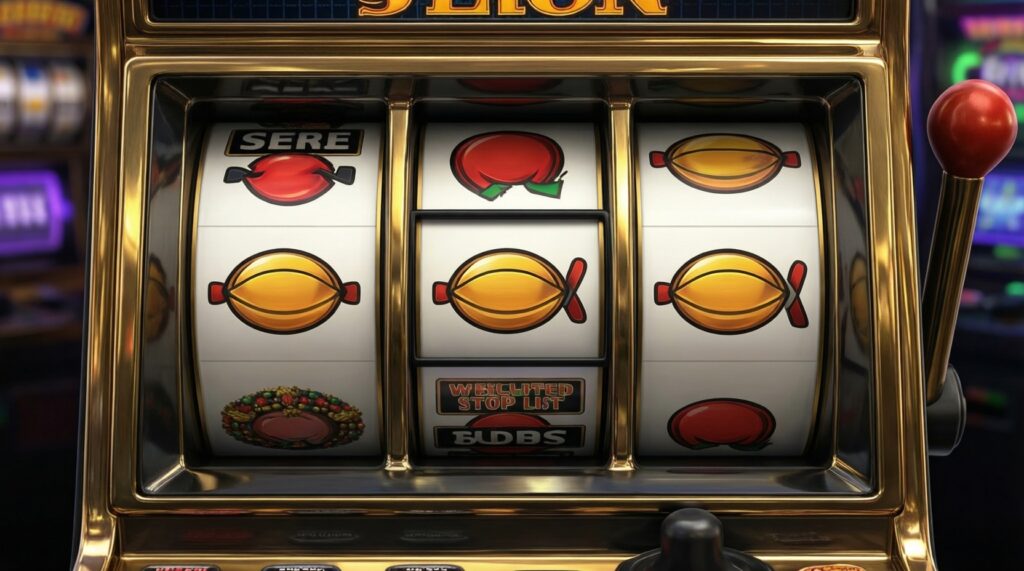
Virtual reels let designers show a small number of visible symbols while controlling probabilities via a larger, weighted stop list behind the scenes. This is how two games can look similar but behave very differently.
Benefits in real slot math design
- Fine-grained tuning of symbol frequency without redesigning visible artwork.
- Stable RTP target while shifting volatility (e.g., fewer small wins, more rare large wins) by redistributing weights.
- Multiple reel sets (different weight tables) to support mode changes, features, or progression.
Constraints and common pitfalls
- Perceived fairness issues: players may assume each visible symbol is equally likely when it is not.
- Unintended correlations: reusing the same RNG value or stream incorrectly across reels can create patterns.
- Bias from naive modulo: mapping with
%can introduce small biases if the source range does not divide evenly. - Overfitting: tuning weights to match a short simulated run instead of long-run expectations can mislead QA results.
Translating probabilities into payouts: hit rate, volatility and RTP
Once symbol probabilities are defined, payouts are determined by the paytable and the combinatorics of how reels intersect with paylines/ways. This is where "online slots payout percentage" discussions come from: it's the long-run expected return implied by the probability model and paytable.
- Myth: RTP guarantees short-term outcomes. RTP is an average over many spins; short sessions can deviate widely.
- Mistake: confusing hit rate with RTP. A game can pay frequently (high hit rate) but mostly small amounts and still have the same RTP as a swingy game.
- Mistake: assuming visible reels define odds. With virtual reels, the displayed strip is not the probability model.
- Myth: a slot is "due" after losses. If spins sample independent RNG outputs, past outcomes do not make a future win more likely.
- Mistake: mixing bonus RTP into base-game intuition. Many designs allocate a meaningful share of expected return to rare features; base-game "dryness" can be intentional.
Quick practical tips for evaluating payouts (Thailand context)
If you're choosing between titles marketed as the best online slots real money, use these mechanics-focused checks to compare games without relying on hype:
- Read the info panel: find RTP, volatility labels, and feature rules; treat them as design intent, not session guarantees.
- Check what drives big wins: if most value sits in rare bonuses, expect longer losing streaks even with decent RTP.
- Compare payout shapes: prefer games whose common wins match your bankroll (many small wins vs. rare spikes).
- Look for transparent rule wording: clear definitions for wilds, multipliers, and retriggers reduce "surprise variance."
- Use controlled testing: in demo mode, record 200-500 spins and note win frequency and largest win; you're observing feel, not proving RTP.
- Avoid pattern hunting: if you catch yourself waiting for "hot" cycles, you're assuming dependence the mapping usually does not have.
Validation, monitoring and handling rare or tied outcomes
Even with correct math on paper, implementations can drift due to mapping bugs, stream reuse, or edge cases (like ties when selecting among equal candidates). A lightweight validation approach checks distributions and determinism boundaries.
Mini-case: verifying that a reel-stop mapping table is honored and that ties are handled consistently.
# Pseudocode for an offline validation run (illustrative)
counts = dict(A=0, B=0, C=0, D=0)

for i in 1..1_000_000:
  x = sample_mapped_stop()   # uses the same mapping code as the game
  counts[x] += 1

# Check approximate proportions and investigate large deviations.
# For tied selections (e.g., two candidate prizes with same weight),
# enforce a deterministic tie-break rule or a secondary RNG draw.- Distribution checks: confirm observed frequencies converge toward the intended weights over large samples.
- Stream isolation: ensure each reel (or decision) uses an independent draw path, not an accidentally shared value.
- Regression snapshots: keep test vectors (seed/state → expected mapped stop sequence) for build-to-build comparisons.
- Rare-event probes: directly simulate bonus triggers and top awards to confirm they are reachable and correctly scored.
Practical clarifications and quick answers
Is the RNG called once per spin or constantly?
In most designs it runs continuously, and the spin reads the next available value(s). The reels are a reveal of an already-selected outcome.
Does changing bet size change the RNG outcome?
Bet size typically changes which paytable/award calculation applies, not the raw RNG stream. The mapping and payout logic decide how that outcome is valued.
What does "slot RTP explained" actually mean in practice?
It means the expected long-run return implied by probabilities and the paytable. It does not predict your next 50 or 500 spins.
Are virtual reels the same as "rigged reels"?
No-virtual reels are a probability model that can be fair and consistent when implemented correctly. They simply decouple visible symbols from weighted stop frequencies.
Why can two games with the same online slots payout percentage feel very different?
Volatility and hit rate differ: one game may return value through frequent small wins, another through rare large features. Same average, different distribution.
Can I identify the best online slots real money just by looking at the reels?

No-visible reels don't reveal the underlying weights. Use the info panel (RTP/volatility/features) and short controlled testing to judge fit.