

Stop-loss and stop-win limits reduce harm by turning risk decisions into pre-committed rules: where you exit a losing trade (stop loss limit) and where you lock profits and stop overtrading (stop win limit). To set stop loss and stop win limits that work, define thresholds from your risk budget, place them at market-structure levels, and automate execution to avoid "in-the-moment" overrides.
Pre-Trade Stop Rules Checklist
- Define your maximum loss per trade and per day before you enter any position.
- Choose a stop loss limit method (price/ATR/structure/time) and write it down.
- Define a stop win limit (profit target and/or daily profit cap) to prevent giving back gains.
- Pre-calculate position size so your stop distance matches your risk budget.
- Decide the order type you will use for exits (stop-market, stop-limit, bracket/OCO) and when.
- Set an exception policy for gaps/slippage and a hard "no revenge trades" rule.
Clarify Risk Objectives and Behavioral Constraints
This approach fits traders who execute repeatedly, feel tempted to "wait for it to come back," or give back profits after a good run. It is especially useful when you trade volatile instruments or trade across sessions where gaps can happen.
Do not rely on stop loss and stop win limits for trading if you cannot tolerate slippage, you trade illiquid markets with wide spreads, or you routinely disable stops. Also avoid ultra-tight stops on noisy timeframes if you are not prepared for frequent small losses.
- Define what "harm" means for you: maximum drawdown you will not cross, and the emotional/behavioral triggers you want to prevent (tilt, overtrading, doubling down).
- Pick your "decision frequency": will you manage stops intraday, at candle close, or only once per session?
Troubleshooting tip: If you often break rules, lower complexity-use one stop method and one daily limit until it becomes automatic.
Define Quantitative Stop-Loss and Stop-Win Thresholds
To set stop loss and stop win limits safely, you need a few basics prepared before placing any order:
- Account risk budget: a fixed amount (e.g., THB value) or a fixed fraction of equity per trade and per day.
- Instrument constraints: tick size, typical spread, volatility, trading hours, and whether gaps are common.
- Charting/volatility reference: recent swing levels and a volatility measure (ATR or an equivalent range proxy).
- Execution capability: ability to place stop orders, OCO/bracket orders, and alerts on your broker/platform.
- A position-sizing method: so the stop distance translates into a controlled loss.
Practical formulas (use one consistent framework):
- Risk per trade (R): choose a fixed amount you can lose without changing your behavior. Example: R = 1,000 THB.
- Stop distance: based on structure or volatility. Example: stop distance = 0.8 × ATR(14) or "below last swing low + spread buffer".
- Position size: position size = R / (stop distance in THB per unit).
- Stop win limit options:
- Per-trade take-profit: e.g., TP at 2R (profit equals 2 × your risk).
- Session/day profit cap: stop trading after +3R (or after your best-quality setup has passed).
- Giveback limit: after reaching +3R on the day, stop if you give back 1R from peak.
Troubleshooting tip: If you frequently hit stops by a few ticks, add a small buffer for spread and normal noise-then reduce position size to keep the same R.
Select Stop Types and Precise Placement Methods
Preparation mini-checklist (do this in under 2 minutes):
- Mark the nearest swing high/low and the invalidation level for your idea.
- Check spread and liquidity at your trading time (especially around open/close).
- Decide whether a stop-market is required for certainty, or a stop-limit is acceptable.
- Calculate position size from your chosen stop distance and risk per trade (R).
- Write the stop win limit rule you'll follow for this trade (take-profit, trailing, or time exit).
-
Choose the exit logic: invalidation first, comfort second
Place the stop where your trade idea is proven wrong (invalidation), not where the loss "feels small." This makes the stop-loss meaningful and reduces random stop-outs.
- Structure example: long trade stop below last swing low (plus a small buffer).
- Volatility example: stop at entry − 1.0 × ATR(14).
-
Select the order type: stop-market vs stop-limit
A stop loss limit (stop-limit order) controls the worst acceptable fill price, but it can fail to execute in fast moves. A stop-market is more likely to exit but may slip.
- Use stop-market when not exiting is worse than slippage (news risk, thin liquidity, gap risk).
- Use stop-limit only when you can tolerate non-fill and have a backup plan (manual hedge/exit rule).
-
Convert risk (R) into position size
Set size so a stop hit equals your planned loss. Example: if R = 1,000 THB and your stop distance equals 10 THB per share, size = 100 shares.
-
Define your stop win limit before entry
A stop win limit is a rule that forces profit capture or halts trading after reaching a profit threshold. Pick one: fixed target, trailing stop, or daily cap to prevent giving back gains.
- Per-trade: take profit at +2R and move stop to breakeven after +1R (only if it matches your strategy).
- Daily: stop trading after +3R or after two high-quality wins, whichever comes first.
-
Use bracket/OCO if available (entry + stop + target)
Attach both the stop and the profit-take to reduce hesitation and accidental "naked" positions. If one order fills, the other cancels automatically.
-
Write the one allowed override condition
Overrides should be rare and pre-defined (e.g., platform error, trading halt). Never widen a stop to avoid taking a loss; if you must change it, reduce risk or exit.
Troubleshooting tip: If you keep moving stops, reduce position size and commit to "no widening"-only tighten or exit.
Order Execution, Automation, and Broker Considerations
- Stop order is actually live on the broker (not only an alert on your chart).
- Order quantity matches your current position size (no leftover partial size unprotected).
- Stop price is on the correct side of the market (sell-stop below price for longs, buy-stop above for shorts).
- You accounted for tick size and spread so the stop is placeable and not rejected.
- If using a stop loss limit, the limit price is realistic (not so tight that it won't fill).
- Bracket/OCO links are correct (one cancels the other after fill).
- Time-in-force is correct (DAY vs GTC) for your holding period.
- You have a backup exit method if the platform disconnects (phone dealing, secondary device, or pre-set broker-side orders).
- Your stop win limit rule is visible (note, template, or checklist) so you don't "keep trading because you're up."
Troubleshooting tip: If you're unsure whether your broker treats stops as server-side, assume they are not and use broker-side orders or fail-safe alerts.
Handling Slippage, Partial Fills and Emergency Overrides
- Mistake: using stop-limit in fast markets without a fallback. Fix: prefer stop-market for protective exits or widen the limit tolerance and reduce size.
- Mistake: placing stops at obvious round numbers. Fix: place beyond the level (structure + buffer) and size down to keep the same R.
- Mistake: ignoring spread at illiquid times. Fix: avoid trading around low-liquidity periods or use wider stops with smaller size.
- Mistake: moving the stop farther away after entry. Fix: forbid widening; if the setup changes, exit and reassess.
- Mistake: no plan for gaps. Fix: reduce overnight exposure, use options/hedges when appropriate, or accept gap risk with smaller size.
- Mistake: partial fills leave a "ghost" position. Fix: immediately update stop quantity to match the filled size; cancel and replace if needed.
- Mistake: take-profit fills, then you re-enter impulsively. Fix: enforce a stop win limit such as a daily profit cap or a cooldown period after a big win.
- Mistake: you hit daily loss limit, but continue trading to recover. Fix: hard stop-close platform, log the day, and resume only next session.
Troubleshooting tip: If slippage is frequent, treat it as part of risk-raise the assumed stop distance in your sizing so losses stay within R.
Post-Trade Review, Metrics and Iterative Adjustment

After each session, adjust only one variable at a time. These alternatives are useful when basic stop loss and stop win limits for trading don't match market conditions:
- Time-based stop: exit if the trade doesn't move in your favor within N candles/minutes; useful in mean-reverting or fast momentum setups.
- Volatility-adjusted trailing stop: trail by a fraction of ATR; useful when trends extend and fixed targets cut winners short.
- Scale-out + protected runner: take partial profit at 1R-2R and trail the remainder; useful when you want a stop win limit without capping upside.
- Session guardrails (daily rules): daily max loss, daily profit cap, and giveback limit; useful for risk management stop loss stop win limits when performance is highly emotional.
Troubleshooting tip: If your review turns into "rule shopping," freeze rules for a fixed number of trades and evaluate only after that block.
Practical Concerns, Edge Cases and Quick Fixes
Is a stop loss limit the same as a stop-loss?
In common speech, yes, but technically a "stop loss limit" usually means a stop-limit order: it triggers at a stop price and then submits a limit order. It can fail to fill in fast markets, so it's not always the safest protective stop.
How do I set stop loss and stop win limits if I trade multiple positions at once?
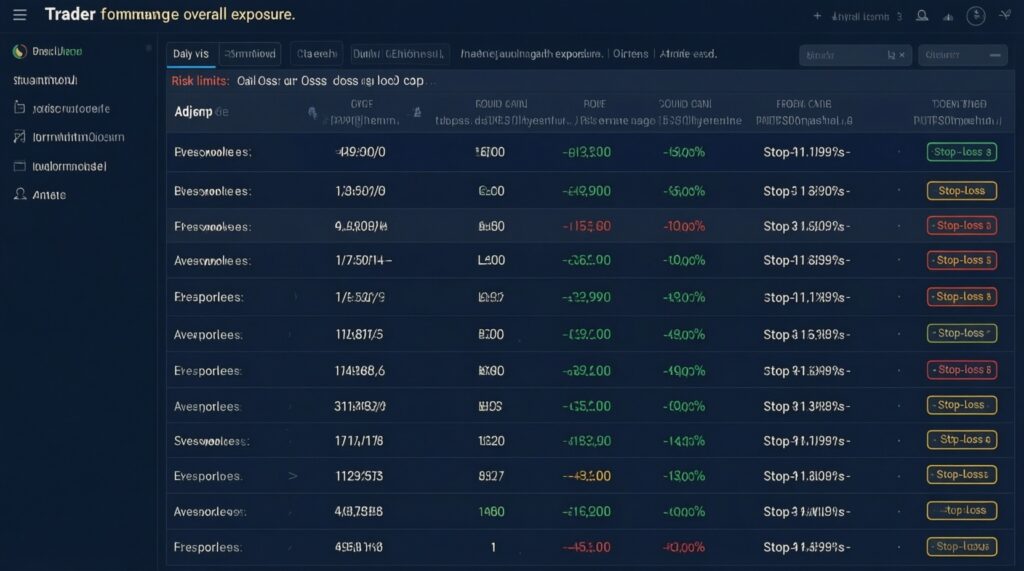
Use a portfolio rule: a maximum total open risk (sum of all trade R) plus a daily loss limit. Then assign each position its own stop and ensure the combined worst-case loss is still acceptable.
What's a practical stop win limit if I keep giving back profits?

Use a daily profit cap or a giveback rule, such as "after reaching +3R, stop trading if I give back 1R from the peak." This directly targets overtrading after wins.
Should I use stop-market or stop-limit for exits?
Stop-market prioritizes getting out; stop-limit prioritizes price but risks non-execution. If "not exiting" is unacceptable, prefer stop-market and control risk via smaller size.
What if price gaps through my stop?
You can't guarantee the exact exit price during gaps. Reduce gap exposure (smaller size, avoid holding through known event risk), and assume extra slippage in sizing so the loss still stays within your risk budget.
How tight should my stop be on a noisy timeframe?
If normal price noise regularly hits your stop, it's too tight for that timeframe. Use a structure/ATR-based distance and reduce size to keep the same risk per trade.
When should I remove or adjust a stop?
Adjust only to reduce risk (tighten) or to follow a pre-defined trailing rule. Removing protection or widening stops usually breaks the core purpose of stop loss and stop win limits for trading.