

An "up to 96.5%" RTP disclosure means the game can be configured to return as much as 96.5% over the very long run, but your actual version may be lower and your short-run results can differ wildly. Treat it as a ceiling, not a promise, and verify which RTP setting your chosen casino instance uses.
RTP at a glance: what the headline number actually conveys
- RTP is a long-run average return; it does not predict near-term outcomes or session results.
- "Up to" language usually signals multiple RTP configurations for the same slot, not one fixed value.
- A displayed slot RTP percentage can be accurate yet still irrelevant to your next few thousand spins due to variance.
- Volatility (pay distribution) and hit frequency can matter more to bankroll safety than a small RTP difference.
- For an RTP casino, the practical question is: which RTP setting is actually deployed and who verified it.
What RTP means and how it's calculated
RTP (Return to Player) describes the expected proportion of total wagered money that a game returns to players over an extremely large number of bets. If a slot is configured at a given RTP, the math model is designed so that, across vast play volume, the average return approaches that value. That's why RTP is an expectation, not a guarantee.
In practice, RTP comes from the game's paytable and probability model: each outcome has a probability and a payout; the weighted sum of payouts relative to the stake yields the expected return. For intermediate players comparing an online casino RTP claim, it helps to separate three ideas:
- Model RTP: what the developer designed for a specific configuration.
- Deployed RTP: what the operator actually runs (may differ if multiple settings exist).
- Realized RTP: what you personally experience (can diverge sharply in any finite sample).
RTP also doesn't tell you how returns arrive. Two games can share the same slot RTP percentage while feeling totally different: one pays frequent small wins; the other pays rarely but sometimes very large. That distinction is volatility and payout distribution, not "RTP vs no RTP."
Why "up to 96.5%" can be misleading: common disclosure tactics
"Up to 96.5%" is a range disclosure in disguise: it communicates a maximum while hiding the lower configurations that may be more common in the market. When you're scanning for best RTP slots or high RTP slots, watch for these tactics that blur what you're actually playing:
- Multiple RTP settings per title: the same slot can ship with several RTP configurations (e.g., "high," "medium," "low"), and the casino selects one.
- Maximum RTP highlighted, minimum omitted: marketing focuses on the best-case number while the lower settings require extra digging.
- RTP shown for a different jurisdiction/build: a help page or affiliate site quotes the developer's top RTP, but your region's deployed build differs.
- RTP quoted without mode conditions: bonus buys, side bets, or feature toggles can change effective returns, yet the headline RTP reflects only one rule set.
- "Theoretical" used as a shield: the word is correct (RTP is theoretical), but it's sometimes used to avoid stating the deployed configuration.
- "Average across bet levels" confusion: some readers assume RTP changes with stake size; for most slots it doesn't, but optional features may.
Interpret "up to 96.5%" as: "this game family can be configured to 96.5%, but we are not telling you which configuration you are currently offered." Your safest stance is to assume it may be lower until you confirm otherwise.
RTP distribution, volatility and the role of hit frequency
RTP is a mean; your bankroll risk is shaped by how outcomes are distributed around that mean. Volatility (how spread-out outcomes are) and hit frequency (how often any win occurs) determine whether a given RTP feels "stable" or "swingy." Typical situations where this matters more than chasing a small RTP edge:
- Short sessions: you may never get close to the theoretical return; a "better" RTP can still lose quickly under high volatility.
- Bonus-dependent slots: a large share of the RTP may sit in rare features, so long droughts are normal even if RTP is high.
- Feature purchases / ante bets: they can raise or lower variance dramatically; the same nominal RTP may imply very different drawdowns.
- Low-balance play: hit frequency becomes a practical safety factor; frequent small hits can extend playtime without changing expectation.
- Comparing "best RTP slots" lists: lists often ignore volatility, which is why two "high RTP slots" can produce very different session survival rates.
| What you see | What it usually means | Typical long-run outcome | What can dominate in the short run |
|---|---|---|---|
| "Up to 96.5%" | Multiple RTP configurations; 96.5% is the ceiling | If (and only if) the deployed setting is 96.5%, the long-run average can approach it | Which RTP setting is deployed; volatility can overwhelm small RTP differences |
| "RTP 96.5%" (no "up to") | Single stated configuration (still needs verification) | Long-run average may approach the stated value under the exact rule set | Sample variance; rare-feature dependence; bankroll drawdowns |
| Affiliate says "96-97%" | Often copied from generic developer info | Not meaningful unless matched to the casino's build | Mismatched jurisdiction/build; outdated config; mode differences |
| Your tracked results over a few hundred/thousand spins | A small sample of a high-variance process | Not a reliable estimator of RTP | Variance and streaks; win clustering; one bonus can skew results |
Regulatory frameworks and the provenance of RTP figures
RTP credibility depends on provenance: where the number comes from, what exactly it applies to, and whether someone independent checked it. In Thailand, many players access offshore platforms; that makes it even more important to separate "developer claims" from "operator deployment," because oversight can vary widely.
- What regulation and testing can improve:
- Independent lab verification that a specific build matches its stated math model.
- Controls that the RNG and game logic behave as tested (versioning, integrity checks).
- Clearer disclosure requirements in some jurisdictions (e.g., requiring display of the configured RTP).
- What regulation and testing cannot guarantee:
- Your personal outcomes or "fairness" in the sense of winning in a given session.
- That every operator displays the RTP clearly or uses the highest configuration.
- That an RTP number quoted on a page applies to bonus buys, side bets, or special modes unless explicitly stated.
How to verify advertised RTPs: audits, samples and independent tools
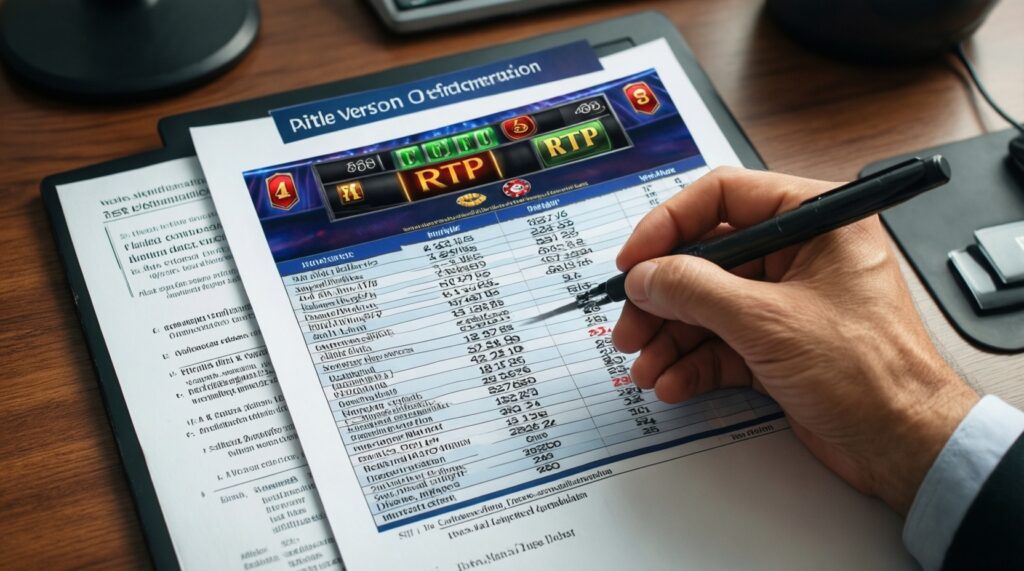
Verification is about matching three things: the title/version you are playing, the operator's deployed configuration, and a credible test or disclosure trail. Common mistakes and myths to avoid:
- Myth: "My results prove the RTP is lower." Small and medium samples are dominated by variance; losing runs aren't proof of misconfiguration.
- Mistake: trusting "online casino RTP" text on a lobby banner. Look for the RTP in the game's info/help panel, rules screen, or provider details for that exact instance.
- Mistake: mixing jurisdictions/builds. A provider may publish a top RTP, while the casino runs a different configuration for your market.
- Mistake: ignoring mode conditions. If you use feature buys/side bets, confirm whether the stated RTP applies to that mode.
- Myth: "High RTP slots are always safer." Higher RTP improves expectation, but high volatility can still create severe drawdowns.
Practical verification steps are simple: capture the exact game name and provider, check the in-game information screen for the RTP value (or range), and compare it with reputable third-party databases that list RTP configurations by provider and version. If the casino cannot show the deployed RTP for that exact game instance, treat "up to" as a warning sign, not a selling point.
Applying RTP to bankrolls and decision-making under uncertainty
Use RTP as a filter, not a forecast. A reasonable workflow is: (1) avoid unclear "up to" claims unless you can confirm the deployed setting, (2) choose volatility that matches your bankroll tolerance, and (3) assume your session result can deviate strongly from expectation.
Mini-case: you're choosing between two "best RTP slots" candidates. Slot A is advertised "up to 96.5%" with unclear configuration; Slot B states 96.0% in-game. Even if 96.5% is better in theory, the uncertainty around A's deployed RTP can make B the safer decision because you can validate the slot RTP percentage you're actually getting.
# Pragmatic selection logic (conceptual)
if RTP_is_range and deployed_RTP_not_confirmed:
    treat_as_lower_config_or_skip
else:
    compare_confirmed_RTPs

choose_volatility = match(bankroll, desired_session_length, drawdown_tolerance)
set_limits = stop_loss + time_limit
expect_variance = "session outcome can be far from RTP"
- Can I see the exact RTP value (not just "up to") inside the game's info/rules screen?
- Do I know whether my play mode (feature buy/side bet) is covered by that RTP statement?
- Have I checked volatility/hit frequency so bankroll risk matches my limits?
- Am I choosing based on confirmed deployment, not generic "high RTP slots" marketing?
Clear answers to recurring RTP uncertainties
Does "up to 96.5%" mean I will get 96.5% back?

No. It indicates a maximum configuration; your deployed version can be lower, and your session can deviate significantly from any theoretical RTP.
Is the slot RTP percentage the same at every online casino?
Not necessarily. Some titles ship with multiple RTP settings, so an online casino RTP for the same game name can differ between operators.
Can I estimate RTP by tracking my results?
You can track for discipline, but it's not a reliable way to infer RTP. Variance can dominate for very large numbers of spins, especially on high-volatility games.
Are best RTP slots always the best choice?
Not automatically. If the RTP is unverified or the game is very volatile, it can be worse for bankroll safety than a slightly lower RTP game with clearer disclosure.
What is the quickest way to validate an RTP casino claim?
Check the RTP in the game's own info/rules screen for that exact instance, then cross-check the provider/version in reputable independent listings where available.
Do bonuses change RTP?
Bonuses change your overall expected value, but they don't necessarily change the game's underlying RTP. Feature buys and side bets can have their own RTP/variance conditions, so confirm mode-specific rules.