

To reduce the chance of going bust, treat bet sizing as a risk-control problem: define a bankroll, estimate your edge conservatively, and stake only a small, repeatable fraction of bankroll per bet. For most risk-aware bettors, fractional Kelly or a fixed-fraction unit system is the safest way to keep losses survivable while compounding when results are good.
Core principles of bankroll risk management
- Separate bankroll from living money; bankruptcy risk is mostly a sizing mistake, not a "bad run."
- Size stakes from bankroll and estimated edge, not from confidence or recent wins/losses.
- Assume your edge is smaller than you think; use "haircuts" and caps on stake size.
- Control variance with limits: per-bet fraction, daily exposure, and correlated-bet rules.
- Prefer systems that can be executed identically every time (repeatability beats cleverness).
Understanding ruin probability and its drivers
This approach fits intermediate bettors doing regular sports betting bankroll management with many repeated wagers (similar market type, similar pricing rules). It is especially useful when you want to reduce risk of ruin betting rather than maximize short-term profit.
Don't use aggressive fraction-based sizing (including full Kelly) when: you can't estimate edge at all, your stake limits force you to "overbet" relative to bankroll, your bets are highly correlated (same match/outcome cluster), or you are likely to deviate from the plan under stress. In those cases, simpler caps and smaller unit sizing are safer.
- What drives going bust: high stake fraction, negative/overestimated edge, high variance (long-odds), correlation, and tilt-driven stake changes.
- What reduces bust risk: smaller fractions, conservative edge inputs, exposure limits, and consistency in execution.
Estimating edge, variance and effective sample size

To decide how to size bets, you need inputs you can justify and update:
- Bankroll (B): the amount dedicated to betting only.
- Odds format: decimal odds d (common in TH sportsbooks). Net odds b = d − 1.
- Win probability estimate (p): your true probability, not the book's implied probability.
- Variance proxy: higher odds and lower strike rates increase drawdowns; treat longshots as higher-risk even with the same estimated edge.
- Effective sample size: if your bets are correlated or come from the same model/league conditions, you have fewer "independent" bets than your bet count suggests.
Practical edge calculation (per bet) in decimal odds:
- Expected profit per 1 unit staked: EV = p·(d−1) − (1−p)
Example (conservative): if d = 2.00 and you believe p = 0.53, then EV = 0.53·1 − 0.47 = 0.06 (about +6% per unit staked). If you might be wrong, "haircut" p (e.g., use 0.51-0.52) before sizing.
Bet sizing with Kelly criterion and fractional Kelly
Risks and limitations (read before applying):
- Full Kelly can create deep drawdowns even with a real edge; many users abandon it mid-run.
- Your biggest risk is edge error: if p is overestimated, Kelly oversizes immediately.
- Correlation breaks the math; multiple "Kelly-sized" bets on the same game can exceed safe exposure.
- Stake limits and liquidity can force suboptimal sizing; never "catch up" by increasing fraction.
-
Convert odds and define variables
Use decimal odds d, bankroll B, and your win probability p. Compute b = d − 1 (net profit per 1 staked if you win).
-
Compute the Kelly fraction
For a binary win/lose bet, the Kelly stake fraction is:
- f* = (b·p − (1 − p)) / b
- If f* is negative, you skip the bet (no bet is a valid bet sizing strategy).
Example: d = 2.00 so b = 1, p = 0.53 ⇒ f* = (1·0.53 − 0.47)/1 = 0.06. Full Kelly would stake 6% of bankroll, which is usually too aggressive for risk-aware bankroll management.
-
Apply fractional Kelly (risk-aware default)
Stake f = k·f*, where k is typically small for safety. Common risk-aware choices are k = 0.25 (quarter Kelly) or k = 0.50 (half Kelly) depending on your confidence in p.
Continuing the example: f* = 0.06, quarter Kelly (k=0.25) ⇒ f=0.015. With B = 10,000 THB, stake ≈ 150 THB.
-
Add two hard caps: per-bet and per-event
Even with fractional Kelly, cap exposure to prevent model mistakes and correlation blow-ups.
- Per-bet cap: e.g., never more than 1%-2% of B on a single bet if you are risk-aware.
- Per-event cap: e.g., total exposure across all bets on the same match not above 2%-3% of B.
-
Recalculate from the new bankroll, not the old one
After each bet (or daily), update bankroll and apply the same fraction to the updated B. This keeps risk proportional and is the core of robust bankroll management.
-
Underestimate edge on purpose (edge haircut)
Before computing f*, reduce p (or EV) to account for estimation error. If your model says 0.53, size as if it were 0.51-0.52 until you have strong evidence it holds.
Practical stake rules: fixed-fraction, unit sizing and stop-losses
Use this checklist to validate that your staking plan is safe and executable day-to-day:
- My default stake is a fixed fraction (or fractional Kelly) and does not change with mood or streaks.
- I have a maximum stake per bet (cap) that I will not override.
- I have a maximum total exposure per event/market cluster to control correlated outcomes.
- I size from the current bankroll, recalculated on a fixed schedule (per bet or per day).
- I skip bets when my estimated edge is small or uncertain; "no bet" is part of the system.
- I avoid long-odds bets unless my stake fraction is smaller than my normal stake.
- I set a daily/weekly loss limit that triggers a pause and review (not "chasing").
- I track closing line movement or another sanity check to detect when my edge may be gone.
- I can explain, in one sentence, why today's stake equals X% of bankroll.
Scenario tables and stress-testing bankroll outcomes
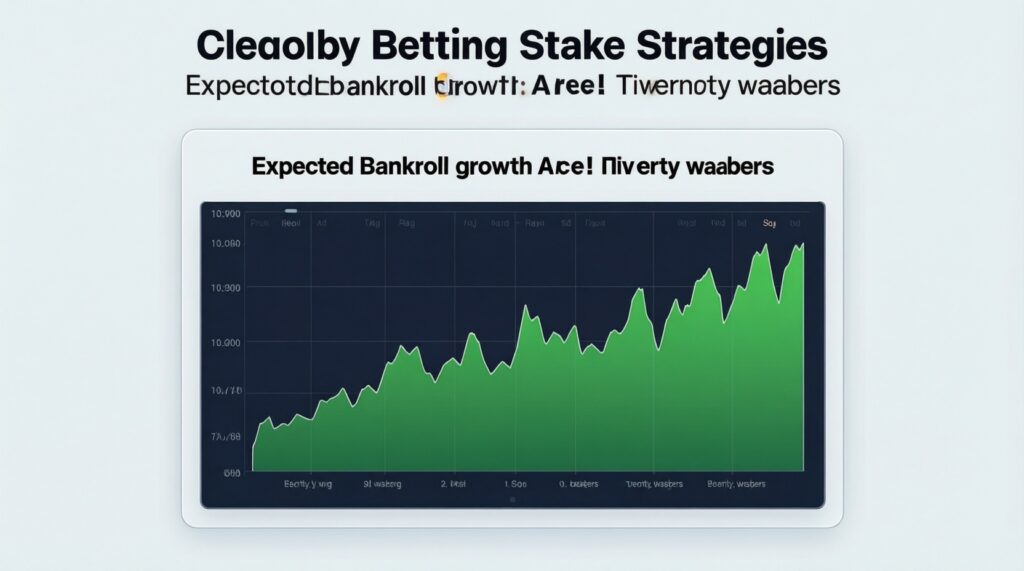
Below is a simple comparison of sizing rules under the same illustrative conditions (not a guarantee): starting bankroll 10,000 THB, decimal odds 2.00, assumed win rate 53%, and 20 bets. Values are rough expected bankrolls (not worst-case drawdowns) to help you see how stake aggressiveness changes the path.
| Sizing rule | Stake per bet (from 10,000 THB) | Expected ROI per bet (assumed) | Approx. expected bankroll after 20 bets | Risk notes |
|---|---|---|---|---|
| Fixed 1% of bankroll | ~100 THB | ~6% | ~10,120 THB | Low stress; slower growth; easiest to follow consistently. |
| Quarter Kelly (k=0.25) based on p=0.53 | ~150 THB (≈1.5%) | ~6% | ~10,180 THB | Good balance if edge estimates are conservative; still cap per event. |
| Half Kelly (k=0.50) based on p=0.53 | ~300 THB (≈3%) | ~6% | ~10,360 THB | Higher drawdowns; more sensitive to edge error and correlation. |
| Full Kelly based on p=0.53 | ~600 THB (≈6%) | ~6% | ~10,720 THB | Fast growth in expectation, but large swings; many bettors abandon during losing streaks. |
Common mistakes when stress-testing and why they matter:
- Using full Kelly with optimistic p: small estimation errors can turn "optimal" into overbetting.
- Ignoring losing streaks: even good strategies can face long downswings; plan stake fraction for survivability.
- Backtesting with too few bets: small samples look stable; effective sample size is what counts.
- Assuming bets are independent: same league, same model features, same injury news can correlate outcomes.
- Increasing stakes after losses (martingale behavior): this is the opposite of risk control.
- Not capping total exposure on a single match: multiple "small" bets can become one big hidden bet.
- Mixing bet types without adjusting fraction: props and long odds usually require smaller fractions.
- Evaluating only final profit: drawdown size determines whether you can actually stay in the game.
Managing correlated bets and dynamic edge adjustments
Alternatives and add-ons that are often safer than trying to perfectly optimize one formula:
- Fixed-fraction with strict caps: stake 0.5%-1.5% per bet, plus a per-event cap; best when your edge estimate is noisy.
- Unit sizing with confidence tiers: 1 unit = 1% of bankroll; allow 0.5u/1u/1.5u tiers only if your selection process is consistent and documented.
- Blended approach (min of two rules): stake = min(fractional Kelly stake, fixed 1% stake). Useful when Kelly suggests higher stakes than your comfort drawdown.
- Dynamic edge haircut: reduce p more when markets move against you (or when you can't beat the closing line), and increase slowly only after sustained validation.
Common clarifications on sizing, risk and recovery
What is the simplest safe starting point for sports betting bankroll management?
Use a fixed 1% of bankroll per bet with a per-event cap. It is easy to execute and already cuts the chance of going bust versus variable "feel-based" stakes.
Is Kelly the best bet sizing strategy for everyone?
No. Kelly is optimal only if your probabilities are accurate and bets are independent; most bettors should use fractional Kelly with hard caps.
How do I decide how to size bets when I'm unsure about my edge?
Start smaller (e.g., 0.5%-1%), apply an edge haircut, and scale only after consistent evidence. Uncertainty should reduce stake, not increase it.
What does "risk of ruin" mean in practical terms?
It's the chance your bankroll falls so low you can't continue your strategy or you abandon it under stress. Lower stake fractions and exposure caps are the direct controls.
Should I use stop-losses to reduce risk of ruin betting?
Use them as a behavior and exposure control (pause and review), not as a way to "optimize" returns. A daily/weekly loss limit helps prevent tilt-driven oversizing.
Do I need to adjust stake size after a winning streak?
Only mechanically: if you size as a fraction of bankroll, stakes rise automatically as bankroll rises. Avoid discretionary increases beyond your preset fraction.
How do correlated bets change bankroll management?
Correlation makes variance worse than expected, so you should cap total exposure per match/market cluster. Treat multiple related bets as one combined risk.