

Risk of Ruin (ความเสี่ยงล้มละลาย) is the probability that your account hits a predefined "ruin" level (often near-zero equity or a maximum drawdown limit) before you reach your goal. You can estimate it from win rate, payoff, and position size, then reduce it by shrinking the fraction risked per trade until the ruin probability matches your tolerance.
Core concept: what 'Risk of Ruin' represents
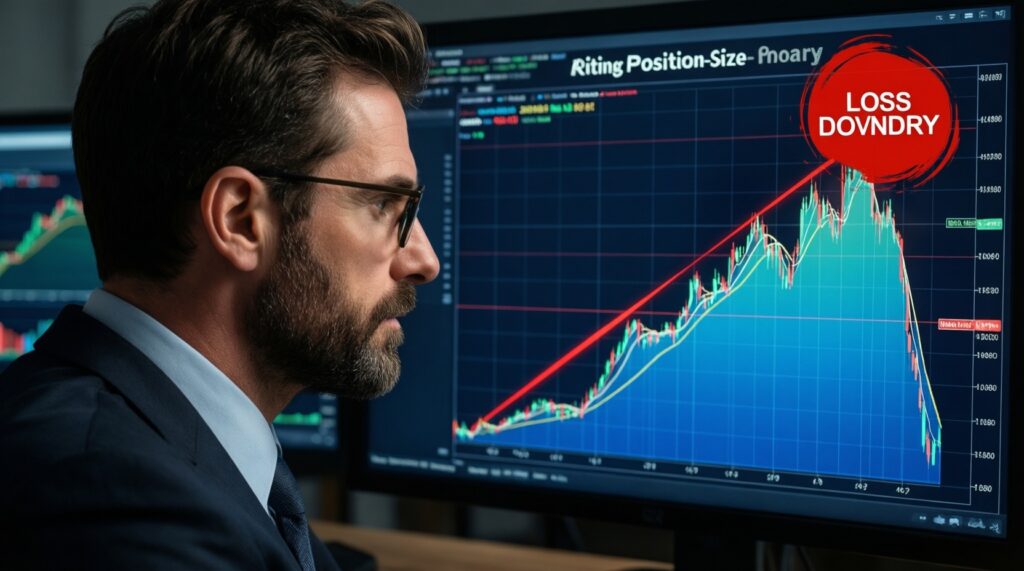
- It is a probability, not a feeling: the chance of crossing a loss boundary given your strategy and sizing.
- "Ruin" must be defined: zero, margin call, or a drawdown limit such as "stop trading at -X%".
- Position sizing is the main control knob: bigger fraction per trade increases ruin risk nonlinearly.
- Edge alone is not enough: a positive expectancy strategy can still have high ruin probability if oversized.
- Time horizon matters: more trades usually increases the chance of hitting a bad streak unless the ruin boundary is far away.
Formal definition and intuitive interpretation
Formally, Risk of Ruin is the probability that a stochastic wealth process (your equity curve) reaches a lower absorbing barrier before reaching an upper target or before the end of a trading horizon. In trading terms, it answers: "What is the chance I blow up (or breach my max drawdown rule) if I keep executing this system with this position size?"
Intuitively, it is about streaks and volatility. Even with a decent win rate, sequences of losses can cluster, and the larger your risk per trade, the fewer losses you can survive before crossing your ruin threshold.
In practice, traders often use a เครื่องคำนวณความเสี่ยงล้มละลาย (Risk of Ruin) to evaluate sizing quickly, but the tool is only as good as your assumptions about win rate, payoff distribution, and stop-out rules.
Basic models and the standard formulae used

-
Gambler's Ruin (discrete steps, simplified)
- Assumes fixed "unit" wins/losses and independent trials.
- Often used for back-of-the-envelope sizing when payoffs are approximately symmetric.
- Common even-odds form (illustrative): if win probability is p and loss probability is q=1-p, then ruin probability decreases rapidly as the number of loss-units your bankroll can withstand increases.
-
Risk-of-ruin via drift vs variability (diffusion-style approximation)
- Uses expected return per trade (drift) and variance (volatility) to approximate barrier-hitting probability.
- Useful when outcomes are not fixed-size (more realistic for trading).
-
Monte Carlo equity simulation
- Resamples or simulates trade sequences using your win rate and payoff distribution.
- Directly estimates probability of breaching a ruin boundary under your exact sizing rules.
- Often implemented in a โปรแกรมบริหารเงินลงทุนและคำนวณขนาดล็อต or a spreadsheet.
-
Link to position sizing formulas
- Any สูตรคำนวณขนาดเดิมพัน (Position Sizing) implicitly changes ruin probability by changing the step size of equity changes.
- Fixed-fractional sizing (risk a constant % of equity) usually lowers "true blow-up" risk versus fixed-lot sizing, but it can still violate a drawdown limit if the fraction is too large.
Required inputs, assumptions and common pitfalls
To apply วิธีคำนวณ Risk of Ruin สำหรับการเทรด, you need inputs that match how your strategy truly behaves. Intermediate traders often get misleading results due to mismatched definitions or unstable estimates.
Typical application scenarios (and what to specify)
- Prop-style drawdown rules: ruin boundary is a maximum drawdown (e.g., "stop at D%"); use equity-to-boundary distance as the bankroll measure.
- Margin/leverage trading: ruin is margin call; include worst-case slippage and gap risk in loss sizing assumptions.
- Strategy with variable R-multiples: outcomes are not fixed; use payoff distribution (R values), not just win rate.
- Scaling/adding to positions: effective risk per "decision" changes over time; model the rule, not a single static fraction.
- Correlated trades (multiple positions): simultaneous losses increase tail risk; treat the portfolio as one combined bet where possible.
Assumptions that quietly break the estimate
- Independence: assuming each trade is independent when regimes cluster.
- Stationarity: assuming win rate and payoff are stable across months.
- Single loss size: ignoring occasional outsized losses (gaps, liquidity, execution).
- Wrong ruin line: calculating "blow-up to zero" when your real ruin is "breach -X%".
Back-of-envelope calculations and approximation methods
For practical sizing decisions, rough approximations can be better than a false-precision model. The key is to choose a method you can actually maintain, then stress it with conservative assumptions.
Fast estimation methods (ordered by ease of implementation)
- Loss-units approach (simplest): define your worst-case loss per trade (in % or currency), then compute how many consecutive losses would hit ruin. Fewer "loss units" means higher ruin risk.
- Streak-based sanity check: decide a plausible losing streak length for your system (based on experience and backtests), and size so that streak does not breach the drawdown boundary.
- Monte Carlo in a spreadsheet: simulate many trade sequences using your historical win rate and R distribution; estimate breach frequency of the ruin boundary.
Where each approximation can mislead you (risk profile)
- Loss-units approach: ignores alternating wins/losses and volatility clustering; good for "can I survive a bad run?" but not a full probability estimate.
- Streak-based check: depends on your streak assumption; underestimates risk if the market shifts to a worse regime.
- Monte Carlo: only as realistic as your input distribution; can understate tail losses if you don't include rare but large adverse moves.
Applying results to choose bet or position size
Use the ruin estimate as a sizing constraint: pick the largest position size that keeps ruin probability acceptable under conservative assumptions. This is exactly what most traders want from a เครื่องคำนวณความเสี่ยงล้มละลาย (Risk of Ruin)-a decision boundary, not a perfect forecast.
Practical decision rule (checklist)
- Define ruin as a specific drawdown boundary (not a vague "blow up").
- Estimate win rate and payoff using out-of-sample or walk-forward logic when possible.
- Start with a small risk fraction per trade; increase slowly while monitoring drawdowns.
- Stress-test: lower the win rate and worsen payoff; re-check ruin risk.
- Prefer methods you can keep consistent (spreadsheet/assistant/your โปรแกรมบริหารเงินลงทุนและคำนวณขนาดล็อต), not one-off calculations.
Common myths that raise ruin risk
- "Positive expectancy means I can't blow up." Oversizing can still force a drawdown breach before the edge plays out.
- "I'll just stop after a few losses." If your plan is not rules-based, you often stop too late or re-enter too large.
- "Fixed-lot is simpler, so it's safer." Fixed-lot can become effectively larger risk as equity falls (relative to remaining bankroll).
- "Kelly is the answer." Full Kelly can be too aggressive under estimation error; many traders use a fraction precisely to reduce ruin risk.
Worked examples with a comparison table of outcomes
Below is a compact way to compare sizing approaches by implementation convenience and typical failure modes. Use it to choose how you'll operationalize your สูตรคำนวณขนาดเดิมพัน (Position Sizing) before you ever look for a paid คอร์สบริหารความเสี่ยงและขนาดเดิมพันสำหรับนักเทรด.
Mini-procedure you can run in a spreadsheet

- Set a ruin boundary (example: "stop trading if equity is down by D").
- Choose a sizing rule (fixed % per trade, fixed lot, or volatility-based).
- Estimate trade outcomes as R-multiples (wins and losses), using a conservative sample.
- Simulate many random sequences (Monte Carlo) and count how often equity breaches the boundary.
- Reduce position size until breach frequency is acceptably low for your tolerance.
| Approach | How you implement it | What you must assume | Main advantage | Main risk / typical failure |
|---|---|---|---|---|
| Loss-units (consecutive-loss capacity) | Compute how many max-loss trades fit between current equity and ruin boundary | Worst-case loss per trade is meaningful and enforceable | Fast, conservative sanity check; easy to maintain | Not a true probability; ignores volatility clustering and variable losses |
| Fixed-fractional (% risk per trade) | Risk a constant fraction of equity; lot size recalculates each trade | Stops are respected; losses scale roughly with planned risk | Auto-deleverages in drawdowns; widely supported in tools | Too-large fraction still breaches drawdown limits; gaps/slippage break assumptions |
| Monte Carlo Risk of Ruin estimate | Simulate sequences from win rate + R distribution; count boundary breaches | Your historical distribution approximates future outcomes | Closest to "probability of breach" under your rule set | False confidence if inputs ignore regime shifts or rare tail losses |
Practical concerns and quick clarifications
Is Risk of Ruin only about going to zero?
No. In trading it's usually more useful to define ruin as breaching a maximum drawdown, a margin level, or a risk limit that forces you to stop.
Can I estimate Risk of Ruin if my payoffs are not symmetric?
Yes. Use R-multiples or a payoff distribution and prefer Monte Carlo over fixed-step formulas when wins and losses vary.
Does a higher win rate always reduce ruin risk?
Often, but not always. If the average loss is much larger than the average win (or tail losses exist), ruin risk can remain high even with a good win rate.
How should I choose the ruin boundary (drawdown limit)?
Pick the level that would realistically force you to stop: broker margin rules, prop firm rules, or your own maximum tolerable drawdown.
What's the most practical tool: calculator, spreadsheet, or software?
A calculator is fastest for rough checks, a spreadsheet is best for transparency, and dedicated software (a โปรแกรมบริหารเงินลงทุนและคำนวณขนาดล็อต) is best for consistent execution-provided you trust the inputs.
How do I keep the estimate from being overly optimistic?
Stress-test: reduce assumed win rate, worsen payoff, and include occasional larger losses; then re-check whether the ruin probability still looks acceptable.