

Progressive jackpots change the math because part of every bet feeds a shared prize, so the game's expected value (EV) rises as the jackpot grows. Your goal is to find the break-even jackpot where base RTP plus your expected share of the progressive equals (or exceeds) 100%, then manage the volatility that comes with rare, huge wins.
What You Need to Know Upfront
- A progressive jackpot is a variable component layered on top of the game's normal payouts; EV depends on the current jackpot size.
- The contribution rate (the slice of each wager added to the jackpot) is the key lever that controls how fast EV improves as the prize grows.
- "Highest paying" claims can be misleading: a high jackpot can still be negative EV if hit odds are extremely long or the base game is weak.
- The actionable task is to compute a break-even jackpot threshold, not to guess when it will hit.
- Even positive-EV moments can be practically unplayable without bankroll discipline because variance is extreme.
Common Misconceptions About Progressive Jackpots
Myth 1: A bigger jackpot means the slot is "due." Progressive jackpot slots are typically random; the jackpot size doesn't make a hit more likely on the next spin. The jackpot only changes the payout if the jackpot event occurs.
Myth 2: The best progressive jackpot casino games are automatically the ones with the largest advertised prize. The ad headline ignores the hit probability, the base-game RTP, eligibility rules (max bet, side bet, must bet all lines), and whether the progressive is shared across many games.
Myth 3: If I play online progressive jackpot slots real money, I can "lock in" profit by grinding. EV can approach or exceed break-even only when the jackpot is sufficiently high, and even then the result distribution is dominated by rare outcomes. Short sessions are still very likely to lose.
Definition boundary: This page focuses on progressive EV math: contribution rate, hit probability for the progressive event, and how current jackpot size changes expected return. It does not assume any pattern-based timing, and it treats "strategy" as selection and bankroll management, not prediction.
How Contribution Rates Alter Expected Value
Contribution rate is the percentage (or fixed amount) from each qualifying bet that increments the jackpot. It matters because it determines how quickly the jackpot climbs per unit of handle, which sets the slope of EV versus jackpot size.
- Identify the qualifying wager. Some progressives require a minimum bet or an added side bet; only those wagers contribute.
- Separate base game vs progressive. Think of the game as: (a) normal paytable outcomes and (b) a rare progressive-trigger outcome.
- Contribution affects future value, not current odds. It increases the prize pool; it usually does not change the probability of hitting it.
- Different networks, different slopes. A local progressive tied to one game can grow differently from a network-wide pool shared across many titles.
- Hidden drains exist. A portion of wagers may fund seed/overhead, must-hit-by mechanics, or multiple progressive tiers; that changes the effective contribution to the top prize.
- EV comparison needs the same unit. Always compute EV per 1 THB (or per 1 unit) wagered to compare games cleanly.
Modeling Expected Value: Integrating Base Payback and Jackpot Growth
Use a simple additive model to estimate EV at a given jackpot size. For intermediate analysis, you only need three inputs: base expected return (excluding progressive), probability of winning the progressive event, and the current jackpot amount.
Core model (per 1 unit bet):
- EV_total = EV_base + p_jackpot × J_current
Where:
- EV_base is the expected return from the normal game outcomes excluding the progressive payout (express it as a decimal like 0.94 per 1 bet unit).
- p_jackpot is the probability of the progressive-winning event per bet unit (or per spin, if your bet unit is one spin).
- J_current is the current jackpot expressed in the same bet units (e.g., "bet units," or THB divided by THB-per-spin).
Typical scenarios where this modeling is useful:
- Comparing progressive jackpot slots at different operators when the same title shows different current jackpots.
- Ranking candidates for the "highest paying progressive jackpots online" claim by checking whether any are near break-even today.
- Filtering the best progressive jackpot casino games by removing those with restrictive eligibility rules that change your effective p_jackpot (e.g., only max bet triggers).
- Estimating when a jackpot becomes mathematically interesting (break-even threshold) without trying to predict hit timing.
- Building a progressive jackpot strategy EV calculator spreadsheet for quick decision-making before a session.
Calculating the Break-Even Jackpot Threshold
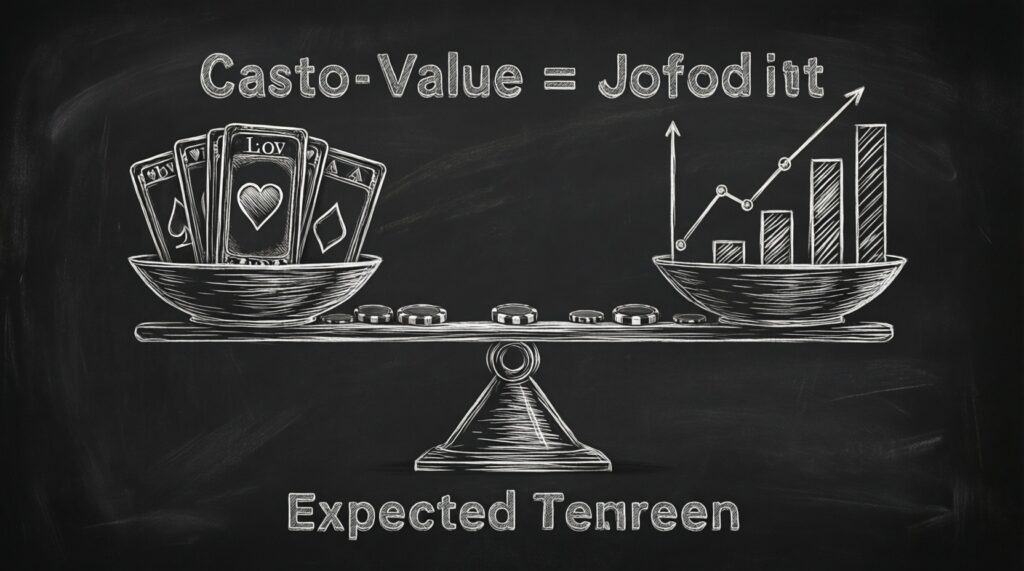
The break-even jackpot is the jackpot size at which expected return reaches 100% (EV_total = 1.00 per 1 unit bet). Solve for the jackpot amount that offsets the base-game house edge.
Break-even formula:
- J_break-even = (1 − EV_base) / p_jackpot
Action checklist: compute your threshold in 5 steps
- Get (or approximate) EV_base excluding the progressive component.
- Get (or approximate) p_jackpot for the jackpot event per bet unit.
- Compute J_break-even = (1 − EV_base) / p_jackpot.
- Convert the displayed jackpot (often in THB) into bet units by dividing by your stake per spin.
- Only consider play if J_current ≥ J_break-even and you can tolerate the variance.
What this method is good for
- Fast go/no-go decisions when you see a large displayed prize on a progressive.
- Apples-to-apples comparisons across stakes (THB/spin) by converting everything into per-bet units.
- Spotting "marketing-only" jackpots that look huge but are still far from break-even.
Limitations to keep you out of trouble
- You need the right p_jackpot. If it's unknown, you can only do sensitivity analysis (best case / worst case).
- EV_base must exclude the progressive. Mixing them double-counts value and produces a fake edge.
- Rules can change your eligibility. If max bet is required, your per-spin cost changes, and so does your effective threshold in THB.
- Positive EV doesn't mean low risk. It can still be a long-shot with a high chance of ruin for small bankrolls.
Risk, Volatility, and Numeric Examples (table included)
Progressives concentrate value into one rare outcome, so volatility dominates experience. Use examples to keep intuition grounded and to avoid common traps.
Worked example A: break-even jackpot in bet units
Assume EV_base = 0.94 and p_jackpot = 1 / 10,000,000 per spin. Then:
- J_break-even = (1 − 0.94) / (1/10,000,000) = 0.06 × 10,000,000 = 600,000 bet units.
If your stake is 10 THB/spin, the break-even jackpot in THB is 600,000 × 10 THB = 6,000,000 THB (convert for your own stake size if different).
Worked example B: comparing two contribution-rate setups (intuition, not prediction)
Suppose two similar progressives share the same EV_base and p_jackpot, but one has a higher contribution rate, so it reaches any given jackpot faster. The break-even threshold (in bet units) is the same if EV_base and p_jackpot are the same, but the time spent waiting for a favorable jackpot differs. That affects practicality, not the algebra.
| Scenario | Assumed EV_base (excl. jackpot) | Assumed p_jackpot (per spin) | Contribution rate (per 1 bet unit) | J_break-even (bet units) | What changes in practice |
|---|---|---|---|---|---|
| A: Slower-growing pool | 0.94 | 1 / 10,000,000 | Lower | 600,000 | More spins (across the network) needed to climb to break-even size |
| B: Faster-growing pool | 0.94 | 1 / 10,000,000 | Higher | 600,000 | Reaches break-even size sooner; more frequent "interesting" windows |
| C: Better base game, same hit odds | 0.97 | 1 / 10,000,000 | Same | 300,000 | Needs a smaller jackpot to reach break-even; often the best lever if you can choose |
| D: Worse hit odds, same base game | 0.94 | 1 / 20,000,000 | Same | 1,200,000 | Needs a much larger jackpot; big headlines may still be far from break-even |
Common mistakes that make EV calculations useless
- Using the displayed jackpot without unit conversion. Always convert THB into bet units (divide by stake).
- Assuming contribution rate equals EV gain. Contribution rate determines growth speed; EV gain at a moment depends on current jackpot and hit probability.
- Ignoring eligibility conditions. If only max bet qualifies, your "per spin" basis changes and so does your bankroll requirement.
- Confusing volatility with value. A swingy game can feel "hot" while still being negative EV far below break-even.
- Chasing the highest paying progressive jackpots online blindly. A larger prize can be paired with worse p_jackpot, pushing break-even even further away.
Strategic Implications for Play and Bankroll Management
Practical "strategy" is selection, thresholding, and risk control. If you can't estimate p_jackpot and EV_base credibly, treat the progressive as entertainment value and size stakes accordingly.
Mini-case: a simple decision rule you can implement in a spreadsheet
- Pick 2-5 candidate games you'd realistically play (stake, rules, comfort with volatility).
- For each, enter EV_base and p_jackpot estimates (or ranges), plus the current displayed jackpot.
- Compute J_break-even and compare to J_current (both in bet units).
- Only shortlist games where J_current is close to or above the threshold under conservative assumptions.
- Set a hard session stop-loss and a maximum time window; do not "extend" sessions because the jackpot is big.
Pseudocode for a conservative selector
for game in candidates:
  EV_base_low = conservative_base_estimate(game)
  p_low = conservative_hit_prob_estimate(game)
  J_break = (1 - EV_base_low) / p_low

  J_current_units = jackpot_THB(game) / stake_THB_per_spin(game)

  if J_current_units >= J_break:
    flag(game, "math-favorable window (still high variance)")
  else:
    skip(game)
Bankroll rules that match progressive reality
- Assume long losing stretches are normal. Plan session stakes so repeated misses don't force you to chase.
- Don't mix goals. If you're targeting a progressive window, don't simultaneously optimize for frequent small wins.
- Thailand context: if you play while in Thailand, prioritize platforms that clearly disclose rules and eligibility; progressive terms vary widely and can invalidate your assumptions.
Technical Clarifications and Short Answers
Do progressive jackpots change the RNG odds of the next spin?
Typically no; the probability of the jackpot trigger remains the same while the jackpot amount changes. The math changes because payout conditional on a hit grows.
Is the contribution rate the same as RTP?
No. RTP/EV is an expected return; contribution rate is a funding mechanism that affects how the jackpot grows over time.
Can a progressive ever be positive EV?
Yes, in principle, if the current jackpot is large enough relative to (1 − EV_base) and the jackpot hit probability. Whether it's practical depends on volatility and bankroll.
What's the single most important number for break-even?
The jackpot hit probability per bet unit (p_jackpot). Without it, you can only estimate thresholds across a range of assumptions.
How do I compare games with different stakes?
Convert everything to bet units: jackpot_in_units = jackpot_THB / stake_THB_per_spin. Then apply the same break-even formula per unit.
Does "must hit by" make the math easier?
It can, because it constrains jackpot size, but you still need the trigger probability and the rule details for how the must-hit-by is enforced.
Is a "progressive jackpot strategy EV calculator" realistic for players?
Yes, as a spreadsheet that computes break-even thresholds and sensitivity ranges. It won't predict timing; it supports selection and discipline.