
A random number generator (RNG) is a process that produces values intended to be unpredictable, but most software RNGs are pseudorandom: deterministic outputs that only look random. The practical takeaway is to match the RNG to your risk: games and simulations can use fast PRNGs, while security needs cryptographic randomness and strict handling.
Essential Concepts to Retain
- RNG meaning in practice: unpredictability to an observer, not the absence of patterns in a short sample.
- Most software is a random number generator built from a deterministic RNG algorithm plus a seed.
- A visually "streaky" sequence can be normal; human intuition systematically misreads probability.
- Statistical tests can detect obvious bias, but they cannot prove true randomness.
- Security depends more on seed quality, isolation, and correct APIs than on clever math.
- RNG generator online tools are convenient, but you should treat them as untrusted for secrets.
Foundations of Randomness: Definitions and Misconceptions
Randomness is best defined by unpredictability under a model. A sequence can contain local clusters, repeated values, or long runs and still be statistically consistent with a random process. The common misconception is that random means "evenly spread out everywhere" at small sample sizes.
In computing, a random number generator is either:
- True/physical RNG: derives entropy from physical phenomena (noise, jitter, hardware sources).
- PRNG: an algorithmic generator producing pseudorandom output from an internal state initialized by a seed.
- CSPRNG: a PRNG designed so outputs are infeasible to predict even if parts of the output are observed.
"Looks random" is not a definition. A short sequence can look patterned yet be fine, and a crafted biased sequence can look convincing. Practical engineering starts by clarifying the threat model: entertainment fairness, statistical validity, or secrecy.
How Pseudorandom Number Generators Actually Operate
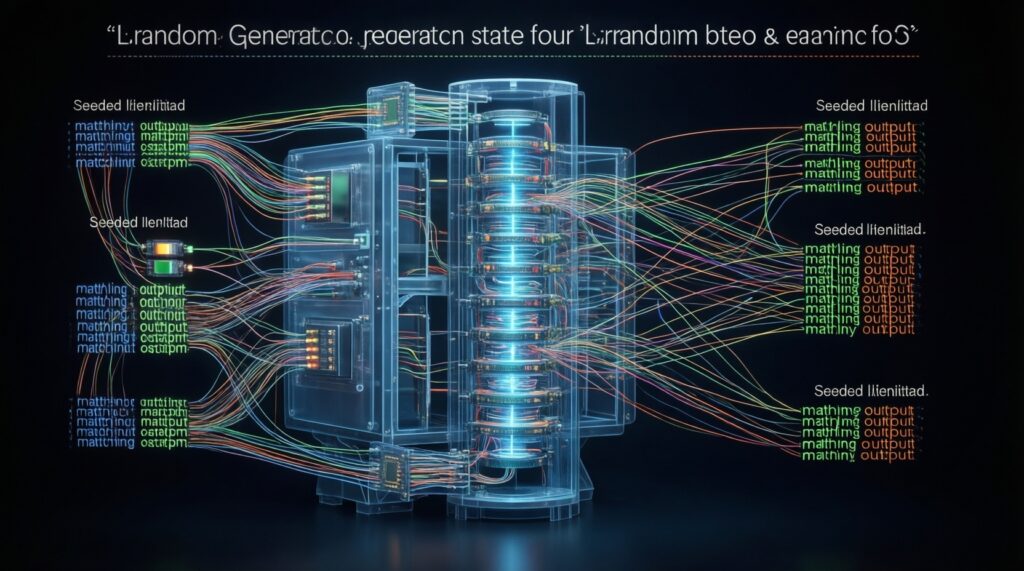
A typical PRNG is a state machine. It stores an internal state, applies a transition function (the RNG algorithm), then maps state to outputs. If two runs share the same seed and algorithm, they produce the same sequence-useful for reproducible simulations, dangerous for secrets.
- Seed acquisition: obtain an initial state (time, counters, OS entropy pool, hardware RNG).
- State transition: update state with a deterministic function (often mixing, modular arithmetic, bit operations).
- Output function: derive output bits/integers/floats from state (possibly with tempering).
- Period: finite state implies eventual repetition; good generators make repetition impractical in normal use.
- Distribution shaping: mapping bits to ranges must avoid bias (naive modulo is often wrong).
- Stream separation: parallel tasks need independent streams; reuse of the same stream can correlate results.
Example: unbiased integer in a range (avoid modulo bias)
# Given a function rand_u32() that returns 0..2^32-1 uniformly
function uniform_int(n):          # want 0..n-1
  limit = floor(2^32 / n) * n     # largest multiple of n below 2^32
  do:
    x = rand_u32()
  while x >= limit
  return x % n
Example: choosing the right API (security vs. reproducibility)
# Security tokens (use OS CSPRNG)
token = OS_CSPRNG_bytes(32)

# Reproducible simulation (seeded PRNG)
prng = PRNG(seed=12345)
x = prng.next_float()
Statistical Tests: What They Reveal-and What They Miss
Tests are useful diagnostics: they can reveal bias, correlations, or implementation mistakes. They cannot certify true randomness, and they often miss problems that only appear under specific usage patterns (range mapping, reseeding behavior, concurrency).
- Gaming fairness checks: evaluate whether outcomes (drops/loot/crit rates) match configured probabilities over many trials for a random number generator for games.
- Simulation sanity: detect correlations that distort Monte Carlo results, especially when generating vectors, permutations, or Gaussian noise.
- Range-mapping validation: confirm that converting bits into 1..N does not introduce bias (common with naive
x % N). - Regression guardrails: ensure changes to the RNG algorithm, compiler, or platform do not alter statistical behavior unexpectedly.
- Entropy-source monitoring: detect when seeding quality degrades (virtual machines, early boot, misconfigured containers).
Quick command-line diagnostics (non-proof, but practical)
# Inspect distribution roughly (example workflow)
# 1) generate many 32-bit numbers to a file
# 2) plot histograms / run simple frequency tests

# If on Linux, compare to OS CSPRNG stream quality baseline:
head -c 1048576 /dev/urandom > urandom.bin
Perception vs. Probability: Why Apparent Patterns Deceive
Humans over-detect structure. We expect alternation and "even spread," but truly random sequences frequently contain streaks, clusters, and gaps. When users say an RNG generator online (or in an app) is "rigged," they often react to normal variance.
Common cognitive traps (why you see patterns)
- Gambler's fallacy: believing a run must "balance out soon" (e.g., after many losses, a win is "due").
- Clustering illusion: interpreting natural clusters as evidence of manipulation.
- Small-sample bias: drawing conclusions from too few trials.
- Outcome weighting: remembering emotionally salient streaks more than ordinary sequences.
Practical ways to reduce false alarms (product and analysis)
- Communicate variance: show confidence bands or expected streak frequency ranges in dashboards (avoid claiming "no streaks").
- Instrument outcomes: log RNG inputs/outputs and mapping steps; debugging is easier than debating perceptions.
- Use fixed seeds for repro: in QA, replay the same sequence to verify claims and isolate non-RNG bugs.
- Separate fairness from feel: if a game needs "less streaky" experiences, implement a stated anti-streak mechanic rather than secretly altering probabilities.
Applied RNGs: Use Cases, Limitations, and Security Concerns
Most failures come from mismatched goals: using a fast PRNG for secrets, using a CSPRNG correctly but mapping outputs incorrectly, or trusting external tools. Decide first whether you need unpredictability against attackers or merely statistical quality for modeling.
- Do not use general PRNGs for secrets: session IDs, password reset tokens, API keys, and lottery-like prizes require a CSPRNG and safe storage/handling.
- Beware "seed = time": timestamp seeding is guessable; attackers can brute-force seeds if they know the approximate generation time.
- Never rely on "RNG generator online" for sensitive values: you cannot verify how it is generated, logged, or reused.
- Avoid modulo bias when mapping to ranges; use rejection sampling or library functions designed for uniform distributions.
- Reseeding myths: frequent reseeding with low-entropy sources can make outputs worse, not better; reseed only with high-quality entropy per platform guidance.
- Concurrency pitfalls: sharing one PRNG instance across threads can create contention or repeated outputs if not synchronized; prefer per-thread streams or a thread-safe generator.
Validation Workflow: Practical Steps to Verify Randomness
This workflow focuses on safe steps and realistic limits: you can verify "no obvious bias or bugs" and confirm correct security posture, but you cannot prove philosophical randomness.
- Define the requirement:
- Security secret: attacker cannot predict outputs → use OS CSPRNG.
- Game/simulation: distribution and independence are "good enough" → vetted PRNG is acceptable.
- Pick the generator and document it:
- Name the algorithm (or OS API), seeding method, and intended scope (per session/per match/per request).
- Implement range mapping safely:
- Use library uniform distributions; otherwise use rejection sampling (see pseudocode above).
- Log for reproducibility (non-secret contexts):
- Record seed, version, and parameters in QA/staging; never log secret seeds/tokens in production.
- Run targeted tests:
- Frequency sanity checks per outcome bucket.
- Correlation checks for sequential outputs used together (e.g., two dice, card shuffles).
- Edge-case tests for N close to powers of two and very small/large ranges.
- Threat-model review (security):
- Verify the code path uses OS CSPRNG, no fallback to PRNG, and no deterministic seeding.
- Check that tokens are long enough for your system's risk model and are compared/stored safely.
Mini-case: investigating a "rigged drops" complaint in a game

- Replay with a fixed seed to reproduce the exact sequence during QA.
- Verify the configured probability matches the implementation (including rounding and range mapping).
- Test for state reuse bugs (e.g., reseeding every frame, shared PRNG across players, repeated seeds on restart).
- Decide whether you need "feel-good randomness" mechanics and disclose them clearly if implemented.
Brief Answers to Typical Implementation Doubts
What is the RNG meaning in software, not in math?
It usually means a deterministic process that produces outputs that are hard to predict without knowing its internal state and seed. For security, "hard to predict" must hold against active attackers, which requires a CSPRNG.
Is a random number generator truly random if it's deterministic?
No; it's pseudorandom. Determinism is fine for simulations and games, but not for secrets where predictability is the core risk.
Can I trust an RNG generator online for passwords or recovery codes?
No. You can't audit its entropy source, logging, or reuse. Generate secrets locally using your OS CSPRNG and keep them off shared systems.
What's the main difference between an RNG algorithm and a seed?
The algorithm defines how state evolves and outputs are produced; the seed initializes the starting state. Weak or guessable seeds can make even a decent algorithm predictable.
What RNG should I use as a random number generator for games?

Use a well-reviewed PRNG provided by your platform or engine and ensure unbiased range mapping. If you need reproducible replays, store the seed and version the generator behavior.
Why do I see streaks even when the RNG is correct?
Streaks and clusters are expected in random sequences, especially in small samples. Treat "streakiness" as a UX concern, not automatically as a bug.
Do statistical tests prove my RNG is safe for cryptography?
No. Passing tests only shows the output doesn't violate certain patterns; it doesn't guarantee unpredictability against attackers. For cryptography, rely on OS CSPRNG APIs and correct operational handling.