

RTP (Return-to-Player) is a long-run mathematical expectation of how much a game returns to players over very large samples, not a promise for your next session. Most RTP myths come from mixing up theory with short-term variance, assuming casinos can freely change outcomes, or trusting poor comparisons of "high RTP" without checking game versions and disclosure.
Essential Clarifications on RTP
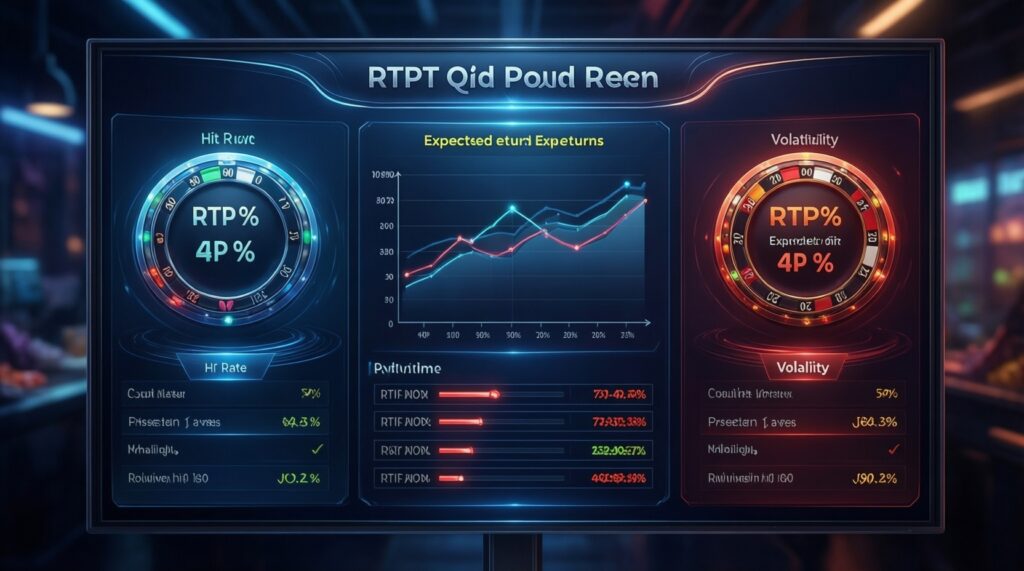
- RTP describes a modelled long-run average, so online casino RTP percentage explained always requires the phrase "over a huge number of spins/hands."
- The RTP meaning in online casino is not "how often you win"; it is expected return, while hit rate and volatility describe different behavior.
- "High RTP" is only meaningful if you verify the exact game and configuration; many providers ship multiple RTP settings for the same title.
- Casinos typically cannot alter each spin on a certified game; they can choose game versions, RTP configurations (if offered), and bonus terms.
- No casino RTP calculator can accurately infer a game's true RTP from a small personal sample; at best it summarizes your session results.
How RTP Is Calculated: Common Misunderstandings
Summary: RTP is computed from the game's rules and probabilities, not from what happened to you last night.
RTP is the expected return of a game under its defined math model (paytable, reel/hand distributions, bonus mechanics, and any feature weighting). For slots, it is derived from the probability of each outcome multiplied by its payout, aggregated across the full state space of the game.
A common myth is that RTP is "what the casino pays back this week." That confusion comes from mixing a theoretical expectation (design-level) with observed results (session-level). Another myth is that RTP is a single universal value: in practice, the same slot title can exist in different RTP configurations chosen at deployment.
In safe terms: treat published RTP as a specification of the game version you are playing. If the casino does not clearly disclose the RTP for that exact version, assume you cannot validate it from play data alone.
Return-to-Player vs. Payout Rate: Are They the Same
Summary: They can overlap in casual speech, but they often refer to different layers (game design vs. operator accounting).
- RTP (game-level): The expected return embedded in the game's math model, typically defined by the provider for a specific build/config.
- Payout rate (operator-level usage): Sometimes used to describe what a casino "paid out" over a period (an observed ratio), which is not the same as theoretical RTP.
- Bonus impact: Promotions can change your personal expected value, but they do not change the underlying game RTP; they change the overall "deal" you are getting.
- Player sample size: Your outcomes can be far above or below RTP in the short run, so a session "payout rate" is noisy.
- Comparisons: When people search for best RTP online casino games, they often compare titles without checking volatility, bet caps, feature buy options, or RTP configuration.
- Disclosure mismatch: Some pages show a generic RTP for a game name; the actual deployed version may differ unless the in-game info panel confirms it.
RTP and Short-Term Variance: What Players Misinterpret
Summary: Variance explains why "high RTP" does not reliably feel better in a short session.
- Chasing after losses: Believing a slot is "due" because RTP must "catch up" creates risky bet escalation; RTP has no memory.
- Judging RTP by a night's results: A few hundred spins can look wildly "wrong" versus RTP without indicating cheating or misconfiguration.
- Confusing hit rate with RTP: A game can pay small wins frequently yet still have lower RTP, or pay rarely with bigger spikes yet have higher RTP.
- Feature-buy misconceptions: Buying a bonus does not guarantee your session will align with RTP; it can increase variance and bankroll swings.
- "High RTP slots online" lists: Many lists ignore volatility and bankroll needs; a higher RTP high-volatility game can still produce long losing stretches.
Operator and Provider Roles in Setting RTP
Summary: Providers design the math; operators choose what to deploy and how transparently to present it.
What providers typically control
- Core game mathematics (paytable, distributions, feature logic) and the published RTP per configuration.
- Available RTP settings (if the title supports multiple configurations) and the compliance artifacts used in certification.
- In-game disclosure surfaces (info panel), though wording and visibility vary by integration.
What operators (casinos) typically control

- Which game/version/configuration is offered in their lobby (including selecting among provider-offered RTP variants where allowed).
- How RTP is displayed on the site, and whether it matches the in-game value for that exact build.
- Bonuses, wagering rules, bet limits, and game eligibility-often the real determinant of "safety" for your bankroll.
Regulation, Audits, and RTP Transparency
Summary: Compliance helps, but the safest approach is still to verify version-specific RTP and avoid unverifiable claims.
- Myth: "A casino can change RTP spin-by-spin." For certified RNG games, outcomes should be determined by the game logic; practical risk is more about which RTP configuration is deployed and how it's disclosed.
- Myth: "If it's licensed, RTP is always clearly shown." Licensing does not guarantee great UX; RTP may be buried in game info, help text, or not shown in the lobby listing.
- Myth: "Streams prove a slot is fair/unfair." Streaming sessions are tiny samples and can't validate RTP; they mainly demonstrate volatility.
- Myth: "Third-party RTP sites are definitive." Aggregators can be outdated or list a different configuration; treat them as leads, not proof.
- Safe step: Prefer games where the RTP is visible inside the game client and matches what the casino claims externally.
Practical Implications for Betting Strategy
Summary: Use RTP to narrow choices and manage risk, not to predict outcomes.
Think of RTP as a filter, then optimize the rest for safety: bankroll, volatility tolerance, and bonus rules. If you want a practical way to avoid self-deception, use a simple session log (not as a validator of RTP, but as a discipline tool).
# Pseudocode: "safety-first" session plan (not an RTP validator)
bankroll = B
stop_loss = 0.30 * B
stop_win  = 0.50 * B
stake = choose_stake(B, volatility)  # smaller for higher volatility

for spin in 1..N:
  if loss_so_far >= stop_loss: break
  if profit_so_far >= stop_win: break
  place_bet(stake)
If you still want a casino RTP calculator, use it only to compute your personal return (total cashed out / total wagered) and to enforce limits. Do not treat it as proof of the game's true RTP.
Self-check checklist before you play
- I can find the RTP value inside the game (or a clearly linked, version-specific disclosure), not only in a lobby card.
- I'm not using short-term results to "confirm" RTP or to justify increasing stakes.
- I picked stakes and stop limits that match the game's volatility, not just its advertised RTP.
- I reviewed bonus wagering, max-bet rules, and excluded games before relying on any promotion.
Clarifying Specific RTP Concerns
Does higher RTP guarantee I'll lose less today?
No. Higher RTP improves long-run expectation, but short sessions are dominated by variance, especially on volatile games.
Where is the most reliable place to check RTP?
The in-game information panel for the exact game instance is usually the safest reference. If it's missing or inconsistent with the casino's claim, treat the RTP as unverified.
Are "best RTP online casino games" lists trustworthy?

They're useful for discovery, but often mix different RTP configurations and ignore volatility and rules. Use them as a shortlist, then verify RTP in-game.
What does "high RTP slots online" actually mean in practice?
It means the game's long-run expected return is higher than alternatives, assuming the same rule set and configuration. It does not imply smoother results or more frequent withdrawals.
Can casinos change RTP whenever they want?
Typically they can't alter certified game math on the fly, but they may select among provider-offered RTP configurations at deployment. Your safe move is to verify what's running now.
Is my session return a good way to validate the online casino RTP percentage explained on a game page?
No. A single player's sample is too small to infer true RTP; it mostly reflects luck and volatility.
What is the simplest RTP meaning in online casino terms?
It's the game's expected long-run return to players, expressed as a percentage, under its defined rules and configuration.