
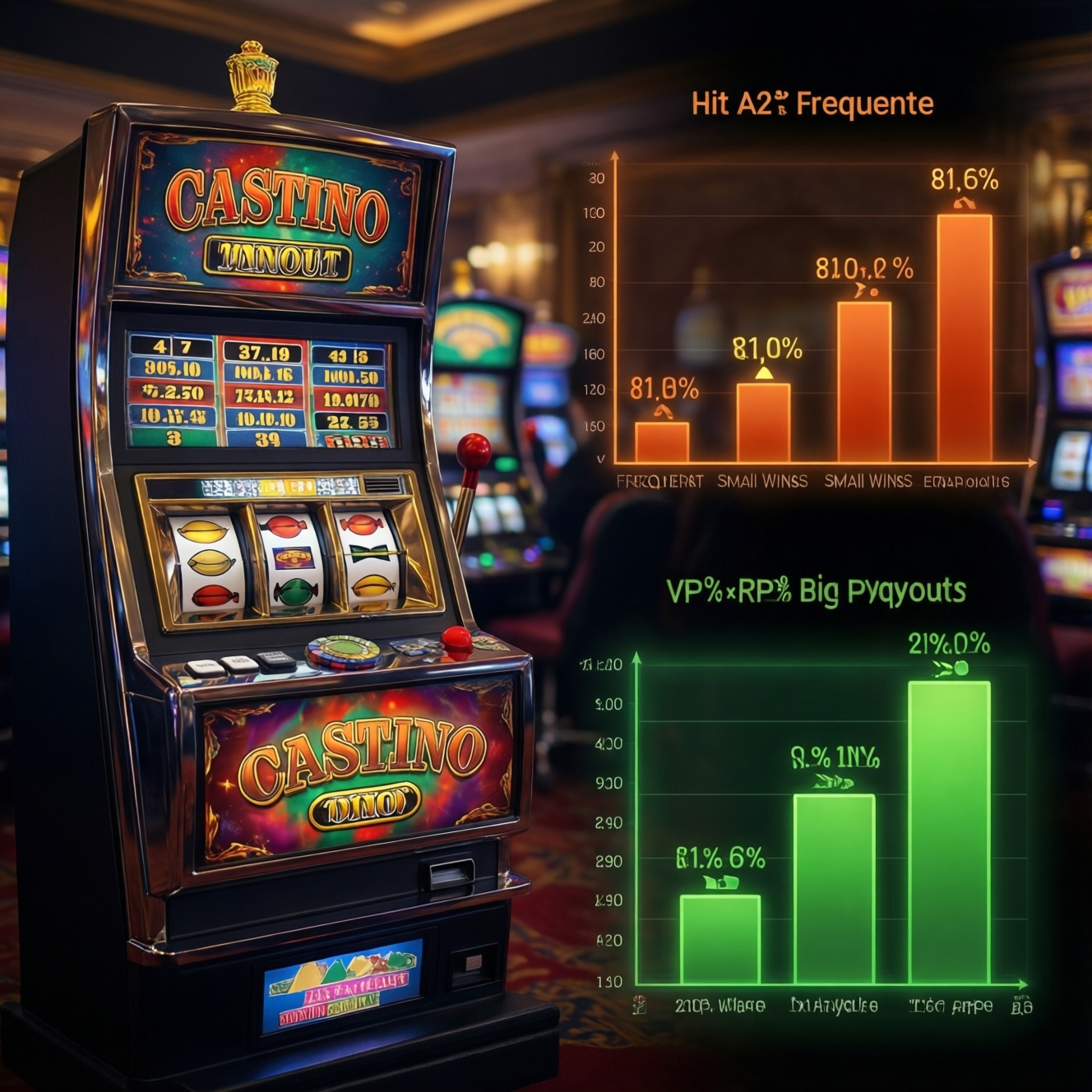
Hit rate and RTP answer different questions: hit rate tells you how often a slot pays any win, while RTP estimates the long-run average return of total bets. A high hit rate can still lose quickly if wins are tiny, and a high RTP can feel "dry" if wins are rare. Use both with volatility to choose.
Core distinctions at a glance
- Hit rate vs RTP: frequency of wins per spin versus long-run expected return across many spins.
- Feel vs math: hit rate shapes session "feedback"; RTP shapes the long-term cost of play.
- High hit rate ≠ low risk: frequent small wins can still drain bankroll if payouts are low.
- High RTP ≠ frequent wins: a slot can return well over time while paying infrequently.
- Volatility connects them: volatility determines whether value arrives as many small wins or few large ones.
- Title selection: prefer transparent paytable + stated RTP; treat hit rate as an experience metric, not a value guarantee.
Mechanics: What Hit Rate and RTP Actually Measure
To choose well, read each metric for what it is (and isn't). Use these criteria when comparing games or reviewing "slot hit rate explained" claims:
- Definition of a "hit": is it any non-zero win, or only wins above the bet (some sources/communities blur this)?
- What is RTP in slots: the expected long-run return as a fraction of total wagered; it does not predict a short session.
- Payout distribution: how much of the return comes from base-game line hits versus features/bonuses.
- Volatility label (if provided): low/medium/high volatility often matters more to bankroll swings than the headline hit rate.
- Minimum/typical win size: high hit rate with many "micro-wins" (e.g., 0.1×-0.5× bet) can still be net negative.
- Bonus trigger frequency: rare features can concentrate most RTP into infrequent events.
- Bet structure: ways/lines, multipliers, and changing stake options can change how "wins feel" at the same RTP.
- Session objective: entertainment time, low drawdowns, chasing a feature, or EV-focused grinding require different trade-offs.
Quick numeric intuition: If you bet 10 units per spin for 100 spins, you wager 1,000 units. An RTP of 96% implies an expected return of about 960 units over a very long run, not "you'll get 960 back today." Hit rate only tells you how often any of those 100 spins will pay something, not the total you'll get back.
Statistical Properties: Variance, Volatility and Expectation
Think of RTP as the long-run average and hit rate as frequency. Volatility/variance determines how "lumpy" the outcomes are. The table below compares practical option profiles you'll see when evaluating "best slots high rtp and high hit rate" claims.
| Variant | Who it suits | Pros | Cons | When to choose |
|---|---|---|---|---|
| High hit rate + low volatility | Time-on-device players; bankroll-sensitive sessions | More frequent feedback; smoother bankroll path | Wins often small; can feel like "treading water" | When you want longer sessions and fewer sharp drops |
| High hit rate + high volatility | Players who like action but accept swings | Frequent hits plus occasional spikes | Many hits still net-negative; spikes not guaranteed | When you can handle drawdowns but dislike long dead stretches |
| Low hit rate + high volatility | Feature-chasers; jackpot-style pacing | Potential for large outcomes; clear "boom/bust" structure | Long losing streaks; short sessions can end quickly | When your goal is a rare big event and you bankroll for droughts |
| Low hit rate + low/medium volatility | Players who tolerate quiet base games but want controlled risk | Less noisy; outcomes can be more predictable than high-vol games | Can feel slow; fewer "small saves" to extend play | When you prefer simpler pacing and can accept fewer hits |
| High RTP + low hit rate (return concentrated in bonuses) | EV-focused players who can wait for features | Good long-run value on paper | Most sessions may underperform until a feature lands | When you specifically want higher RTP and accept sparse wins |
| Moderate RTP + very high hit rate (return spread thin) | Players prioritizing "constant activity" | Frequent hits; psychologically easier to endure | Often many sub-bet wins; bankroll can still erode steadily | When you value frequent small wins more than long-run efficiency |
Player Experience: Frequent Small Wins versus Infrequent Large Payouts
Use these scenario rules to map your preference to a metric mix (this is where "high hit rate slots real money" expectations often go wrong):
- If you tilt when you see long losing streaks, then prioritize higher hit rate and lower volatility, and accept that many wins will be small.
- If you care most about long-run cost per wager, then prioritize higher RTP first, then choose volatility based on your bankroll size and patience.
- If your session is short or you have a tight stop-loss, then avoid low hit rate + high volatility profiles; they are most likely to "miss" in a short window.
- If you're chasing a feature/bonus, then accept lower hit rate, but check whether base-game wins are meaningful enough to fund attempts.
- If you prefer steady small wins, then look for high hit rate with a paytable that shows many mid-tier returns (not only tiny line hits).
- If you want occasional large payouts, then pick higher volatility and do not use hit rate as a proxy for "chance to win big."
Operator Perspective: House Edge, Game Design and Profit Drivers
Use this fast selection checklist to separate experience metrics from profit structure:
- Start with RTP: higher RTP generally implies a lower house edge in expectation; treat it as a long-run parameter, not a session forecast.
- Read the paytable distribution: identify whether returns come from frequent small hits or rare large events.
- Check volatility/variance indicators (official label or community consensus) to estimate bankroll swings.
- Inspect feature mechanics: buy/trigger frequency, retriggers, and multipliers can concentrate RTP in specific events.
- Validate what "hit" means: many "hits" can be below your total stake per spin, which extends play but still loses money per spin.
- Match to your staking plan: if you must downshift stakes after losses, avoid profiles that rely on rare big hits to realize their RTP.
Evaluating Titles: Reading RTP alongside Hit Rate and Paytable

- Assuming high hit rate means "more profitable" instead of "more frequent non-zero outcomes."
- Comparing RTP across games while ignoring that RTP can be realized through very different payout shapes.
- Not checking whether common wins are sub-bet wins (e.g., wins that return less than your total stake for the spin).
- Believing "best slots high rtp and high hit rate" is automatically the best choice for a short session; volatility can still dominate.
- Using a short trial to "prove" RTP; RTP is not testable in a small sample in any meaningful way.
- Ignoring that bonus-centric games can have long dead zones despite strong RTP on paper.
- Conflating volatility labels across providers; "medium volatility" is not standardized.
- Letting promotional language substitute for the paytable; always anchor on mechanics you can read, not adjectives.
Decision path for players: Choosing a game by goals and bankroll
- Goal: longer, smoother session → choose higher hit rate → then pick low volatility → confirm paytable has meaningful mid-tier wins.
- Goal: minimize long-run cost → choose higher RTP first → then pick volatility you can bankroll → accept that hit rate may be lower.
- Goal: chase big outcomes → choose high volatility → accept lower hit rate → bankroll for long droughts and avoid raising stake impulsively.
- Bankroll is tight → avoid low hit rate + high volatility → prioritize smoother profiles even if RTP is similar.
- Bankroll is flexible → you can choose based on preference: frequent small wins (hit rate) versus rare large payouts (volatility), while keeping RTP as the value baseline.
Best for players who want frequent feedback is typically a higher hit-rate, lower-volatility slot; best for players optimizing long-run return is typically a higher-RTP slot with volatility matched to bankroll; best for big-hit seekers is a higher-volatility slot where you explicitly accept low hit rate and variance. None of these is universally best-your goal and bankroll decide.
Targeted clarifications for common practical doubts
Is hit rate the same as win probability?
Hit rate is usually the fraction of spins with any non-zero payout. It does not tell you whether those hits are profitable relative to your total bet.
What is RTP in slots and can I "feel" it in one session?

RTP is the long-run expected return over a very large number of spins. A single session can deviate widely because volatility dominates short-term outcomes.
Can a slot have high RTP but still lose often?
Yes. High RTP can be delivered through rare high payouts, producing many losing spins and occasional large wins.
Are high hit rate slots real money safer?
Not necessarily. Frequent small hits can still produce steady losses if the average hit size is below the stake and big payouts are limited.
How do I pick between hit rate vs rtp for my goal?
Use RTP as the value baseline and hit rate as the pacing/feedback metric. Then use volatility to ensure the bankroll swings fit your limits.
Do "best slots high rtp and high hit rate" exist, and are they always optimal?
Some games combine higher RTP with frequent small wins, but the paytable may still be dominated by tiny returns. Always confirm win size distribution and volatility, not just the two headlines.