

To stay in control, treat gambling like a measurable activity: log each session's start/end, stakes, wins/losses, and your emotions before and after play. Then apply simple limits (time, spend, loss, and "chasing" signals) and act immediately when thresholds trigger. This method complements responsible gambling tools, not replaces professional help.
Essential metrics for monitoring responsible play
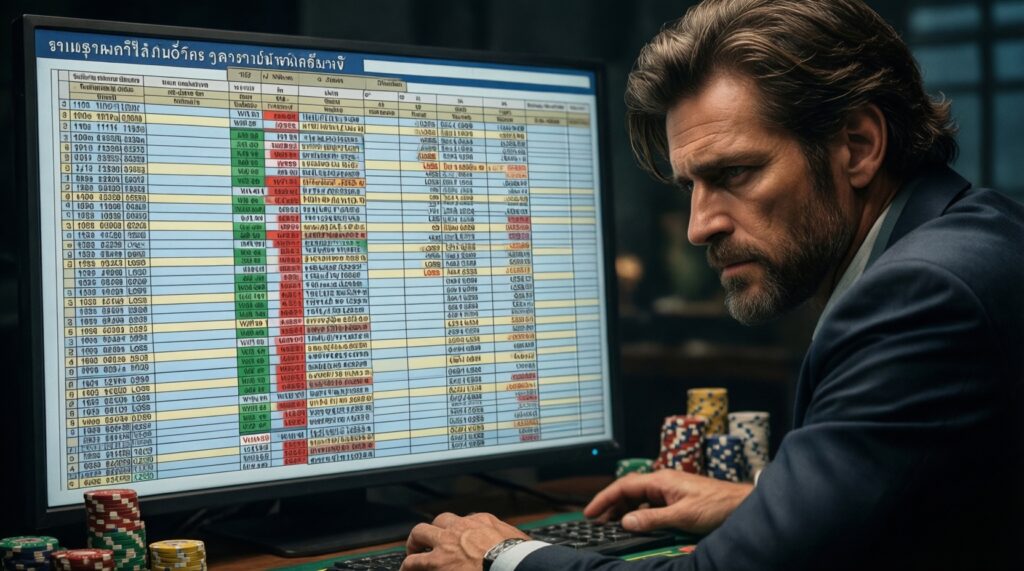
- Session duration: start/end time, breaks taken, and whether you exceeded your planned stop time.
- Net result per session: total stakes minus total returns (track in THB, not "credits").
- Stake escalation: maximum stake, average stake, and "step-ups" after losses.
- Loss-chasing marker: any increase in stake/frequency immediately after a loss.
- Emotional state: pre-play mood, mid-session triggers, post-play regret/relief.
- Limit compliance: whether self exclusion and deposit limits were enabled and respected.
Defining the core events: spins, stakes, wins, losses, and session boundaries
Best for: intermediate players who want an objective "mirror" of behavior, or anyone testing whether their play stays within planned boundaries. It works with a notebook, a gambling tracking app, or platform exports if available.
Do not do this: if tracking becomes obsessive, increases your urge to gamble, or you feel unable to stop once you start. In those cases, prioritize direct safeguards (self exclusion and deposit limits) and talk to a qualified support service.
Setting measurable limits and dynamic thresholds for early warning
You'll need a simple place to log data (notes app/spreadsheet), a timer, and at least one hard limit you cannot "negotiate" mid-session. If you use a gambling spending tracker, ensure it captures timestamps and net results per session (not only monthly totals).
- Hard limits (set before play):
- Time cap: e.g., 30-60 minutes per session.
- Spend cap: a fixed session bankroll (e.g., THB X) that you can afford to lose.
- Loss cap: stop when net loss reaches your limit, even if time remains.
- Dynamic thresholds (early warning):
- Stake escalation: any jump above your pre-set max stake triggers a break.
- Chasing: two or more "raise stake after loss" events triggers session stop.
- Speeding up: noticeably shorter time between spins/bets triggers a forced pause.
- Mood shift: anger, urgency, numbness, or "I must get it back" triggers exit.
- Access controls: enable self exclusion and deposit limits at the operator level where possible; your tracking is only a second line of defense.
Practical data-capture methods: manual journals, telemetry, and lightweight APIs
Risks and limitations (risk-aware):
- Tracking can rationalize extra play ("I'm collecting data")-treat limits as non-negotiable.
- Operator records may be delayed or incomplete; do not "top up" while waiting for updates.
- False positives happen (e.g., a single large bet for fun). Use repeated patterns, not one-off events.
- Do not track other people's play without explicit consent; avoid shared devices for logging.
-
Choose your capture mode (start simple)
Pick one primary method for 2 weeks: a manual journal, a gambling tracking app, or platform history exports. "Best" is the one you will actually use every session.
- Manual: fastest to start, lowest privacy risk.
- App/spreadsheet: easier totals and charts.
- Exports/API: most precise if your operator provides transaction history.
-
Define a session boundary rule
Use one consistent rule so your stats mean something. Recommended: a session starts at first wager and ends after 15 minutes of no bets, or when you cash out/close the app-whichever comes first.
-
Log the minimum viable event set
For each session, record: start time, end time, game/type, total staked, total returned, and net result. If you can't see totals, approximate with "# bets/spins × average stake" and refine later.
- Spin/bet count: optional but useful for identifying speed-up patterns.
- Max stake: required for detecting escalation.
-
Add a quick "emotion annotation" at three moments
Rate mood on a simple scale (e.g., calm/tense/angry/numb) before play, once mid-session, and immediately after. Keep it short to avoid friction; the point is trend detection, not therapy notes.
-
Implement limit checks and stop actions
Before starting, write your time/spend/loss caps for that session. When any cap is hit, execute a pre-decided stop action: close the app, take a walk, or hand the device to a trusted person-no "one more spin."
- If you repeatedly override limits, upgrade to responsible gambling software features at the operator level (cool-offs, deposit caps, self-exclusion).
-
Review weekly and tighten thresholds
Once per week, scan your log for patterns: increasing duration, higher max stakes, more chasing markers, or negative mood shifts. If risk signals cluster, reduce session caps and increase friction (shorter sessions, longer cool-off).
Mapping outcomes to emotions: constructing trigger markers and annotations

- I can identify at least two recurring emotional triggers (e.g., boredom, stress after work, social pressure).
- My log shows when mood changes during a session (early vs late), not only after it ends.
- I have a clear label for chasing language (e.g., "get it back") and I mark it every time it appears.
- I can point to the exact moment I escalated stakes and what happened right before it.
- I mark speed-up (shorter pauses between spins/bets) as a trigger, not as "being efficient."
- I separate outcome (win/loss) from feeling (relief/regret), even when they contradict.
- I have at least one non-gambling coping action linked to each trigger (walk, call, gym, sleep).
- I track limit compliance as a metric (kept vs broken), not as an afterthought.
Action plans and automated interventions when risk signals appear
- Mistake: relying on willpower once you're already tilted. Fix: pre-commit stop actions and keep them simple (close app + leave the room).
- Mistake: raising the limit after a win ("playing with house money"). Fix: treat wins as volatile; keep the same caps for that week.
- Mistake: tracking only deposits/withdrawals. Fix: log net per session and max stake; that's where escalation appears first.
- Mistake: ignoring near-miss frustration and "I almost had it." Fix: mark near-miss reactions as a trigger equal to losses.
- Mistake: using a gambling spending tracker but not turning on platform controls. Fix: enable deposit caps, cool-offs, and self exclusion and deposit limits where available.
- Mistake: too many alerts that you ignore. Fix: use 2-3 high-signal thresholds (chasing, time cap, max stake) and require action on any trigger.
- Mistake: automating data capture without privacy thought. Fix: minimize fields, store locally, and delete regularly; do not share raw logs.
- Mistake: treating responsible gambling tools as proof you're safe. Fix: if you repeatedly breach limits, stop play and seek qualified support.
Privacy, consent, and ethical handling of behavioral play data
If tracking feels invasive or risky, use lighter alternatives that still reduce harm:
- Operator-only controls: rely on responsible gambling software features like deposit limits, cool-offs, and self-exclusion when you don't want personal logs.
- Minimal-session logging: record only start/end time and net result (no emotions) if detailed notes increase rumination.
- Device-level friction: app timers, screen-time limits, or blocking categories during high-risk hours (useful when triggers are time-based).
- Accountability without data sharing: agree on a simple "I stopped on time" check-in with a trusted person instead of sending spreadsheets.
Common implementation issues and practical solutions
Which is better: a manual log or a gambling tracking app?
Start with whichever you'll maintain every session. Manual logs reduce privacy risk; an app helps totals and trends if you keep fields minimal.
My operator history doesn't show spins or bet counts-what should I track?
Track session duration, total staked, total returned, net result, and max stake. Bet/spin counts are helpful but not required for effective early warning.
How do I set thresholds without overreacting to one bad session?
Trigger actions on repeated patterns (e.g., chasing markers twice in a session or across two sessions). Use one-off spikes as "review" signals, not automatic bans.
What if I keep overriding limits in the moment?
Upgrade from self-tracking to hard controls: deposit caps, cool-offs, and self exclusion and deposit limits at the operator level. If overrides continue, stop play and seek professional support.
How can I track emotions without turning it into therapy homework?
Use a 1-2 word label at three moments (before/mid/after). The goal is to detect triggers that precede chasing, not to write detailed narratives.
Can responsible gambling tools fully prevent harm if I'm already stressed?

No-tools reduce access and add friction, but they're not a complete safeguard. Treat stress as a high-risk trigger and choose non-gambling coping actions first.
Is it safe to store my gambling data in the cloud?
Only if you understand who can access it and you've minimized sensitive fields. When in doubt, store locally, protect with device security, and delete older logs regularly.