
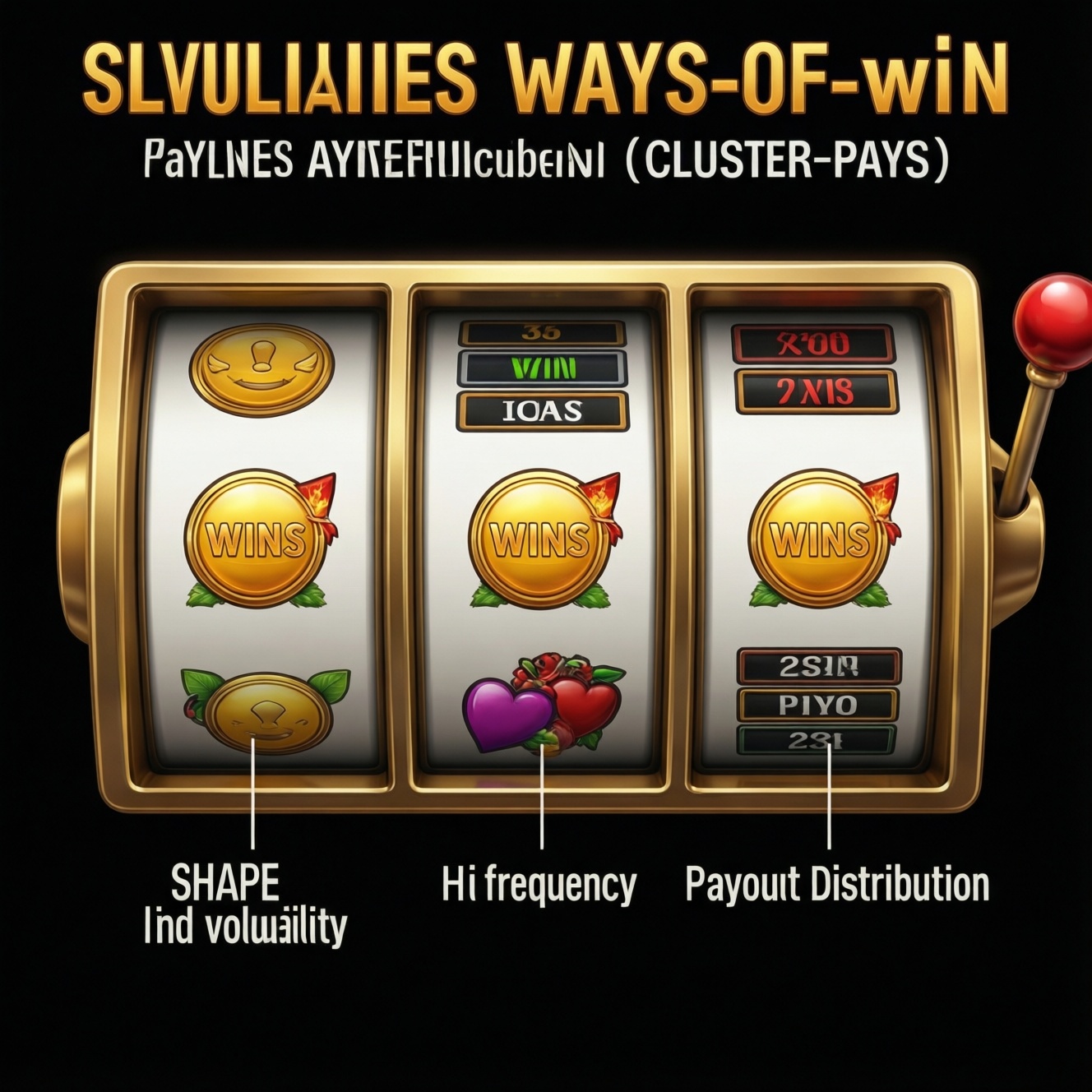
Paylines, ways-to-win, and cluster-pays are three different slot "win evaluators": they define which symbol arrangements qualify as wins and how your bet is distributed. They don't directly set RTP, but they strongly shape hit frequency and win size distribution-two inputs that drive volatility. Understanding the structure lets you predict how "swingy" a game will feel.
Core mechanics summarized
- Paylines pay on predefined patterns; your stake is typically split per line, so line count affects win frequency but not automatically RTP.
- Ways-to-win pays by counting matching symbols on adjacent reels, increasing "hit rate" while often reducing average win per hit.
- Cluster-pays rewards groups of touching symbols; cascades and expanding mechanics often amplify variance.
- Volatility is mainly about how often you win and how concentrated big wins are, not about how many lines/ways exist.
- Features (free spins, multipliers, bonus buys) usually dominate volatility more than the base evaluator.
- Low-resource approach: you can approximate volatility by tracking hit frequency and top-end multipliers without full math models.
Common misconceptions about paylines, ways, and clusters
Myth 1: "More paylines/ways means better odds." In practice, "slot paylines explained" correctly means "which patterns are checked," not "higher RTP." Designers can keep RTP similar while changing how wins are distributed (more small hits vs fewer bigger hits).
Myth 2: "Ways-to-win is always low volatility." The ways to win slots meaning is "count combinations across reels," which often increases hit frequency, but volatility can still be high if most return is concentrated in rare premium hits or feature multipliers.
Myth 3: "Clusters are just paylines with a different shape." "Cluster pays slots explained" is about connected groups and often includes cascades. Cascades can turn one hit into multiple sequential wins, which changes the win-size distribution and can increase swinginess.
Myth 4: "High volatility is a setting you can read from one number." "High volatility slots how it works" is structural: it's the combination of hit rate, payout curve, and feature contribution. Two games can both be labeled "high volatility" yet feel very different session-to-session.
Paylines explained: pattern rules, bet allocation, and payout calculation
Paylines are fixed (or selectable) paths across the reels. A win occurs when a line shows a qualifying sequence, usually starting from the leftmost reel unless the rules allow both-ways or right-to-left evaluation.
- Line patterns: each payline is a predefined sequence of reel positions (straight, zig-zag, etc.).
- Evaluation direction: most often left-to-right; some games allow "both ways," which effectively increases hit frequency.
- Bet allocation: common models are:
- Total bet split per line (e.g., total stake / number of active lines).
- Bet per line you choose (total bet = per-line bet × active lines).
- Payout calculation: win = line-bet × paytable multiplier for the matched symbol and length.
- Multiple line wins: the same spin can pay on several lines; this increases "hit rate" and smooths returns.
- Typical volatility effect: more frequent small wins in the base game, while big wins are often pushed into rare symbol alignments or features.
Ways-to-win: combinatorics, adjacency variants, and impact on hit rate
Ways systems pay when matching symbols appear on adjacent reels in the same spin, regardless of exact row positions. This is the practical meaning behind "ways to win slots meaning": you are paid for the count of combinations across reels, not for hitting a drawn line.
- Classic adjacent-reel ways: any matching symbol on reel 1 connects to any matching on reel 2, and so on, creating multiple combinations for a single symbol type.
- Changing reel heights: some games vary rows per reel, changing the total "ways" dynamically and affecting hit frequency.
- "All-ways" with symbol multipliers: the evaluator produces many small hits, but multipliers (per symbol, per reel, or per cascade) can reintroduce high variance.
- Different start rules: some titles allow wins starting on reel 2 (or "anywhere"), increasing hits but usually reducing paytable values to balance.
- Where it's used: ways systems are common when designers want lots of screen activity (frequent payouts) without relying on many paylines.
Cluster-pays mechanics: grouping rules, cascade interactions, and volatility signals
Cluster-pays rewards groups of adjacent matching symbols. This is the core of "cluster pays slots explained": instead of counting across reels, you count touching symbols meeting a minimum cluster size.
Advantages and when it feels better
- Natural fit for cascades: winning symbols disappear, new ones drop, and one spin can produce multiple payouts, increasing engagement and allowing "combo" multipliers.
- More design room: cluster thresholds, gravity directions, and special symbols can sculpt the payout curve without adding paylines.
- Good for small screens: clusters are easy to read on mobile; players see groups rather than line paths.
Limitations and what to watch
- Volatility can spike via cascades: if multipliers grow with each cascade, return can become concentrated in rare long chains.
- Minimum cluster size matters: larger minimums reduce hit frequency; smaller minimums increase hits but often shrink average win.
- Connectivity rules vary: orthogonal-only vs including diagonals changes hit rate; don't assume one cluster model behaves like another.
Quantifying volatility: how structure, hit frequency, and win distribution interact
Volatility is best understood as the shape of returns over time: how many losing spins you see, how often small wins occur, and how much of the total return is locked in rare outcomes (big base hits or features). That's the actionable interpretation of "high volatility slots how it works."
- Mistake: equating "more evaluators" with lower risk. Many paylines/ways can increase hit frequency while still being high volatility if most RTP sits in rare bonuses or top symbols.
- Mistake: reading volatility from base game only. If free spins (or bonus-buy features) carry most of the return, the base evaluator (lines/ways/clusters) is secondary.
- Mistake: judging by session luck. A short session can invert your impression; "swingy" games can look calm until a feature lands, or look brutal until it does.
- Useful low-resource proxy (no full model needed):
- Track hit frequency (wins per spins) over a fixed sample.
- Note the median win size vs the largest win you observe.
- If the largest win is orders of magnitude above the median, volatility is likely higher.
- Why "best online slots by volatility" is context-dependent. "Best" depends on whether you prefer steadier small returns (higher hit rate) or tolerate long droughts for rare spikes (top-heavy distribution).
Comparative design examples with table: paylines vs ways vs clusters
Below is a practical comparison you can use when scanning game rules. Treat the "typical" notes as qualitative: studios can tune paytables and features to change the feel even with the same evaluator.
| Evaluator | What qualifies as a win | Hit rate tendency | Average win per hit | Variance tendency | Common tuning lever (what designers tweak) |
|---|---|---|---|---|---|
| Paylines | Specific symbol sequences on predefined paths | Low-medium (higher if many lines and both-ways rules) | Medium (often many small line wins) | Low-medium unless features dominate | Line count, direction rules, paytable for long matches, feature weighting |
| Ways-to-win | Matching symbols on adjacent reels, any row positions count as combinations | Medium-high | Low-medium (many small combination wins) | Medium; can be high with premium-symbol concentration and multipliers | Reel heights, symbol distribution per reel, payout scaling per length, multiplier mechanics |
| Cluster-pays | Connected groups meeting a minimum cluster size | Variable (depends heavily on minimum cluster size) | Variable (cascades can create chains) | Medium-high; often higher with cascade multipliers | Cluster threshold, cascade rules, multiplier growth rate, special symbols (bombs/wild zones) |
Mini-case: same bankroll feel, different evaluator
- Paylines build: many active lines + small line-bet → frequent tiny returns; droughts are shorter but big spikes usually come from features.
- Ways build: high "ways" count + reduced paytable → lots of small hits; add a rare premium symbol that pays big only at 4-5 reels to increase swing.
- Cluster build: low cluster minimum creates frequent small clusters; add cascade multipliers that grow per chain to move a large portion of return into rare long cascades.
Low-resource alternatives (if you can't do deep math)
- Rule-first filtering: read the win evaluator + feature description; if there are growing multipliers, retriggers, or bonus-buy-only value, assume higher variance.
- 20-50 spin sanity check: record number of winning spins and the biggest single-spin payout; compare across games using the same stake.
- Budget matching: if you prefer steadier play, prioritize higher hit-rate structures (many lines/ways, smaller cluster thresholds) with limited multiplier growth.
Targeted clarifications and non-obvious edge cases
Can two slots with the same RTP feel totally different?
Yes. RTP is an average; volatility depends on how that return is distributed across small frequent hits versus rare big hits, often driven by feature weighting.
Does selecting fewer paylines increase my chances on the lines I keep?
Usually no; it mainly changes how your total bet is distributed and how many patterns are checked. In many modern games, all lines are always active with a fixed total bet.
Are "ways" always calculated left-to-right?
Most are, but some pay both ways or allow wins starting on reel 2. Always confirm the start reel and direction rules in the paytable.
Do cascades automatically mean higher volatility?
Not automatically. Cascades with flat payouts can be relatively smooth; volatility jumps when cascade chains feed escalating multipliers or unlock rare high-paying states.
In cluster games, do diagonals count as connected?
It depends on the title's connectivity rule. Some count only orthogonal adjacency; others include diagonals, which can materially raise hit frequency.
Is "best online slots by volatility" a meaningful ranking?
Only if the ranking defines volatility consistently and separates base-game feel from feature-driven variance. Otherwise, it's a preference list, not a technical comparison.
How can I quickly interpret "high volatility slots how it works" from a paytable?

Look for a top-heavy paytable (big jump at max length/size) plus features that multiply wins or concentrate return in free spins. That combination usually signals longer losing streaks but larger potential spikes.