

A "hot streak" is a short run of favorable outcomes that feels meaningful but usually does not change the underlying probability model. If the game rules, payouts, and your edge stay the same, the expected value stays the same; what changes is variance showing up in clusters. Treat streaks as information only when they indicate a real, measurable parameter change.
Essentials: how expectation governs streaks
- Expected value (EV) is the long-run average outcome; streaks are typical short-run volatility around that average.
- If the odds and payouts are unchanged, a win after a win is not "more likely" than a win after a loss (independent trials).
- Clusters happen naturally: randomness commonly produces runs that look like momentum.
- Changing bets because you feel "hot" usually increases risk without improving EV.
- Only evidence of a parameter shift (skill, lineup, fatigue, table conditions, price movement) should update your probabilities.
- With limited resources, simple checks (tracking, binomial tests, basic EV math) outperform intuition.
Myths about hot hands and why they persist
Myth: "After several wins, the odds are better because I'm hot." Math counter: if each trial has probability p and trials are independent, then P(win next | won last k) = p. The streak changes your history, not the process generating outcomes.
Myth: "Streaks prove the game has patterns you can ride." Boundary: patterns exist only when the system has memory (a changed deck composition, a weaker opponent, a tilted player, an injured athlete). In many gambling games and many pricing models, the "memory" is either absent or already priced in.
Myth: "Luck has to balance out soon, so I should press now." Math counter: the gambler's fallacy confuses long-run frequencies with short-run obligations. Even if long-run frequency approaches p, the short run can wander widely without "needing" to correct on your schedule.
Why it persists: streaks are emotionally salient, easy to recall, and often reinforced by selective sharing ("I was on fire last night") while the quiet, boring average is ignored.
Expected value, variance and the law of large numbers
Misconception: "If I'm ahead, my strategy must be +EV." Reality: being ahead is compatible with negative EV; it can be pure variance.
- EV definition: for discrete outcomes, EV = Σ p(i) · x(i), where x(i) is profit/loss and p(i) is probability.
- Variance explains streaks: even when EV is stable, variance determines how "streaky" the path looks. High variance creates dramatic runs in both directions.
- Law of large numbers (LLN): as the number of trials n grows, the sample average tends to EV. LLN says nothing about what happens in the next few trials.
- Independence vs dependence: independence implies streaks don't alter next-trial probability; dependence (true momentum) requires a mechanism you can describe and measure.
- Practical EV workflow: compute EV per bet, then scale by volume. If you use an expected value calculator, verify inputs (true win probability, payout, fees/commission) before trusting the output.
- Low-resource alternative: use a phone notes template or a basic spreadsheet: columns for implied probability, your estimated probability, payout, stake, and EV; no paid tools required.
Modeling short‑term streaks: Bernoulli, binomial and Markov views
Misconception: "A streak needs a special cause." Reality: standard probability models produce runs naturally.
- Bernoulli trials (coin-flip style): use when each bet is a win/loss with constant p. This is the baseline for many "hot streaks gambling odds" debates: the odds don't improve just because the last few outcomes were wins.
- Binomial counts: use when you care about "how many wins in the next n bets." Example question: "What is the chance of ≥7 wins in 10 bets if p=0.55?" This is also a clean way to sanity-check narratives about being "on a heater."
- Runs (streak length) within Bernoulli sequences: use when you care specifically about "how often runs of length k occur." Runs are common in random sequences; seeing one is not, by itself, evidence of skill.
- Markov models (memory allowed): use only if state affects probability (fatigue, confidence, changing opponents, changing rules). If you can't define states and estimate transition probabilities with data, assuming Markov "momentum" is usually story-first modeling.
- Sports betting scenario: for sports betting expected value, "streak" stories often reflect market movement, injuries, or schedule strength. Model those drivers; don't model "hotness" as a free bonus probability.
Cognitive biases that create the illusion of momentum
Misconception: "My brain is detecting a real signal." Reality: perception is optimized for pattern-finding, not probability calibration.
Biases that push you toward overconfidence during streaks
- Availability: recent wins are easier to recall, so you overestimate how often you win.
- Selective memory: you remember the peak streak, not the full distribution of sessions.
- Outcome bias: you judge decisions by results, not by whether the decision had positive EV.
- Illusion of control: you attribute random variation to personal "form" or "flow."
Biases that distort your probability updates
- Gambler's fallacy: expecting reversal "because it's due."
- Hot-hand fallacy: expecting continuation "because I'm hot."
- Confirmation bias: searching for explanations that justify pressing bigger after wins.
- Base-rate neglect: ignoring the starting odds when a compelling streak story appears.
Practical rules for decisions under streaky outcomes
Misconception: "Bet sizing should react to my last few outcomes." Reality: bet sizing should react to edge and bankroll constraints, not emotions or short streaks.
- Separate probability from narrative: update p only when inputs change (information, prices, conditions). A win/loss itself usually isn't new information about p.
- Use EV gates: place the bet only if EV > 0 after costs/commission; otherwise skip, even if you feel hot.
- Stake rule (resource-limited version): choose a fixed small fraction per bet (flat staking) when you cannot reliably estimate edge. This is a safer alternative to "pressing the heater."
- Stop rules: define limits before you start (max loss, max time, max number of bets). Streaks encourage breaking limits.
- Track a minimal dataset: date, market/game, odds/payout, stake, result, and your pre-bet probability estimate. This costs almost nothing and beats memory.
- Know what you're calculating: for how to calculate odds in gambling, distinguish (a) implied odds from price, (b) your estimated true probability, and (c) payout rules; mixing them creates fake "edges."
Testing for real change: statistical methods and required sample sizes
Misconception: "My last 20 bets prove I've improved." Reality: short samples are noisy; you need a structured test that compares performance to a baseline probability model.
Mini-case: You suspect your win probability increased from p0 to p1 after a strategy change, and you observed w wins in n bets.
- Define the null: H0: p = p0. Alternative: p > p0.
- Compute a binomial tail p-value: pval = P(X ≥ w | n, p0). If pval is small enough for your decision standard, you have evidence (not proof) of improvement.
- Low-resource option: use a spreadsheet function for binomial tails or a free stats page; you do not need a paid analytics suite.
- Guardrail against story bias: pre-register your test rule: pick n, p0, and the threshold before looking at results.
Practical note for card games: the poker hot streak myth often comes from mixing skill edges with variance. If you changed table selection, opponents, or tilt control, you changed p; if you only ran above expectation, you didn't.
Clarifying frequent confusions and quick answers
If I'm on a hot streak, are the next odds better?
Not unless something in the probability model changed. In independent trials, the next-trial probability stays at p regardless of recent results.
Does a winning session mean my strategy has positive expected value?
No. A single session (or a few) is dominated by variance; EV is a long-run property that needs consistent edge and enough volume to evaluate.
How do I use an expected value calculator correctly?

Input your best estimate of true probability, the exact payout/odds, and all costs. If your probability estimate is guesswork, treat the EV output as fragile and size down.
What's the fastest way to check "hot streaks gambling odds" claims?
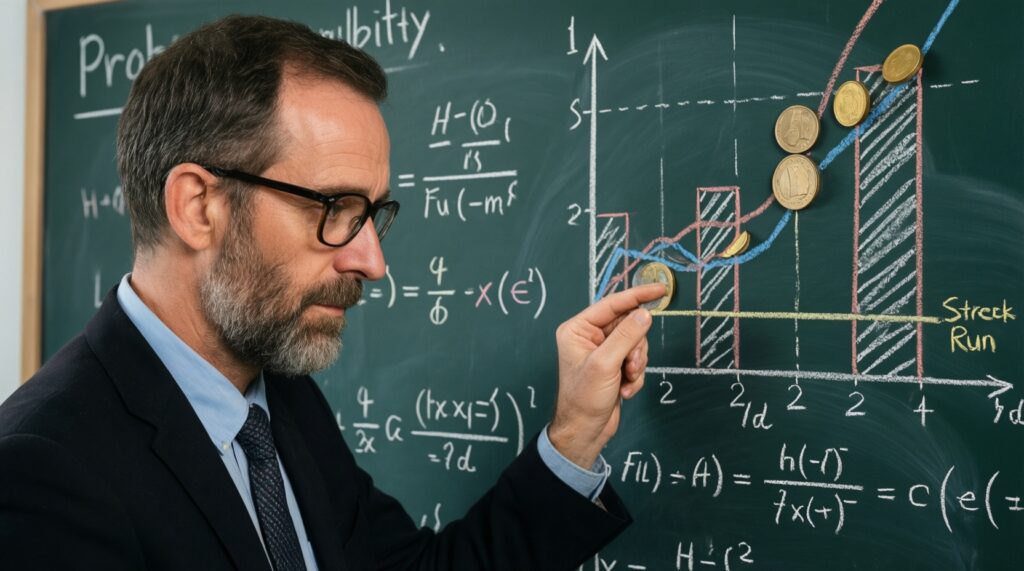
Assume a constant p and compute how likely the observed streak is under randomness (runs/binomial). If it's not unusually rare, the streak is not evidence of changed odds.
In sports betting expected value, what should I update after a streak?
Update for new information (injuries, lineup changes, market price shifts), not for the streak itself. Streaks are often explained by schedule and opponent strength rather than "form."
How to calculate odds in gambling without advanced tools?

Convert price to implied probability, estimate your true probability, then compute EV = (true_prob × profit_if_win) − (lose_prob × stake). A simple spreadsheet is enough.
When can a streak be real momentum rather than randomness?
When you can identify a mechanism with measurable impact (state dependence) and verify it with data, not just with recent outcomes.