

To estimate bankroll risk for slots, treat your play as a sequence of small bets with a negative expected value and high variance. "Ruin probability" is the chance your bankroll hits a stop point (often zero or a session stop-loss) before you reach a target or end time. You can approximate it with a random-walk model or simulate it.
Core concepts of ruin probability for slot bankrolls

- Ruin probability depends more on volatility (swing size) than on the average loss rate over short sessions.
- Define "ruin" precisely: bankroll hits 0, hits a stop-loss, or drops below the minimum bet threshold.
- Model at the correct granularity: per spin, per fixed bet block, or per "unit" of loss/win.
- Any house edge makes ruin inevitable given unlimited play; your goal is to control the chance of ruin within your planned session.
- Use formulas only when assumptions match; otherwise prefer a Monte Carlo approach (a practical slot bankroll calculator).
- Your starting bankroll (in THB) and your base bet (THB per spin).
- Your session limit: max spins, max time, or a stop-loss amount.
- A "walk-away" rule: profit target, or "stop after X units up/down".
- Estimated volatility proxy: a plausible distribution of outcomes per spin (simple) or per bonus cycle (advanced).
- The slot's house edge/RTP estimate (even a rough one is better than none).
- Whether you will change bet size (flat betting vs. scaling) during the session.
How volatility and house edge drive bankroll decay
This method is most useful if you want a disciplined view of bankroll management slots decisions: "What is my chance to bust before I'm done?" It is less useful if you frequently change games, change bet sizes aggressively, or chase losses-because those behaviors break the assumptions behind simple models.
Use it when you have (a) a fixed base bet, (b) a defined stop-loss, and (c) a rough idea of game volatility. Skip it when you cannot commit to a session plan, or when you are playing for an indefinite time horizon (ruin becomes a near-certainty with a negative edge).
- Pick your ruin boundary and your session boundary (spins/time/profit target) before doing any math.
- Decide whether your "unit" is 1 spin or a block of spins with the same bet.
- Write down what you will hold constant (bet size, game, and rules).
Choosing a mathematical model: random walk, Gambler's Ruin, and Monte Carlo
You have three workable levels. Start simple; move up only if the output will change your decisions.
- Random walk with approximations: treat each spin as a small step with negative drift and some variance. Good for rough sensitivity checks.
- Gambler's Ruin (discrete units): convert your bankroll into "units" and assume each step changes the bankroll by +1 or −1 unit. Good when your outcomes are close to binary or when you intentionally simplify.
- Monte Carlo simulation: generate many simulated sessions using an outcome model; count the fraction that end in ruin. This is the closest "risk of ruin calculator gambling" approach for slots.
What you need:
- A spreadsheet (Google Sheets / Excel) or a small script (Python/JS).
- A way to represent outcomes per spin (even a simplified set of outcomes).
- Your fixed rules: base bet, stop-loss, max spins/time, optional profit target.
- Choose a model based on how stable your bet sizing and game choice will be.
- Define the unit size (e.g., 1 base bet) and convert bankroll to units.
- Decide whether you need "good enough" (formulas) or "behaviorally accurate" (simulation).
Step-by-step: computing ruin probability with common formulas
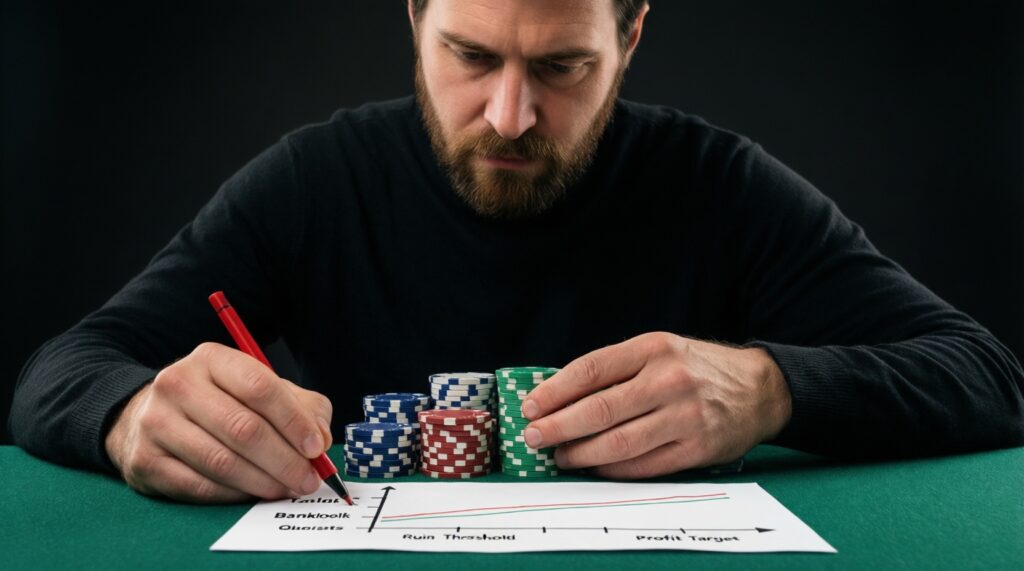
- Starting bankroll in units (e.g., bankroll / base bet).
- Ruin point (0 units or stop-loss units).
- Target point (optional): profit target in units.
- Per-step win probability p and loss probability q for your simplified model.
- Convert everything to units. Pick a unit (usually 1 base bet). Bankroll units N = bankroll / unit; stop-loss units L = stop-loss / unit; profit target units U = target / unit. Round conservatively (down for bankroll, up for required loss thresholds).
- Decide if you need a target or "ruin within time". Gambler's Ruin formulas naturally handle "hit ruin before target." If your real question is "ruin before 2 hours," plan a Monte Carlo run with max spins instead.
- Build a simplified step model (p/q). If you approximate each step as +1 unit with probability p and −1 unit with probability q (where p + q = 1), set p to reflect your simplified chance to end a step up. For slots, be conservative: the negative edge implies p < q in a fair ±1 unit abstraction.
- Compute "ruin before target" with Gambler's Ruin. Let total boundary be B = L + U units, and your starting position be i = L units above ruin (i.e., distance from ruin). Then the probability of hitting the target before ruin is:
- If p = q: P(target before ruin) = i / B.
- If p ≠ q: P(target before ruin) = (1 - (q/p)^i) / (1 - (q/p)^B).
Then P(ruin before target) = 1 - P(target before ruin). This is a clean baseline and a common backbone behind a "risk of ruin calculator gambling" widget.
- Translate the result into an actionable session rule. If ruin probability is too high, change one lever at a time: increase bankroll units, reduce unit size (bet), lower target, or shorten the session (switch to simulation with max spins). This is the core of a best slot bankroll strategy: control the downside first.
- Compute ruin probability for at least two bet sizes (current and one step smaller) to see sensitivity.
- Recompute with a stricter ruin definition (stop-loss instead of zero) to match real play.
- If your real constraint is time/spins, move the same inputs into a Monte Carlo simulation.
Practical bankroll rules: sizing, stop-loss, and replenishment schedules
- Use a fixed base bet per session; if you must change bets, only step down after losses, not up.
- Set a stop-loss that triggers before you are forced to change behavior (tilt control), not after.
- Choose a profit target you will actually stop at; otherwise you are modeling the wrong end condition.
- Decide the maximum spins/time in advance; open-ended sessions make "how much money do you need to play slots" drift upward without bound.
- Keep a minimum-bet buffer: don't plan to end the session with a bankroll that cannot support your base bet.
- Avoid "reloading" mid-session; if you allow replenishment, model it explicitly (separate sessions).
- If you track results, track units (multiples of base bet), not THB, to keep decisions consistent across games.
- Run your plan through both a formula estimate and a quick simulation; if they disagree materially, trust the simulation.
- Write your stop-loss and max session length on the same line as your bet size.
- Decide whether replenishment is allowed; if yes, define "cooldown" and treat it as a new session.
- Re-check your plan whenever you change slot volatility class (low/medium/high).
Interpreting simulations: sample size, confidence, and a summary table
Simulations are only as good as the assumptions you put in. Many "slot bankroll calculator" outputs look precise but are driven by hidden simplifications.
- Using an unrealistic outcome model: a ±1 unit model can understate tail risk for highly volatile bonus structures.
- Mixing bet sizes: if you change the unit mid-session, your "N units" is no longer stable.
- Too few trials: if you run only a small number of sessions, rare ruin paths can be missed.
- Wrong stopping rule: modeling "until ruin" when you actually stop after 1 hour changes the answer dramatically.
- Confusing average loss with ruin risk: a small expected loss can still come with a large short-session bust probability.
- Ignoring minimum bet constraints: if the bankroll falls below what you need to continue, that is functional ruin.
- Comparing different games without normalizing units: THB-based comparisons hide the effect of bet sizing.
| Approach | Inputs you must supply | What you compute | When it fits slots | Compact numeric example (units) |
|---|---|---|---|---|
| Gambler's Ruin (±1 unit) | Start units N, ruin boundary L, target U, step probabilities p and q | P(ruin before target) = 1 − (1 − (q/p)^i) / (1 − (q/p)^B) | Quick baseline; useful for disciplined flat betting and conservative planning | N=200, L=100, U=50 ⇒ B=150, i=100; choose p/q for your simplification and compute |
| Random-walk approximation (drift/variance) | Expected loss per spin, variance proxy, session length (spins) | Approximate chance to cross a loss barrier within a horizon | Sensitivity checks when you can estimate volatility roughly | Define barrier = −100 units over T spins; plug drift/variance assumptions |
| Monte Carlo session simulation | Outcome generator per spin or per block; stop-loss; max spins/time; optional target | Ruin frequency = ruined trials / total trials | Best match for volatile slots; closest to an honest risk-of-ruin calculator gambling workflow | Simulate 50,000 sessions with max spins = 3,000; count sessions hitting stop-loss first |
- Validate your stopping rule first (max spins/time + stop-loss + target) before trusting any probability.
- Run a sensitivity sweep: change bet size by one step and compare ruin probability directionally.
- Document assumptions (p/q or outcome model) so you can reuse and improve them later.
Operational checklist: session setup, monitoring, and post-session actions

Alternatives that are often more practical than chasing a "perfect" ruin probability:
- Fixed-loss session budgeting: decide a hard loss cap (in units) and treat it as the only "ruin" boundary. Use this when you mainly need behavioral safety and consistent bankroll management slots.
- Time-boxed play with flat betting: set a max spins/time and never vary the bet. Use this when your goal is entertainment time and controlled variance rather than "beating" the slot.
- Two-tier bankroll (session roll + reserve): keep a separate reserve you do not touch during the session. Use this when you want replenishment rules without emotional reloads.
- Downshift-only staking: predefine smaller bet steps and only move down after drawdowns. Use this when you are prone to volatility spikes and want a simple best slot bankroll strategy guardrail.
- Before play, write your bet size, stop-loss, and max duration on one note and commit to it.
- During play, track current bankroll in units and stop immediately at the boundary.
- After play, record the session rule compliance (not just win/loss) and adjust one lever next time.
Technical clarifications and edge-case guidance
Is ruin probability the same as expected loss?
No. Expected loss describes the average outcome; ruin probability describes the chance of hitting a boundary (like a stop-loss) within your session rules.
Do I need the exact RTP/house edge to estimate ruin?
Not for a first pass. For short sessions, volatility assumptions often dominate; use a conservative edge estimate and focus on stop-loss and bet sizing.
How do I handle bonus buys or feature purchases?
Treat each purchase as a single high-variance "step" with its own outcome distribution, and simulate. Simple ±1 unit formulas usually misrepresent this risk.
What if I change my bet size during the session?
Then bankroll units are not constant, and formula-based Gambler's Ruin results become unreliable. Use a Monte Carlo model that applies your exact bet-change rules.
How many simulation trials are enough?
Enough that repeating the run gives a similar ruin estimate under the same inputs. If results swing noticeably between runs, increase trials and simplify fewer assumptions.
Can I model "ruin" as dropping below the minimum bet instead of zero?
Yes, and you often should. Functional ruin occurs when you can no longer follow your plan (for example, bankroll below what your base bet requires).