

Near-miss (the "almost won" outcome) increases the urge to continue because it feels informative and controllable, even when it is statistically just a loss. In slots and many gamified systems, near-misses amplify attention, arousal, and goal-pursuit signals-so people keep pressing-especially when presentation (sound, animation, timing) makes "close" outcomes salient.
Near‑miss: concise summary of phenomenon and effects
- Near-miss is an engineered or naturally occurring "close to success" loss that is perceived as progress.
- It boosts motivation by activating "try again" interpretations (skill cues, learning cues) even in pure chance tasks.
- In slot contexts, it can be implemented via reel mapping and stopping positions (often discussed as ระบบ near miss สล็อต).
- It is easy to misread near-miss frequency as evidence of being "due," which fuels persistence and higher spend.
- Practical design impact: near-miss is mainly a presentation layer effect, not a true change in win probability.
- Ethical design requires limits, transparency, and harm-minimization because near-miss can intensify risky play.
Defining near‑miss: behavioral and statistical perspectives
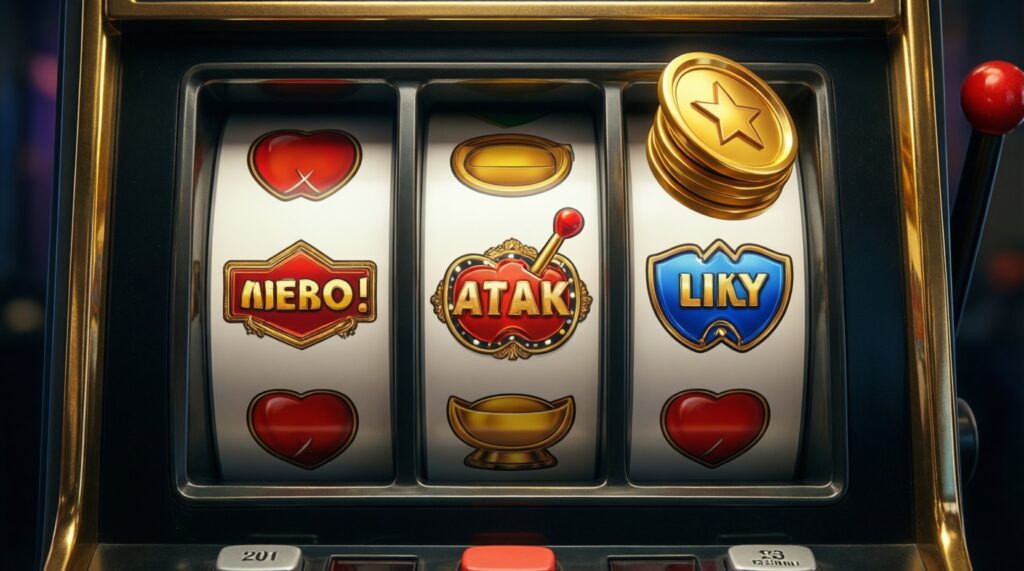
A near-miss is an outcome that is objectively a failure but subjectively resembles success-e.g., two jackpot symbols plus a third just above the payline, or a progress bar that ends at 99%. When people ask สล็อต near miss คืออะไร, the clearest answer is: it is a loss framed to look like "almost a win," so it recruits motivational systems that normally respond to real progress.
Behaviorally, near-misses sit between clear losses and wins: they feel "closer," invite counterfactual thinking ("if only I had...") and often trigger another attempt. Statistically, however, a near-miss has the same payout as any other non-winning outcome; it does not imply higher underlying probability on the next trial.
In many slot implementations, near-miss is not random "bad luck," but a controllable feature of symbol placement, reel strips, and stop distribution. That's why players perceive patterns-especially in contexts marketed around สล็อตออนไลน์ได้เงินจริง-even though "almost" outcomes do not convert into expected profit without a genuine edge.
How near‑misses influence motivation: cognitive and affective pathways
Near-misses work because they change interpretation, not arithmetic. Common pathways:
- Counterfactual simulation: the brain automatically constructs the nearby win ("one symbol away"), making the win feel attainable.
- Perceived skill cue: timing, stopping, or "choice" elements create a sense that better execution could convert the near-miss into a win.
- Progress framing: "close" outcomes resemble incremental advancement, similar to leveling systems in apps.
- Arousal + attention capture: celebratory audiovisual feedback around near-misses keeps salience high and reduces the psychological impact of losing.
- Reinforcement ambiguity: unclear boundaries between win/near-win blur learning signals, encouraging more sampling ("let me test again").
- Gambler's fallacy leverage: frequent near-misses are misread as "the big one is coming," despite independence.
Quantifying near‑miss: metrics, distributions, and misinterpretations
In practice, teams quantify near-miss to tune engagement, but the biggest risk is confusing presentation frequency with probability of winning. Typical scenarios where near-miss metrics are used:
- Slot reel-stop analytics: count "two-of-three" (or "one away") outcomes per 1,000 spins and compare across reel maps (ระบบ near miss สล็อต discussions often point here).
- Payline adjacency rates: measure how often a key symbol appears immediately above/below paylines (a near-miss by spatial proximity).
- Event-sequence design: monitor whether near-misses cluster after wins or long losing streaks, which changes perceived momentum.
- Player-segment response: estimate how near-miss exposure correlates with session length, re-spins, or deposit triggers (high risk in เกมพนันออนไลน์ เครดิตฟรี funnels).
- A/B testing of feedback: keep the underlying RNG and payout constant while varying sound/animation intensity for near-miss outcomes.
Common misinterpretations to actively prevent: (a) "more near-misses means higher RTP," (b) "near-miss predicts the next outcome," (c) "near-miss is harmless because it pays zero anyway."
Experimental designs and empirical findings in gambling and games
Before you rely on near-miss as a lever, understand what experiments typically can and cannot show.
Mini-scenarios: practical application before the lab framing
- Slots: keep win probability constant but adjust how often the third jackpot symbol lands one stop away; track changes in "spin again" latency and session continuation.
- Gamified loyalty app: show "almost unlocked" rewards (e.g., 9/10 stamps) with prominent visual proximity; track whether users complete the final action or churn.
- Onboarding funnel: avoid combining near-miss framing with aggressive acquisition prompts like คาสิโนออนไลน์ สมัครสมาชิก calls-to-action, unless you also add clear spending/time controls.
What controlled studies are good at (strengths)
- Isolating causality: holding true win rate constant while manipulating near-miss presentation.
- Measuring mechanisms: separating "felt closeness," perceived control, and arousal from actual outcomes.
- Comparing formats: spatial near-miss (symbol adjacency) vs temporal near-miss (stopping "just before") vs goal near-miss (progress bars).
Where evidence often becomes fragile (limitations)
- External validity: lab tasks may not match real-money play, marketing pressure, or bonus ecosystems (e.g., เกมพนันออนไลน์ เครดิตฟรี).
- Short horizons: experiments may capture immediate persistence but not longer-term harm or learning.
- Participant heterogeneity: effects differ for novices vs experienced players and for at-risk vs non-risk groups.
- Operational definitions: "near-miss" can be coded differently (one symbol away, two away, visual proximity, etc.), complicating comparisons.
Applying near‑miss insights to UX, product design, and reinforcement schedules
- Myth: near-miss improves user skill. In chance-based systems, near-miss teaches persistence, not competence; don't present it as learning feedback.
- Mistake: tying near-miss to monetization triggers. Triggering offers right after near-miss (top-up prompts, "limited bonus") can be perceived as exploitative, especially in สล็อตออนไลน์ได้เงินจริง positioning.
- Mistake: amplifying near-miss feedback more than wins. If near-miss looks like a win, users feel misled; keep outcome categorization unambiguous.
- Myth: more near-misses means "more excitement" for everyone. Some users disengage when they recognize manipulation; others may escalate risky behavior.
- Mistake: not separating RNG from presentation in analytics. Always log the true outcome class (win/loss) separately from the near-miss rendering variant.
- Practical tip: if you use near-miss for benign goals (habit formation, education), pair it with transparent progress rules and easy stopping points.
Risks, biases, and ethical safeguards when leveraging near‑miss effects
Mini-case: A Thai-facing slot lobby uses intense "almost jackpot" animations, then immediately surfaces a deposit bonus banner (often framed as เกมพนันออนไลน์ เครดิตฟรี) after three near-misses. Players interpret the sequence as "I'm close," increasing deposits, even though the RNG is unchanged.
Safeguards you can implement without changing the core product concept:
- Make losses look like losses: near-miss can be "close" without being celebratory; avoid win-like fanfare.
- Introduce friction at risk moments: cooldowns after repeated near-misses; reminders that each spin is independent.
- Limit coupling with acquisition and payment: avoid placing คาสิโนออนไลน์ สมัครสมาชิก and deposit prompts immediately after near-miss sequences.
- Player controls: easy-to-find limits (time/spend), session summaries, and opt-outs from intense effects.
- Audit logging: record near-miss exposure rate by user to detect potentially harmful configurations.
// Pseudocode: flag potentially risky near-miss coupling
if (nearMissCountLastNSpins >= threshold
    && depositPromptShown == true
    && timeSinceLastBreak > maxContinuousPlay) {
  triggerCooldown();
  showIndependenceReminder(); // "Each spin is random; near-miss does not predict wins."
  suppressDepositPromptsFor(windowMinutes);
}
Practical clarifications and quick answers
Is a near-miss a sign the next spin is more likely to win?
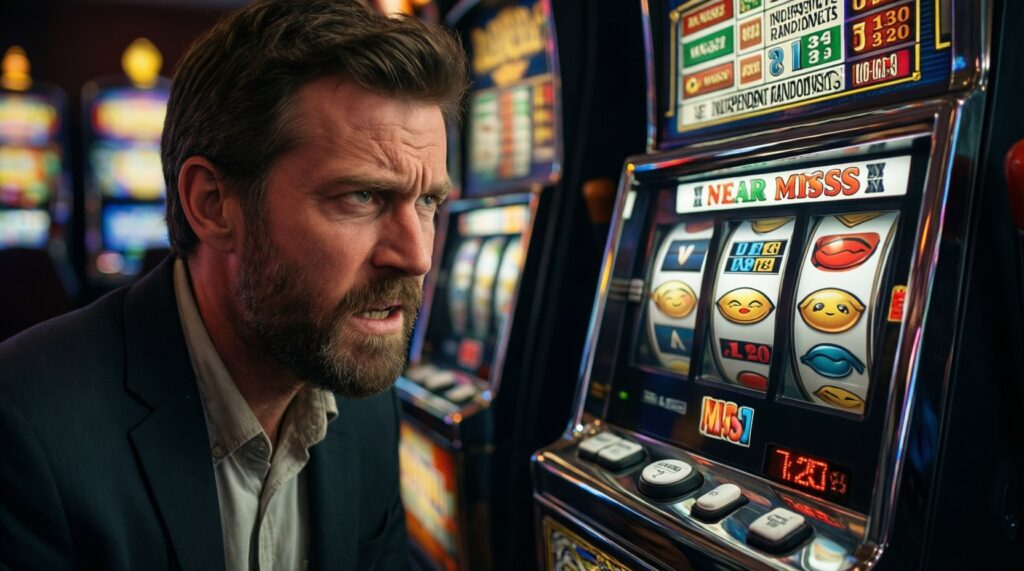
No. A near-miss is still a loss and does not change the probability of the next outcome in an independent RNG system.
How is near-miss created in slots without changing payout?
By controlling symbol distribution and stop positions so "almost" patterns appear more often, while the payout table and win frequency remain the same.
Why does "almost winning" feel better than a normal loss?
It activates a mental simulation of the win and a sense of progress, which can feel motivating even though nothing was earned.
Does near-miss matter in non-gambling products?
Yes. Progress bars, streaks, and "one step away" rewards can create a similar persistence effect in apps and games.
What's a safe way to use near-miss framing in UX?
Use it for clear, rule-based progress (e.g., defined milestones) and avoid pairing it with pressure tactics or immediate purchase prompts.
How do I measure near-miss impact without fooling myself?
Keep RNG/payout constant, A/B test only the near-miss presentation, and track both short-term continuation and longer-term satisfaction/complaints.