

A slot paytable is more than a list of prizes: it's a map of risk and payout style. You read it by tracking three signals-top payout vs. typical payouts, how wins scale with bet/ways/lines, and how much value is locked inside bonuses. Those cues indicate whether the game pays often, pays big rarely, or concentrates results in features.
Interpreting Paytable Signals: What the Numbers Reveal
- Look at the "ceiling" first: the maximum win (or highest symbol payout) is a fast proxy for volatility-very high ceilings usually mean rarer big outcomes.
- Scan the middle, not just the top: if most 3-4-of-a-kind payouts are tiny, the game tends to feel "dry" between features.
- Check win conditions: paylines, ways, clusters, or scatters change how often small wins appear and how streaky the session feels.
- Identify where the money lives: if the paytable highlights multipliers, free spins, or bonus buy, the game's value is feature-driven.
- Confirm bet scaling: some games scale prizes with total bet; others scale per line/coin-misreading this is a common reason players misjudge risk.
Anatomy of a Paytable: Symbols, Lines, and Bet Options
A paytable explains what combinations pay, under which rules, and how your bet interacts with those rules. It typically includes symbol values (often for 3/4/5-of-a-kind), special symbols (wild/scatter), the win evaluation method (paylines, ways, clusters), and any feature triggers (free spins, respins, hold-and-win, etc.).
The boundaries are important: the paytable describes what can pay and how it is counted, but it usually does not show the full probability model behind each outcome. That's why you use it to infer style (frequent small hits vs. feature-centric swings) rather than to "calculate guaranteed profit."
Bet options are part of the reading. "Total bet," "coin value," "bet per line," "ways," and "feature buy" can change whether a payout number is large or small relative to your actual stake. Always map a listed prize back to a multiplier of total bet (for example, 50×, 200×, 1000×) to compare games consistently.
Payout Structures and Volatility: Recognizing Risk Profiles
Volatility (risk profile) shows up in how payouts are distributed across common hits vs. rare hits. Use the paytable to spot whether the game rewards you through steady base-game wins, through rare premium symbols, or mainly through bonuses.
- Top symbol gap: if the best symbol pays 500× for 5-of-a-kind while the next symbols are 50×-100×, the game is often "top-heavy."
- Minimum qualifying wins: games that pay from 2-of-a-kind (or with many "ways") tend to produce more frequent small hits than games that require 3+ on strict paylines.
- Wild behavior: expanding or multiplier wilds often shift value into fewer, bigger moments rather than many tiny line wins.
- Scatter-only value: if scatters pay and also trigger features, you'll see sessions driven by "hit feature or nothing" dynamics.
- Multipliers listed in the feature section: when multipliers are mostly inside free spins/bonus rounds, base game can feel low-paying until a feature lands.
- Win caps and caps phrasing: a clearly stated maximum win can hint at design intent (big, rare outcomes), even though it's not the probability of reaching it.
Mini-scenarios: how the same stake can feel totally different
- Scenario A (steady): many mid symbols pay 1×-5× for common hits, and wins can start from 2-of-a-kind in a "ways" game. Expect frequent small returns and smaller swings.
- Scenario B (feature-driven): base-game symbol pays are low (for example, 0.2×-2× on common combos), but free spins advertise multipliers up to 10× or more. Expect long quiet stretches, then sharp spikes.
- Scenario C (top-heavy): the highest symbol offers a very large multiple, while everything else is modest. Expect fewer meaningful hits; bankroll impact is higher when chasing rare premiums.
Bonus Mechanics and Their Impact on Expected Value
Bonus rules change where the game returns value. The paytable's feature pages often contain the most important risk signals, because bonuses can compress a large portion of outcomes into occasional events.
- Free spins with multipliers: if multipliers apply to all wins in free spins (or can grow), the base game may be intentionally underpowered.
- Pick-and-win or wheel bonuses: paytables may show wide prize ranges; a huge displayed top prize usually means most outcomes are far smaller.
- Hold-and-win / lock-and-spin: look for additive jackpots, collector meters, or reset rules; these often produce many "small saves" with occasional big landings.
- Buy feature / bonus buy: if shown, it signals that the feature is central to the math model; volatility often increases when players buy repeatedly.
- Random modifiers: "random wilds," "random multipliers," or "mystery symbols" can increase variance because they cluster value into fewer spins.
Quick practical tips you can apply in under 60 seconds
- Convert every headline payout to total-bet multipliers: treat "pays 2,000" as meaningless until you know whether it's per line, per coin, or total bet.
- Circle three numbers: (1) typical 3-of-a-kind payout, (2) premium 5-of-a-kind payout, (3) maximum win or max feature multiplier-this trio usually reveals the game's style.
- Ask "does the base game pay without the feature?" if most attractive values sit under the bonus rules, expect feature dependency.
- Check the trigger: if the feature needs 4-5 scatters (or multiple steps), it's often rarer than a simple 3-scatter trigger.
- Don't judge by one symbol: compare 3-4 mid symbols and the wild/scatter rules to avoid misclassifying volatility.
RTP, Hit Frequency and How to Read Them Reliably
RTP and hit frequency are often mentioned alongside paytables, but they answer different questions. The paytable shows the payout menu; RTP/hit rate relate to how often and how much the game tends to return over time.
What these metrics help you do
- RTP (Return to Player): a long-run average return indicator; useful for comparing games only when you're sure you're looking at the same configuration (some games have multiple RTP settings).
- Hit frequency / hit rate: a clue about how often any win occurs (including tiny wins). It helps predict "how busy" the game feels.
- Volatility labeling (if provided): can validate what you inferred from the paytable structure (top-heavy vs. steady payouts).
Limitations you must keep in mind
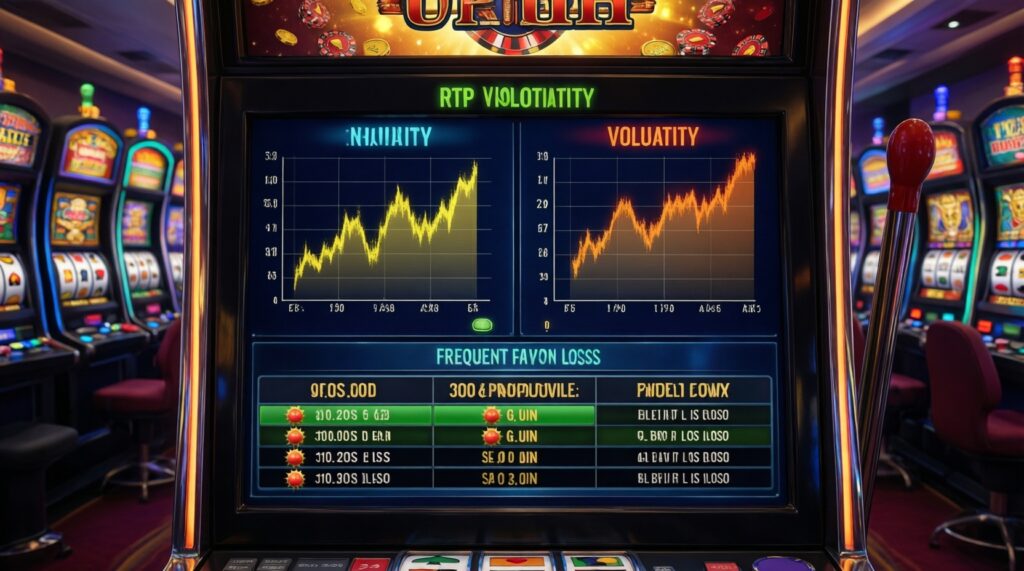
- RTP doesn't describe the ride: two games can share similar RTP but feel completely different due to volatility and feature concentration.
- Hit frequency can be misleading: frequent micro-wins (like 0.1×-0.5×) may not offset losses; the paytable tells you whether common wins are meaningful.
- Paytable alone won't give probabilities: it lists outcomes, not how likely each outcome is; use it for style/risk inference, not precise EV calculations.
Translating Paytable Data into Betting Tactics
Reading the paytable correctly helps you avoid tactics based on false assumptions. These are the most common myths and mistakes intermediate players run into.
- Mistake: treating "max win" as reachable on demand. A higher maximum often means lower frequency of big wins; adjust session expectations, not just excitement.
- Mistake: ignoring bet scaling. If payouts are "per line" but you compare them to a "total bet" game, you'll misjudge value and volatility.
- Myth: changing bet size changes your odds. In most slots, it scales the payout amounts, not the underlying probability of patterns (unless a feature explicitly requires a minimum bet, which would be stated).
- Mistake: overvaluing hit rate. If common line wins are tiny, a high hit frequency can still lead to fast bankroll drain.
- Myth: bonus buys are always "better EV." The paytable may highlight the feature, but it doesn't guarantee the purchase price is favorable; it primarily changes variance and time-to-feature.
Classifying Game Style: Identifying High-Variance vs. Frequent-Payout Designs
Use this quick classification method when you open a new game. It's not a mathematical proof-it's a practical filter based on paytable signals that correlate with session feel.
Mini-case: classify a game in 30 seconds
Inputs from paytable:
- TopPayoutX = highest listed win in X× total bet
- MidPayoutX = typical mid-symbol payout for common combo (e.g., 3-of-a-kind)
- FeatureBoost = "strong" if feature pages show big multipliers/jackpots; else "moderate"

Rules of thumb:
if FeatureBoost == strong and MidPayoutX is low:
    Style = "feature-driven, higher variance"
else if TopPayoutX is moderate and MidPayoutX is noticeable:
    Style = "frequent-payout, lower variance feel"
else if TopPayoutX is very high and mid range is thin:
    Style = "top-heavy, high variance"
Worked example (with concrete multipliers)
- Game 1: mid combos often pay ~1×-3×, top symbol ~100×, modest bonus rules → tends to play more "steady."
- Game 2: mid combos often pay ~0.2×-1×, but free spins advertise multipliers up to 10×+ → tends to be feature-driven and swingy.
- Game 3: top symbol or max win is extremely large while most of the table is low → tends to be top-heavy, with rarer meaningful hits.
Quick Clarifications for Paytable Interpretation
Is the paytable enough to know whether a game is "risky"?
It's enough to infer style (steady vs. swingy) by seeing where payouts concentrate, but it won't tell exact probabilities. Use it to spot feature dependency and top-heavy design.
What's the fastest volatility clue inside a paytable?
Check the highest win (or premium 5-of-a-kind) and compare it to typical mid-symbol payouts. A large gap usually signals higher variance.
Do paylines vs. ways change how often I win?
They change win evaluation, which often changes how frequently small wins appear. "Ways" formats commonly produce more frequent small hits than strict payline games.
Why do some games feel like they only pay in the bonus?
The paytable often reveals this: base-game payouts are small, while feature rules include multipliers, jackpots, or special mechanics that hold most of the value.
If I increase my bet, do I improve my chance to trigger a bonus?
Usually no-your bet changes payout size, not trigger odds, unless the rules explicitly state a threshold or a buy option. Always check the feature rules page.
How do I compare two games with different coin/line systems?
Convert payouts to X× total bet. Comparing multipliers (not raw numbers) is the cleanest way to compare risk and style across formats.